Mastering the rational use of chemical pesticides in Tea gardens according to control indicators, and strictly adhering to the criteria for rational use of chemical pesticides, are essential aspects in reducing pesticide residues in tea and ensuring its quality and safety. During the application of pesticides, it is necessary to follow the stipulations on pesticide dosage (concentration), application methods, number of applications, and pre-harvest intervals as outlined in the national standards for rational use of pesticides. Pesticides prohibited by the state should not be used. For special requirements of certain types of tea, such as organic or export teas, pesticide use should be tailored accordingly.
I. Criteria for Rational Use of Pesticides
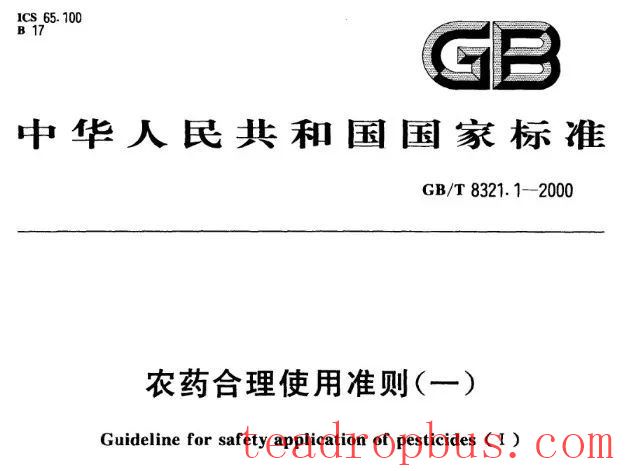
The national standards rigorously specify parameters such as the concentration, frequency of application, and pre-harvest intervals for different pesticide formulations. In 1987, the Ministry of Agriculture, Animal Husbandry, and Fishery approved and published “Criteria for Rational Use of Pesticides (Part 1)” (GB 8321.1—1987). In 2000, the General Administration of Quality Supervision, Inspection, and Quarantine revised and issued “Criteria for Rational Use of Pesticides (Part 1)” (GB/T 8321.1—2000), “Criteria for Rational Use of Pesticides (Part 2)” (GB/T 8321.2—2000), “Criteria for Rational Use of Pesticides (Part 3)” (GB/T 8321.3—2000), and “Criteria for Rational Use of Pesticides (Part 6)” (GB/T 8321.6—2000).
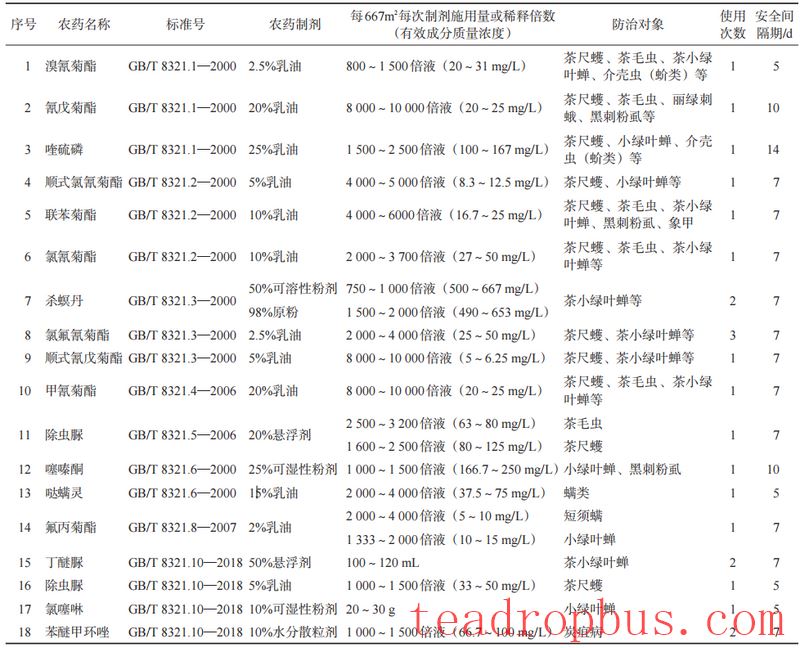
By 2025, GB/T 8321 had successively specified the use criteria for 24 pesticide formulations in tea. Some of the pesticide use criteria applicable to tea gardens are shown in Table 1. When monitoring for pest outbreaks or before the control indicators are reached, biopesticides like microbial pesticides and plant-derived pesticides should be used in combination.
The use of pesticides in tea gardens must strictly adhere to the parameters prescribed in the national standards for the rational use of pesticides. The effective dose and frequency of application should not be arbitrarily increased. Over time, increasing the dose or frequency can accelerate the development of resistance and reduce control efficacy. Harvesting must occur after the stipulated pre-harvest interval following pesticide application. Picking fresh leaves before the pre-harvest interval can often result in pesticide residues exceeding the maximum residue limits in tea.
II. Techniques for Rational Use of Pesticides
1. Select an Appropriate Time for Application
Pesticide application should be based on monitoring results and control indicators, taking into account the growth status of the tea plants. For example, for small green leafhoppers, apply when nymphs are at their peak hatching period; for tea tussock moths and Black Tea looper, apply before the third instar larvae stage; for scales and black scale insects, apply during the peak hatching period; for diseases, apply at the initial stage of infection. During periods of peak activity or sensitivity for natural enemies, avoid or minimize pesticide use to protect these beneficial organisms.
2. Choose an Appropriate Time for Application
Meteorological factors such as temperature and rainfall can affect the physical and chemical properties and efficacy of pesticides. For instance, parathion belongs to a class of pesticides with a positive temperature coefficient, where its effectiveness increases with rising temperatures. Therefore, these pesticides should be applied when temperatures are higher. Pyrethroid pesticides have better efficacy at lower temperatures and should be applied in the morning or evening, avoiding application before rain.
3. Rotate Pesticides to Slow Down Resistance Development
Continuous use of a single pesticide can lead to resistance in pests, particularly for pyrethroids and systemic fungicides. Therefore, pesticides that have developed severe resistance in the region should not be used again in the short term. Instead, choose pesticides with different mechanisms of action for rotation. Pesticides that were discontinued due to resistance may also be considered for rotation, but the rotation cycle should not be too short.
4. Strictly Prohibit the Use of Banned and Restricted Pesticides
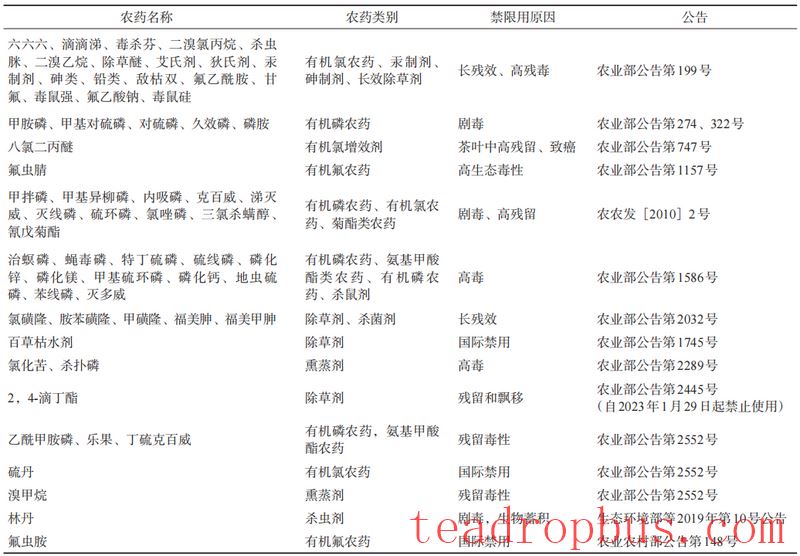
As of January 2025, over 60 types of pesticides and chemicals will be banned for use in tea production (Table 2). Additionally, four neonicotinoid pesticides—imidacloprid, acetamiprid, thiamethoxam, and dinotefuran—are recommended to be discontinued due to their high water solubility, toxicity to bees, and high residues in tea infusions.
Table 2 List of Banned and Restricted Pesticides and Chemicals in Tea Production in China
This excerpt is from “Rational Selection and Use of Pesticides in Tea Gardens,” by Zhou Li and Guo Mingming, published in *China Tea* (Issue 9, 2025), pp. 1-7. Images are sourced from the internet.
Contact us if there is any infringement, and we will remove them.