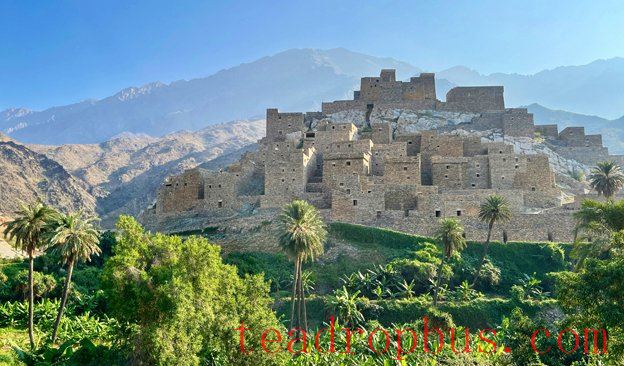
Saudi Arabia heavily invests in the development of the Kingdom’s coffee sector, converting Al Baha (pictured above) into the largest coffee farm in the Middle East.
The Kingdom of Saudi Arabia celebrates the region’s first coffee-producing city, a massive agricultural hub in Ma'shuqa, in Al-Baha province, where 500,000 coffee trees have been planted. Covering an area of 1.6 million square meters, the city’s high altitude, cooler climate, and abundant rainfall lead to fertile soil, making it the ideal location for growing world-class arabica coffee.
Initially, the Ministry of Environment, Water and Agriculture signed a 15-year investment contract with the Baljurashi Agricultural Cooperative Society to establish the Kingdom's first coffee city with a plan of growing 300,000 coffee trees in 2021. Then, the Agricultural Development Fund and the Baljurashi Agricultural Cooperative Society signed a financing agreement worth 72 million Saudi riyals ($19.4 million) for the Coffee City project in Aug 2023. Now, the site is the largest coffee farm in the Middle East.
The city plans to plant an additional 100,000 coffee trees, supported by a dedicated factory, roastery, modern irrigation systems, and transport infrastructure. It aims to become the premier destination for coffee production and export, both locally and regionally, and to create an integrated agricultural experience that combines heritage and modern technologies to promote a sustainable agricultural economy. The mission is to supply more than 10,000 tons annually to local and international markets.
Investments and plans are in the works to help Al-Baha’s neighboring provinces enter the coffee industry as well. Asir Province has 13 coffee-producing governorates as of 2024. The number of farms has also significantly increased, with an expectation of reaching 1,400 farms by 2025, and the number of coffee trees rising to approximately 350,000. Asir produces two main types of coffee: Adini and Shabraqi, both high-quality arabica varieties known for their unique flavor.
The Kingdom’s second smallest province, Jazan, also has its eye on coffee. Engineer Abdul-Ilah Idris, CEO of the Strategic Office for the Development of the Jazan Region, stated at the 2025 Saudi International Coffee Exhibition that the region has serious potential to become a global center for coffee production. Efforts are underway to boost local production and expand global exports.
The Jazan Coffee Cooperative exported its first shipment of Saudi coffee to Belgium and Eastern Europe in early 2025, a significant step that paves the way for Saudi coffee to spread globally. Plans are underway to expand exports to 10 to 15 countries in the coming years.
The Najran province has witnessed remarkable growth in coffee cultivation, with the number of planted trees rising from just 4,000 in 2022 to over 116,200 today, distributed across 111 farms. This transformation positions Najran as a prominent producer of high-quality specialty coffee in the country.
In May 2022, the Public Investment Fund and the Saudi Coffee Company announced an investment plan estimated at approximately 1.2 billion Saudi riyals ($320 million) to increase domestic coffee production from 2022 to 2032. Along with its potential to reduce the country’s dependence on oil, coffee’s deep historical and cultural roots in the Kingdom are fueling the development of coffee cultivation in these southwestern regions.