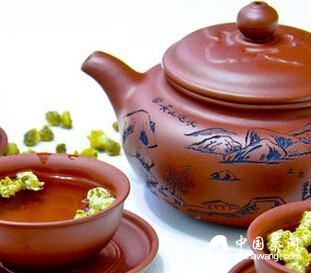
Methods for identifying authentic Zisha:
1. Look at the color: The color of authentic Zisha, whether purple, yellow, red, or a blend, should have a jade-like charm. Its luster is a subdued glow, like an oily surface that becomes more polished the more it is wiped. It cannot be waxed or polished. Refer to the texture effect of old jade. The rarer the material, the more valuable it is due to limited resources.
2. Listen to the sound: Zisha teapots are the finest of pottery, so their sound is that of pottery. After brewing tea, the sound should be sandy, dull, and deep, not crisp like metal or porcelain. A sandy, dull sound indicates good material breathability, lack of internal crystallization, ability to preserve tea fragrance, and resistance to flavor alteration.
3. Hand feel: A Zisha teapot should feel smooth, rounded, and comfortable to the touch. Although granular, it should be rounded. Zisha particles are generally suitable between 32 to 60 mesh. The hand feel of sand powder processed traditionally by stone grinding differs from that processed by machine.
4. Maintenance effect: Good Zisha clay, after a little tea brewing and maintenance, followed by dry wiping with a cloth, will show a matte luster and heavy oiliness. The longer it is maintained, the deeper, more ancient, and serene the color becomes, until it develops the teapot's spiritual essence, connecting with the user's temperament.
Zisha teapots first emphasize the Zisha material and the effect of its sandy texture. Zisha ore weathers from rock to granules, then is ground into granular powder using a stone mill, mixed with water to form workable clay, and used to make teapots. This primitive processing method well preserves the teapot's breathability, ensuring good daily functionality. The excellent granular texture gives the teapot a deep, heavy, sandy, and dull sound. The optimal particle size for the sand material is 32 to 60 mesh. The primitive processing method can give the teapot a round, smooth, and comfortable feel. Regardless of whether the surface of the Zisha teapot is purplish, reddish, pinkish, or bean-purple, after a short period of maintenance, it should have an oily feel, not dry or dull, appearing lifeless like an elderly person's skin.
Purple clay should appear purple with hints of blue or red; red clay should be red but not gaudy; local green clay should appear yellow with hints of green. In the past, the color of teapots was related to the atmosphere of the dragon kiln. Teapots fired in dragon kilns generally have a black cross-section.
Authentic Zisha material is the prerequisite for the design of Zisha teapots, fully utilizing the characteristics and color of the material to express the beauty of the Zisha material, the artistry of the form, and the functionality for daily use. With the improvement of modern living standards and the emphasis on health and longevity, non-toxic and harmless authentic Zisha tea sets are increasingly favored.
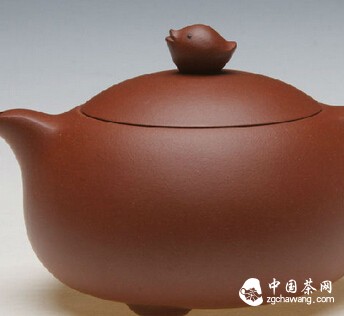
Whether traditional or modern, the form of a Zisha teapot emphasizes the beauty of its points, lines, and surfaces. It requires the overall design to be perfect and novel, demanding that the maker adopt a human-centered, ergonomic design. The teapot body should convey dignity, with reasonable and coordinated functional pairing of the spout, handle, and lid. For teapot enthusiasts, first distinguish whether the teapot is fully handmade or hand-finished. Observe whether the form of the teapot body is elegant and possesses individuality. Whether the structural pairing of the teapot body is harmonious is key. For plain teapots, check if the surface is smooth, if the transition between spout and handle is natural, and if the workmanship is fine, clean, and neat.
Next, observe whether the water flow is smooth and clean, whether the handle is comfortable to hold, and whether the lid fits tightly. This refers to modern teapots.
In traditional concepts for plain teapot forms, even a slight difference in the contour curve of the same shape can lead to vastly different results. Plain teapot forms may be full, delicate, rugged, or resolute, giving a feeling of "roundness, stability, balance, and correctness."
Teapots made using modern ceramic art techniques emphasize the artistic interest of the form, seeking stability within irregularity and regularity within variation, fully displaying the piece's vitality. They focus on the artistic effect of the work, pursuing a back-to-basics意境. They transform from the original principles of teapot art into a rule-free state, allowing full enjoyment of aesthetic sensation.
Floral teapots are inspired by natural forms in nature and various motifs from real life, refined and decorated. Among ancient floral teapots, the Gongchun Teapot and Fish Transforming into Dragon are particularly exquisite. Modern works, such as始祖, etc., emphasize spirit, refinement, and variation. The artist must have a rich artistic imagination and ensure comfortable handling. A good floral teapot must have excellent form, craftsmanship, artistic conception, daily functionality, and firing results.