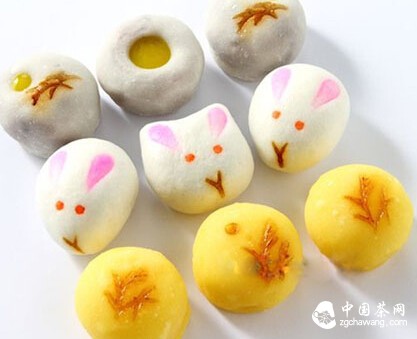
As the saying goes: "Tea can be used in cooking, even made into food." Tea and food have always been inseparable, like twin brothers or a pair of lovers. No wonder the ancients referred to drinking tea as "eating tea." On today's dining tables, there is a dish called "green tea cake," said to be made from tea extract mixed with starch and white sugar, shaped and fried into a sweet treat, very popular on northern tables.
Tea snacks, as the name suggests, are foods eaten while drinking tea. This is a different concept from food made with tea.
Do you still need to eat something when drinking tea? Yes, whether in ancient or modern times, it has always been this way. In my early childhood, in the countryside of northern Anhui, I saw an old man surnamed Lin drinking an unknown green tea while rubbing a handful of fried peanuts in his hand. To me, he seemed different in temperament from other men reeking of alcohol.
Tea snacks exist in both the south and the north, but with differences—southerners prefer lighter flavors. For example, when drinking Longjing tea in Hangzhou, people enjoy a plate of crystal shrimp dumplings with great relish. In Suzhou, when "eating tea," people like to have some fruit or small pastries while listening to Pingtan storytelling, savoring an ancient charm in pavilions and towers. On the northern bank of the Yangtze River in Anqing, tea is often accompanied by Huangmei opera, with snacks like melon seeds and bayberries, as well as some mung bean cakes—a true harmony of tea, opera, and flavor.
Wang Zengqi could be considered a southern man, originally from Gaoyou, Jiangsu, and later living in Kunming for many years. In his "Ordinary Tea Talk," he says: "In my hometown, there is a habit of 'morning tea,' or as it's called, 'going to the teahouse.' Going to the teahouse is really about eating snacks—buns, steamed dumplings, shaomai, layer cakes... of course, tea must be drunk. Before the snacks arrive, a bowl of dried tofu shreds is served first. We didn't have cooked dried tofu shreds back then, only scalded ones. The dried tofu shreds are piled like a tower in a wide bowl, and when eating, the waiter pours seasonings—soy sauce, vinegar, sesame oil—from a teacup over them. Drinking hot tea and eating dried tofu shreds—a perfect match!"
Dried tofu shreds should still be considered light. Such tea snacks are delicate, much like the southern landscape of small bridges and flowing water and the temperament of the locals. In contrast, northern tea snacks are richer and more indulgent, emphasizing a sense of experience.
For example, in my hometown Bozhou, there are hardly any proper teahouses. Tea is mostly drunk in bathhouses, where people meet completely naked—what snacks could go with that? Fresh water radishes, cut into thumb-sized pieces, eaten while drinking, very refreshing. There are also stuffed lotus roots, filled with glutinous rice, boiled with sugar and honey, sliced into segments—also excellent with tea. Drinking tea at such times is not very particular; it's about a carefree feeling, what is called "engaging the heart."
Zhou Zuoren, in his "Beijing Tea Snacks," describes this "engaging the heart" feeling: "Beyond the necessities of daily life, we must have a little useless play and enjoyment to make life interesting. Watching the sunset, gazing at the autumn river, looking at flowers, listening to the rain, smelling incense, drinking wine that doesn't quench thirst, eating snacks that don't satisfy hunger—these are all necessary in life, though they are useless adornments, and the more refined, the better. It's a pity that current Chinese life is extremely dry and crude. For one thing, after wandering in Beijing for ten years, I still haven't had good snacks."
The ultimate purpose of tea is not to quench thirst—at least it should be to relieve boredom and comfort the heart. Tea snacks and tea are of one mind, existing in a common magnetic field, mutually complementing each other. Tea is linear; supplemented with food, it becomes three-dimensional. Add the spiritual resonance of the tea drinker and a harmonious atmosphere, and the scene becomes entirely different.