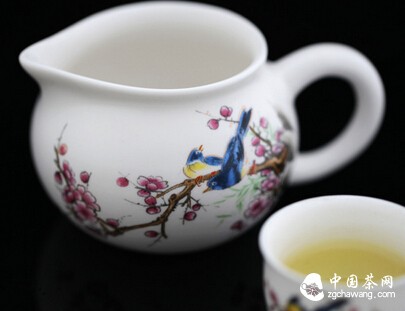
1. Different raw materials. Pottery tea sets can be made from ordinary clay and fired into shape, while porcelain tea sets require specific materials, using kaolin as the body. If fired at the temperature suitable for pottery, the result is pottery—for example, ancient white pottery was made this way. When kaolin is fired at the temperature required for porcelain, the body becomes porcelain. However, a body made from ordinary pottery clay, when fired to 1200°C, cannot become porcelain and will melt into a glassy substance.
2. Different firing temperatures. The firing temperature for pottery tea sets is generally lower than that for porcelain, sometimes as low as below 800°C, and at most around 1100°C. The firing temperature for porcelain tea sets is relatively high, usually above 1200°C, and some even reach around 1400°C.
3. Different glazes. Pottery tea sets can be either unglazed or glazed. The glaze used on pottery melts at a lower firing temperature. Porcelain tea sets have two types of glaze: one that can be fired together with the body at high temperature, and another that is applied as a low-temperature glaze on a high-temperature bisque body and then fired a second time at low temperature.
4. Different hardness. Pottery tea sets are fired at lower temperatures, so the body is not fully sintered. They produce a dull sound when tapped and have lower hardness—some can even be scratched with a steel knife. Porcelain tea sets are fired at higher temperatures, and the body is mostly sintered. They produce a clear, crisp sound when tapped, and it is difficult to scratch the surface with a regular steel knife.
5. Different transparency. Pottery tea sets, even when thin, are not translucent. For example, the black pottery of the Longshan culture is as thin as an eggshell but not transparent. Porcelain tea sets, whether thick or thin, have a translucent quality.