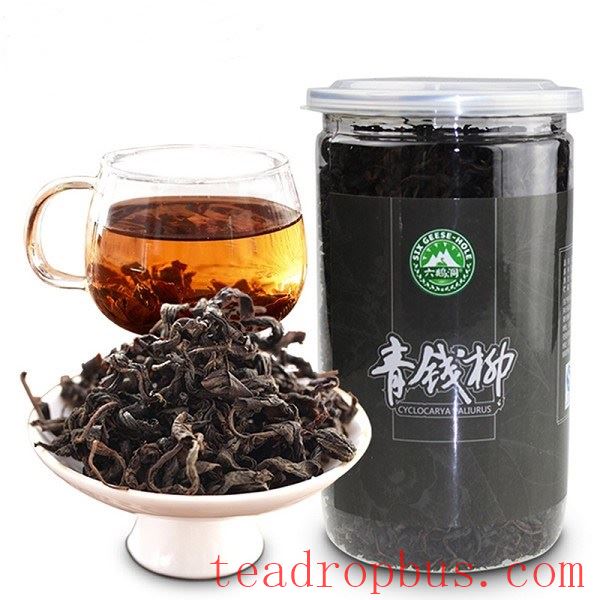
Basic Introduction to Suining Qingqianliu Tea
Suining Qingqianliu Tea, a specialty of Suining County, Hunan Province, is a Chinese national geographical indication product. Qingqianliu is a tree species under national second-class protection and is one of the rare tree species that survived from the Quaternary glaciation, existing only in China. In Suining, Qingqianliu is commonly known as the “Money Tree,” growing in humid mountainous areas at elevations ranging from 500 to 2,500 meters. Suining's Qingqianliu series of health teas, processed using unique techniques, have effects such as lowering “three highs” (high blood pressure, high cholesterol, high blood sugar) and are favored by consumers.
Suining is located at the convergence of the Xuefeng Mountains and the Eighty-Li DaNanshan Mountains. Its climate is warm and humid with abundant rainfall and significant diurnal temperature differences, creating a superior natural environment for the production of Suining Qingqianliu Tea. During the spring tea production period, the area is often shrouded in mist, with over 100 days of fog annually. This unique climate satisfies the preference of Qingqianliu trees for diffused light and moisture. The fog reflects long-wave light from sunlight while allowing short-wave light to pass through, promoting the formation of amino acids and aromatic substances within the leaves of Qingqianliu trees. This results in the distinctive characteristics of Suining Qingqianliu Tea, including plump leaves, tender yellow infusion color, bright leaf residue, rich fragrance, fresh and sweet taste, and abundant nutritional value.
In 2016, Suining had 50,000 mu of wild Qingqianliu trees and cultivation bases covering over 20,000 mu. Leading enterprises produced more than 5,000 kilograms of tea annually, encouraging local residents to join the industry of refined processing of Qingqianliu. More than ten households in Zhaishi Miao and Dong ethnic town produced over 500 kilograms of tea each year. Various towns in Suining have developed 21,000 mu of Qingqianliu cultivation bases, with 228 households engaged in Qingqianliu processing. The annual output value of Qingqianliu tea exceeds 100 million yuan, with products sold in countries like Japan, Britain, South Korea, and Russia. By 2025, Suining had established 14 Qingqianliu professional cooperatives and introduced leading enterprises, setting up modern tea production lines. These initiatives involved 17,000 farmers in planting activities, expanding the cultivation area to 20,000 mu, generating an annual output value of over 100 million yuan.
Geographical Protection Scope
The origin scope of Suining Qingqianliu Tea covers the current administrative regions of 25 towns and townships in Suining County, Hunan Province, including Huangsangping Miao Ethnic Township, Zhaishi Miao and Dong Ethnic Township, Le'anpu Miao and Dong Ethnic Township, Dongshan Dong Ethnic Township, Egonling Dong and Miao Ethnic Township, Chaoyi Dong Ethnic Township, Baiyu Township, Lixiqiao Town, Guanxia Miao Ethnic Township, Changpu Town, Changpuzi Miao Ethnic Township, Matang Miao Ethnic Township, Hekou Miao Ethnic Township, Fengmutuan Miao and Dong Ethnic Township, Lianmin Miao and Yao Ethnic Township, Wawutang Town, Jinwutang Town, Tangjiafang Town, Shuikou Township, Zhuzhoujiang Miao Ethnic Township, Maiping Township, Dangping Miao Ethnic Township, Wuyang Town, Huangtukuang Township, and Hongyan Town.
Nutritional Value
Suining Qingqianliu Tea is sweet and refreshing, quenching thirst and clearing heat and toxins. Testing by relevant authoritative institutions has shown that it contains not only essential macronutrients such as potassium, calcium, magnesium, and phosphorus but also trace minerals and nutrients crucial for health, such as manganese, iron, copper, zinc, selenium, germanium, vitamin E, vitamin C, vitamin B1, and vitamin B2.
Product Features
Suining Qingqianliu Tea is made from the tender leaves of the unique Chinese plant Qingqianliu, processed through a series of unique techniques, including selection, cleaning, spreading, fixation, kneading, cutting, drying, and more, to create a healthy beverage. The leaves of Qingqianliu can regulate blood sugar, enhance the body's ability to accept and utilize sugar, protect and repair pancreatic cells, adjust blood lipids, inhibit the activity of lipase, reduce the digestion and absorption of fats, eliminate free radicals, combat fatigue, and prevent senile dementia.
Suining Qingqianliu Tea is sweet and refreshing, quenching thirst and clearing heat and toxins. It contains not only essential macronutrients such as potassium, calcium, magnesium, and phosphorus but also trace minerals and nutrients crucial for health, such as manganese, iron, copper, zinc, selenium, germanium, vitamin E, vitamin C, vitamin B1, and vitamin B2. According to tests and inspections conducted by relevant authoritative institutions under the Ministry of Agriculture and the provincial quality and technical supervision bureau, the quality of Suining Qingqianliu Tea surpasses national standards and industry standards. It has been certified as organic food by the Ministry of Agriculture, pioneering the way for organic forest beverages in China and earning the title of “China's First Organic Forest Tea.”
Historical and Folk Customs
According to the “Suining Nationalities Annals,” the Miao people of Suining have been using the tender leaves of Qingqianliu to make tea for over five hundred years.
In the tenth year of the Wanli period (1582), Vice General Deng Zilong learned that the nuns at the Shenpo Mountain temple often drank tea made from Qingqianliu leaves and offered Qingqianliu tea as a sacrifice to the gods. Those who drank Qingqianliu tea were all healthy and long-lived, so he decided to investigate. One day, General Deng, undeterred by the steep mountain slopes, specifically climbed the 1,100-meter-high Shenpo Mountain to taste the Qingqianliu tea. Upon tasting it, he found the tea fragrant and refreshing, and exclaimed, “This is divine tea!” Seeing the tall and straight Qingqianliu trees on the mountain, their branches adorned with copper coins that tinkled in the breeze, he joyfully inscribed the words “First Mountain in the Southeast” on a large rock, which remains well-preserved to this day.
During the Ming Dynasty, Li Tianbao led a Miao uprising against the ruling authorities and established his capital in Shangbao (Shangbao Village, Zhaishi Town, Suining County). Surrounded by dense forests, there were plentiful Qingqianliu resources in the area; particularly noteworthy was the tall and straight Qingqianliu tree in front of the Golden Hall. Every spring and summer, the Miao people picked its leaves to make tea, selecting the best tea as a tribute to the ancient kingdom. The rebels, after drinking the Qingqianliu tea, became energetic, physically strong, and their morale soared, leading to repeated victories. King Wu Lie Li Tianbao was delighted and issued an imperial decree designating Qingqianliu tea as the national tea, encouraging all rebels and Miao people to drink it. He also ordered special protection for these trees, forbidding any damage or felling. As a result of the Miao people's frequent consumption of Qingqianliu tea, they suffered fewer illnesses and lived longer lives, attributing this to the benevolence of the mountain gods. It was due to the Miao people's reverence for Qingqianliu that this endangered and rare plant species survived.
In the 1930s, four divisions of the Chinese Central Red Army passed through Suining. One of these divisions started from Dan Kou in Chengbu, crossed Mount Wuji, and entered the Shangbao, Jie Xi, and Chiba areas of Suining. Here, the mountains were green, covered by virgin forests, and rich in Qingqianliu resources. Every household in the Miao village drank Qingqianliu tea. Wherever the Red Army went, the Miao people enthusiastically offered them Qingqianliu tea. An elderly man aged ninety-six from Shangbao brought a pot of Qingqianliu tea for the Red Army to drink. Noticing that the tea infusion looked different from other teas, the Red Army