To taste tea and comprehend its essence, follow the Tea Story subscription account teastory_007, or scan the QR code to follow.
Legend has it that long ago, the Queen Mother of the West held a grand Peach Banquet in heaven. Deities from all over were invited. Divine boys and fairies played music, served tea, and offered fruits, bustling back and forth. Just as the Earth Immortal was presenting tea, the Boy Benefactor suddenly cried out: "Your wife has fallen seriously ill, rolling and crying out in bed! Go quickly!" In his distraction, the tea tray tilted, and a teacup tumbled down to the mortal world.
The Earth Immortal was frightened out of his wits, his face turned pale. He rushed back to his palace in great haste.
At that moment, Lü Dongbin calculated what had happened. He took the Earth Immortal's tea tray, distributed the remaining seven cups of tea to the Seven Immortals, leaving none for himself. He took out a divine elixir and said to the Earth Immortal: "Quickly, take this to save your wife, then go to the mortal world to find the teacup. I will manage things here for you temporarily."
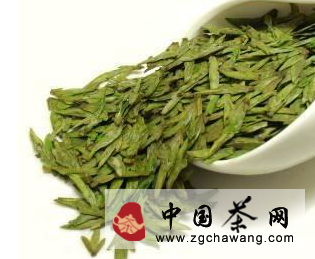
(Longjing tea has a flat, smooth appearance, sharp bud tips, buds longer than leaves, a tender green color, and no fuzz on the surface; the liquor is bright, tender green (or yellowish); the aroma is fresh or has a tender chestnut fragrance, though some carry a high-fired aroma; the taste is refreshing or mellow and rich.)
The Earth Immortal was extremely grateful. After thanking him, he left. "A day in heaven is years in the mortal world." The Earth Immortal somersaulted down to the mortal realm, landing in Hangzhou. He transformed into a monk and went to search for the teacup in the western hills. One day, he saw a mountain shaped like a crouching lion, with beautiful rocks and green ravines. Beside a bamboo grove on the mountain stood a thatched cottage, with an old lady, over 80 years old, sitting at the door. The Earth Immortal approached and saluted, asking: "Respected hostess, what is this place called?"
The old lady replied: "It's called Huiluowu. According to our ancestors, one night, thousands of golden lights suddenly fell rumbling from the sky. Since then, this place has been called Huiluowu (Glow Fall Valley)."
Hearing this, the Earth Immortal felt both startled and joyous. He quickly looked around, and suddenly his eyes lit up—wasn't that his teacup? It turned out that next to the old lady's house was an old stone mortar piled with garbage, overgrown with lush, emerald green grass. A shimmering, crystalline spider silk hung from the eaves right down into the mortar.
The Earth Immortal understood: this spider spirit was secretly sucking the immortal tea! He hurriedly said: "Respected hostess, may I exchange a golden belt for this stone mortar?"
The old lady said: "You want this stone mortar? It's no use to me anyway, take it!" The Earth Immortal thought, I need to find some vine grass to weave a rope ninety-nine feet long to bundle it up and carry it away.
As soon as the Earth Immortal left, the old lady thought, this mortar is so dirty, how can I handle it! So she found a ladle, scooped out all the garbage, and dumped it on the ground in front of her house where eighteen tea bushes grew. Then she found a rag to wipe it clean. Unexpectedly, this disturbed the spider spirit, who thought someone was coming to steal its tea! It cast a magic spell—with a loud "CRACK!"—and drove the stone mortar deep underground.
When the Earth Immortal returned with the rope, he saw the mortar was gone. He had no choice but to return to heaven empty-handed. Later, the heavenly "teacup" that had been driven underground became a well. It was said a dragon once came to suck the immortal tea; the dragon left, leaving behind a well of water. This is the legendary Dragon Well (Longjing).
Time passed, the seas changed into mulberry fields. The old lady's thatched cottage was rebuilt into the Old Longjing Temple, later renamed the present-day Hugong Temple in Longjing Village. The eighteen tea bushes in front of the temple, nourished by the celestial dew, grew more and more luxuriantly, their quality surpassing all others.
When Emperor Qianlong toured southern China, he visited Longjing Village in Hangzhou incognito. At the foot of Lion Peak Mountain, an old monk from Hugong Temple accompanied the Emperor on a tour of the mountain scenery. Suddenly, they saw several village girls happily picking fresh buds from the eighteen tea bushes in front of the temple. Feeling pleased, Qianlong quickly walked into the tea garden and also started picking tea leaves. After picking for a short while, a eunuch suddenly reported: "Your Majesty, the Empress Dowager is ill. Please return to the capital immediately."
Hearing that the Empress Dowager was ill, Qianlong became anxious. He immediately put the tea buds he had picked into his pouch and returned to the capital day and night without stopping. Back in the palace, he went to pay respects to the Empress Dowager. Actually, the Empress Dowager wasn't seriously ill; she just had a sudden rise of liver fire, causing swollen, red eyes and stomach discomfort. Suddenly seeing her son arrive improved her mood, and she noticed a fresh fragrance wafting towards her. She quickly asked: "My son, you've returned from Hangzhou. What precious thing have you brought that smells so fragrant?"
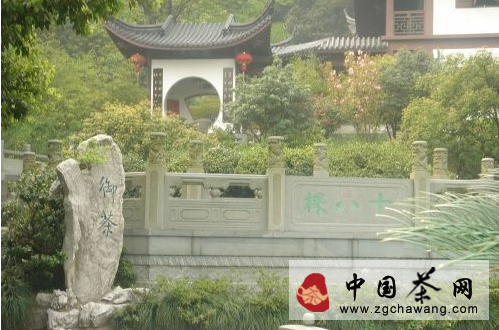
(The legendary eighteen imperial tea bushes personally picked by Emperor Qianlong)
Emperor Qianlong also found it strange. He had returned in a hurry and hadn't brought anything—where was this fragrance coming from? He sniffed carefully; there was indeed a rich, elegant fragrance coming from his pouch. He reached in and felt around—it turned out to be the handful of tea leaves he had picked in front of Hugong Temple in Longjing Village. After a few days, they had dried and emitted a strong aroma. The Empress Dowager wanted to taste this tea. A palace maid brewed it and served it. Indeed, the fragrance was captivating. After drinking, her mouth felt refreshed and sweet, her mind clear and spirit invigorated. After three cups, the swelling in her eyes dissipated, and her stomach felt comfortable. The Empress Dowager was delighted and declared Hangzhou's Longjing Tea to be a miraculous medicine.
Seeing the Empress Dowager so happy, Emperor Qianlong also laughed heartily. He immediately issued a decree, designating the eighteen tea bushes in front of Hugong Temple at the foot of Lion Peak Mountain in Hangzhou—from which he had personally picked leaves—as "Imperial Tea." They were to be specially picked and processed each year as tribute for the Empress Dowager. From then on, the fame of Longjing Tea grew ever greater. Although the eighteen imperial tea bushes have been replanted and replaced multiple times, this "Imperial Tea Garden" has been preserved to this day and has become a tourist attraction.