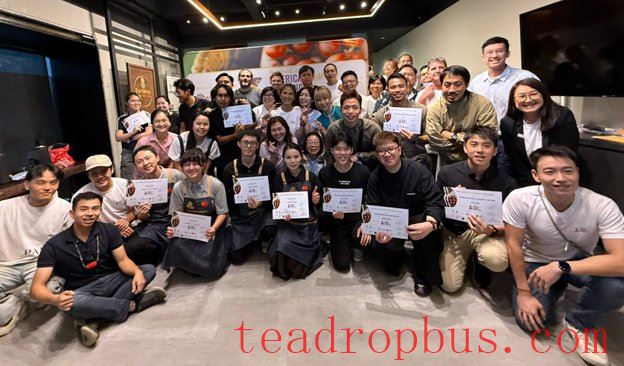
The world’s first Liberica Team Brewing Championships demonstrates that ASEAN coffee varietals deserve respect and recognition. Photo credit: ASEAN Coffee Federation
Spurred by rapid growth in both coffee production and consumption, the Association of Southeast Asian Nations (ASEAN) Coffee Federation is making it easier for the rest of the world to understand, appreciate, and more accurately value the diverse varietals and flavors of the region’s coffees. New education protocols and liberica-focused events celebrate distinct cultural heritage and emphasize the fact that ASEAN countries are among the world's fastest-growing coffee markets — paving the way for ASEAN coffee to take center stage.
ASEAN Coffee Appreciation Protocol: A Timely Necessity
In a recent presentation at the Asian International Coffee Conference in Ho Chi Minh City, Justin Metcalf, director and chief education officer at the ASEAN Coffee Institute (ACI), explained exactly why ASEAN countries need new methods and language for evaluating their coffee.
“Most traditional cupping frameworks were built around high-grown arabica from the West,” said Metcalf. “While they are excellent for that purpose, they don’t fully capture the diversity of flavors, species, and processing methods that define coffee in ASEAN.”
ASEAN coffees often contain tropical fruit flavors such as durian, jackfruit, and longan. Highly prized in Asian markets, these elements aren’t even listed on most Western cupping forms. Different production methods that suit diverse varietals, such as liberica and excelsa, aren’t included either.
“The ASEAN Coffee Appreciation Protocol (ACAP) was created to address these gaps,” Metcalf told STiR Coffee and Tea Media. “It provides a structured, science-aligned appreciation system that finally reflects the true identity of ASEAN coffees. It gives our farmers, processors, roasters, and baristas a shared sensory language and, importantly, enables the international market to understand and value our coffees more accurately.”
Over the last decade, the ASEAN Coffee Federation (ACF) has developed tools such as the ACF Cupping Form, ASEAN Coffee Flavour Sphere, the Scentible Aroma Kit, and the new ACAP, which utilizes the Cpin app, a digital platform for coffee evaluation conducted entirely online and in multiple languages. In 2021, the ASEAN Coffee Institute (ACI) opened in Singapore to facilitate training.
Celebrating Liberica and Excelsa
Southeast Asia is one of the few regions in the world that produces large quantities of liberica and excelsa. Liberica has been an essential varietal in Malaysia since its introduction in the 1870s. Due to its ability to resist pests and diseases and produce fruit in hot, humid climates at low to mid-level elevations, liberica now makes up 87% of the country’s total production.
This November, the Borneo Coffee Symposium, held in Kuching, Sarawak, hosted the world’s first Liberica Team Brewing Championships. “For the first time, liberica and excelsa weren’t treated as curiosities or secondary species,” Metcalf explained. “They were given a dedicated platform that recognized their cultural, agricultural, and sensory importance.”
Recent research on the genetic diversity of liberica and excelsa, and their ability to adapt to climate change, highlights the significant potential of these species.
“Liberica and excelsa are not fringe species,” added Metcalf. “They are expressive, resilient, and culturally meaningful coffees that have long been overlooked simply because the frameworks to understand them didn’t exist. Now that those frameworks are emerging, it’s time for the global industry to recognize their place in the broader specialty landscape."
ASEAN: A Rapidly Rising Global Coffee Powerhouse
According to Deep Market Insights, the ASEAN specialty coffee market was worth $1.63 billion in 2024 and is projected to reach $4.14 billion by 2033, with a compound annual growth rate (CAGR) of 10.91%.
“Asia is rapidly rising as a global coffee powerhouse,” AIC technical director Dave Lim told Comunicaffe in September. “With consumption projected to surpass Europe by 2030 and accounting for around 30% of global production — 27% from Southeast Asia alone — the region is central to both demand and supply.”
The spike in production is being driven by a massive increase in local demand. ASEAN countries are experiencing economic growth and a rising middle class. The younger generations are curious about local coffees, different production methods, and are willing to pay more for single-origin coffees.
More European companies are expanding operations in Southeast Asia. PROBAT just opened a new service center in Singapore to meet the growing needs of the region. “The specialty coffee market in Southeast Asia is experiencing dynamic growth, driven by a young, urban population and an evolving coffee culture," Stephane Sene, managing director of PROBAT Service Southeast Asia wrote in an email to STiR.
"Consumers are increasingly well-traveled and educated and are demanding more refined coffee experiences," Sene continued. "This trend requires bespoke machines and service solutions to cater for a range of needs. At the same time, customers expect localized support and fast response times...PROBAT's presence in the region means we can deliver advanced solutions and world-class service where it matters most for all our customers in the food processing industry — beyond coffee.”
“What excites me most about the ASEAN coffee landscape right now is that we are experiencing something quite rare in the global industry: a region that is simultaneously emerging as both a major producer and a rapidly maturing consumer market,” exclaimed Metcalf. “That combination creates a momentum you don’t see very often, and it positions ASEAN to shape the future of specialty coffee in a truly unique way.”