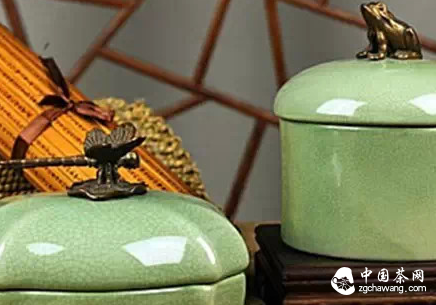
When storing tea at home, note that tea generally prefers warmth and dryness over cold and dampness, and values cleanliness over strong odors. Therefore, the choice of containers and methods requires certain considerations. Regardless of the storage method, packaging materials must be odor-free and highly moisture-proof. Containers should be as airtight as possible to minimize air exposure, and storage locations should be dry, clean, and odor-free. Below are some summarized methods for household tea storage.
(1) General Storage Method:
For small household quantities, it’s common to use colored iron tea caddies, tin canisters, colored glass jars, or ceramic containers. Double-lidded iron caddies or long-necked tin bottles are preferable. For ceramic containers, choose ones with small openings and large bodies. When filling these containers, ensure they are tightly sealed and pack the tea firmly to reduce air inside. This method is simple and convenient but suitable only for short-term storage (usually a few months), as it doesn’t provide complete airtightness.
(2) Using Desiccants for Storage:
Using desiccants can extend tea storage to about a year. The choice of desiccant depends on tea type and availability. For green tea, use un-slaked lime blocks; for black tea and scented tea, dry charcoal works well; if possible, silica gel is also an option.
When using lime, first wrap loose tea in thin kraft paper (in portions of a few ounces to half a pound), secure it, and layer it around a dry, odor-free jar or small-mouthed iron bucket. Place one or several bags of un-slaked lime in the center, add a few small tea packets on top, then seal the opening with kraft paper and cotton padding before closing the lid. Store in a dry place. Replace the lime every 1–2 months to prevent moisture absorption.
The charcoal method is similar to lime storage and won’t be detailed here.
Silica gel desiccant offers better moisture protection. The method resembles lime and charcoal storage. It’s more effective, often preserving tea freshness for over six months. Silica gel is blue when dry; when it turns translucent pink, it’s saturated and must be baked or sun-dried until blue again for reuse.
(3) Refrigerator Storage Method:
Low-temperature storage in a refrigerator below 5°C preserves tea quality well, often keeping flavor unchanged for over a year. For small packaged tea in tins, cans, or boxes with good seals, simply place them in clean plastic bags, seal tightly, and refrigerate. For loose tea, fill clean, odorless brown glass jars or tin containers, seal tightly with tape and wax, then place in a sealed plastic bag before refrigerating.
(4) Thermos Flask Storage Method:
Well-insulated thermos flasks or vacuum bottles can store tea effectively, preserving color, aroma, and taste for about a year. Fill a new thermos with loose tea, pack it tightly to minimize air, cork it securely, and seal the cork with white wax.
(5) Plastic Bag Storage Method:
Use two new, odorless, non-porous plastic food bags. Wrap dry tea in moisture-proof paper, place it in one bag, squeeze out air, and seal. Then, turn the sealed end downward and place it into the second bag, again removing air before sealing. This alone offers some freshness preservation. For better results, place the bags inside a dry, odorless, airtight metal canister.