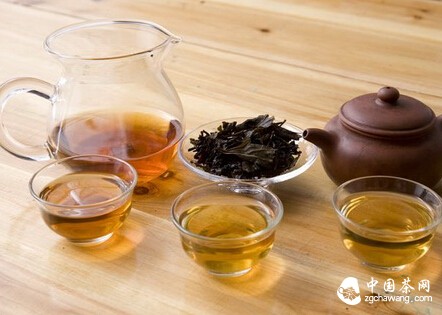
Classification of Anhua Dark Tea:
Fu Brick
Fu Brick Tea pressing involves raw material processing, steam piling, pressing and shaping, flowering and drying, and final packaging. Its pressing procedure is largely similar to that of Hei Brick and Hua Brick teas, with a key difference being the thickness of the brick. This is because the unique "flowering" process of Fu Brick requires, among other conditions, a moderate brick compactness to facilitate microbial activity. Another difference is that after being removed from the mold, Fu Brick is not sent directly to the drying room. Instead, to promote "flowering," it is first wrapped in its trademark paper before drying. The drying speed is not rushed; the entire drying period is over twice as long as that for Hei and Hua Bricks, aiming for a slow development of "golden flowers" (i.e., the growth of Eurotium cristatum).
Sanjian (Three Tips)
Tianjian: Pressed from first-grade dark coarse tea. It has a dark, glossy appearance, clear aroma, rich and mellow taste, orange-yellow liquor, and yellowish-brown leaves.
Gongjian: Pressed from second-grade dark coarse tea. It has a blackish-brown appearance, pure aroma, mellow and smooth taste, slightly orange-yellow liquor, and dark yellowish-brown leaves.
Shengjian: Pressed from third-grade dark coarse tea. It has a blackish-brown appearance, mild aroma with a slight roasted note, a strong and slightly astringent taste, dark brown liquor, and coarse, dark brown leaves.
Hua Brick
Historically called "Huajuan," it was also known as "Thousand Liang Tea" because one roll weighed 1000 liang on the old scale. In the past, Huajuan was made from high-quality dark coarse tea from Gaojiaxi and Majiaxi in Anhua. It was manually tamped and packed into long cylindrical bamboo baskets, forming a cylinder 147 cm high and 20 cm in diameter, known for its fine craftsmanship and excellent quality. In 1958, "Huajuan" was reformed into rectangular brick tea. The规格 is 35×18×3.5 cm. The正面 has patterned edges. The brick surface is blackish-brown, with a pure aroma, rich and slightly astringent taste, reddish-yellow liquor, and evenly mixed old and tender leaves. Each brick净重 2 kg. Currently, there are specifications like 1kg and 2kg. Although the shape differs from Huajuan, the intrinsic quality is similar, making it a new variety in the dark tea category that replaced the historical Huajuan, well-received in销售 regions. The name "Hua Brick" comes from two aspects: first, the change from a roll to a brick shape; second, the patterned edges on all four sides of the brick face to distinguish it from other brick teas. The manufacturing process of Hua Brick Tea is basically the same as that of Hei Brick Tea. The raw materials for pressing Hua Brick mostly consist of third-grade dark coarse tea and a small amount of downgraded second-grade dark coarse tea. The total stem content does not exceed 15%. After arrival at the factory, the coarse tea undergoes screening, crushing, blending, and other processes to become合格的 semi-finished products. Then, steaming, pressing, baking, packaging, etc., follow, with the same工艺 as Hei Brick Tea.
Hei Brick
Hei Brick Tea, named for its use of dark coarse tea as raw material, its black, moist color, and its brick-like成品 shape. Its raw materials are selected from high-quality dark coarse tea produced in Anhua, Taojiang, Yiyang, Hanshou, Ningxiang, and other counties. During production, the raw materials are first screened and shaped, winnowed and sorted for purity, and then blended in proportion. During machine pressing, high-temperature steam sterilization is applied first, followed by high-pressure shaping, inspection and trimming, slow drying, and packaging into the final brick tea product.
Each brick weighs 2 kg, in a rectangular brick shape, 35 cm long, 18.5 cm wide, and 3.5 cm thick. The brick surface is smooth and flat with distinct edges and corners; the tea has a pure aroma, reddish-yellow to slightly brown liquor, and a relatively rich and mellow taste. This product is a semi-fermented tea, with the grassy smell of fresh leaves removed. Combined with the tight brick body, it is not prone to dampness and mold, maintaining its flavor even after years of storage, improving with age. It is suitable for boiling and drinking and can also be mixed with dairy products and sugar. Annual production is about 5000 tons, mainly sold in Gansu, Ningxia, Qinghai, Xinjiang, and other provinces/regions, with Lanzhou as the distribution center.
Qing Brick Tea
Qing Brick Tea belongs to the dark tea category, primarily made from old green tea from southern Hubei, processed through multiple steps and pressed into long rectangular bricks. Sensory characteristics: bluish-brown color, pure aroma, strong taste without grassy smell, reddish-yellow and relatively bright liquor, and dark, coarse old leaves. The materials for Qing Brick Tea are divided into three parts: the surface layer, the secondary layer, and the inner tea. The surface and secondary layers form the outer part, brown in color, with a strong,可口 tea taste, unique aroma, and lasting sweet aftertaste. Between the surface and secondary layers is the inner tea, bluish-brown in color, with a pure aroma, reddish-yellow liquor, and a fragrant, strong taste. Drinking Qing Brick Tea, besides quenching thirst and promoting salivation, also has effects such as refreshing the mind, aiding digestion, sterilizing and stopping diarrhea, and lowering the three highs (high blood sugar, high blood lipids, high blood pressure). It is a daily consumer good for people in Inner Mongolia and other northwestern regions and is part of national emergency reserves. Among them, the "Chuan" brand Qing Brick Tea produced by Hubei Province Zhaoliqiao Tea Factory Co., Ltd. is the only China Time-honored Brand recognized by the Ministry of Commerce in the dark tea industry, enjoying a long-standing reputation and remains the daily first choice for people in border regions. Some ethnic minority consumers who do not understand Chinese only need to gently touch the brick surface. As long as they feel three concave marks, they are completely assured. The "three lines" (i.e., the character "Chuan") have become a symbol of trust in the minds of border people.
Thousand Liang Tea
During the Tongzhi reign of the Qing Dynasty (1862-1874), Hunan tea merchants, based on the "Hundred Liang Tea," created the Thousand Liang Tea, also known as "Huajuan" tea. Each finished product净重 1000 liang on the old scale, hence commonly called "Thousand Liang Tea." Thousand Liang Tea uses locally produced high-quality dark coarse tea from Anhua as raw material. After being steamed soft, the dark coarse tea is packed into long cylindrical bamboo baskets lined with polygonum leaves and palm fibers. Using rods, hammers, and other tamping tools, techniques like twisting, pressing, stepping, rolling, and hammering are applied repeatedly to achieve dense and firm compaction, finally forming a tree-like cylinder about 160 cm high and 0.2 m in diameter. It is then naturally dried under "daytime sun and nighttime dew" for forty-nine days.
Thousand Liang Tea has原始 unique packaging, a large and straight外形, offering a strong visual impact. Its appearance is black, glossy, and oily; the liquor is orange-yellow and bright; the taste is醇厚, with hints of polygonum leaf, bamboo yellow, and glutinous rice aroma. The longer it is stored, the better the taste.
The production process of Thousand Liang Tea and Hundred Liang Tea is完全相同, but the smaller the tea, the greater the difficulty of the craftsmanship, demanding higher skills from the technicians. Thousand and Hundred Liang teas are classic teas among Anhua Dark Teas, with aged tea being the best. Existing 50-year-old Thousand Liang Tea has a market value of around 2 million RMB. In places like South Korea and Japan, Thousand Liang Tea is used as a treasure for shops, and collecting Thousand and Hundred Liang teas is even more popular. It is said that Thousand and Hundred Liang teas have excellent health benefits. The special fermentation process of "daytime sun and nighttime dew" creates the unique quality characteristics and distinctive pharmacological effects of "Thousand Liang Tea" on the human body. Long-stored "Thousand Liang Tea" has a "medicinal" effect in regulating the肠胃. Clinical experiments prove that "Thousand Liang Tea" has明显的辅助疗效 in improving human blood circulation and lowering blood lipids and blood pressure. "Thousand Liang Tea" uses raw material from dark tea, commonly called "post-fermented tea" in tea academia. Therefore, as long as it is stored in a dry, odor-free place, the longer the time, the more prominent its pharmacological and health benefits, and the more醇厚 and natural the taste becomes. "Thousand Liang Tea" has become a收藏 for far-sighted individuals and a living room decoration.