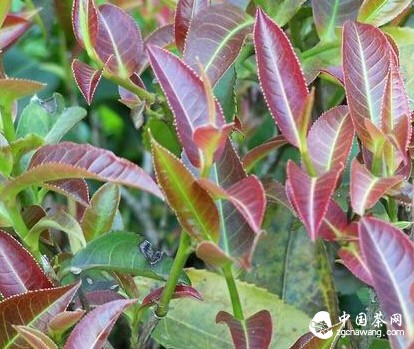
The purple color of the buds and leaves in Purple Bud Tea is due to their high anthocyanin content. While green bud tea contains about 0.01% anthocyanins, Purple Bud Tea can contain 0.5% to 1%, which is 50 to 100 times higher than ordinary tea leaves. Anthocyanins are a type of polyphenolic compound and an important plant pigment. They possess strong antioxidant and health-promoting effects, can inhibit lipid peroxidation and scavenge free radicals, thereby reducing oxidative damage caused by free radicals in the human body.
Professional data is as follows:
The Zijuan tea tree belongs to the small tree/shrub type, with large leaves and medium buds. The tree has a semi-open posture, with a high branching point and medium branching density. The leaves grow obliquely upward, with a length of 11.0-13.0 cm and a width of 3.4-3.6 cm. They are willow-shaped with pointed tips, a purple color, and purplish-red petioles. The leaves are relatively hard, with an average of 9-11 pairs of veins. The leaf surface is smooth, the margin is even, and the serrations are shallow, blunt, and sparse. The corolla diameter is 4.10 cm × 3.44 cm, with 5-6 petals that are white with a green tint and soft in texture. There are 5 sepals with a diameter of 0.45 cm, and the pedicel is 0.89 cm long. The sepals and pedicel are light purple. The petals, sepals, and pedicel have no hairs. The style is 1.25 cm long, divided into 3 parts, typically split to one-third. The ovary has many hairs, the pistil and stamens are of equal height, there are about 240 stamens, and they are fused at the base.
The peak flowering period is in early October, with a low fruit set rate. The tea fruit is spherical or oblong, with a slightly purple skin and an average thickness of 0.71 mm. The fruit has 2-3 chambers, with a diameter of 1.96 cm × 1.77 cm. The seeds are oval or hemispherical. For the Zijuan tea tree, spring bud emergence begins in late February, and the peak period for one bud with three leaves is from late March to early April. It has strong bud-forming ability, medium sprouting density, purple buds and leaves that are relatively plump and have many hairs, and strong tenderness retention. The weight of 100 buds with three leaves is 115g. It has strong cutting propagation ability and high survival rate. It is resistant to cold, drought, and pests and diseases, suitable for planting in large-leaf species areas, with cultivation methods similar to those for Yunnan large-leaf species. This tea tree variety has medium yield. According to experiments by the Yunnan Tea Research Institute, the average yield of dry tea from 6-10 year-old trees in their experimental field was 103.3 kg per mu.
According to biochemical analysis by the Yunnan Tea Research Institute, steamed green tea samples made from spring tea (one bud with two leaves) of the Zijuan tea tree variety contained 35.52% tea polyphenols, 3.49% amino acids, and 44.58% water extract. Summer black broken tea contained 0.91% theaflavins, 6.99% thearubigins, and 5.86% theabrownins. Sensory evaluation scores were 34.7 for strength and 37.6 for freshness. It is described as having a pronounced aroma, but a relatively light taste with noticeable bitterness, fully reflecting the characteristics of Zijuan as a cutting-propagated garden tea. In 1991, Senior Engineer Lin Yongyue and others from the Yunnan Institute of Materia Medica conducted multiple experiments on domestic cats, showing that Zijuan green tea has a certain auxiliary effect in lowering blood pressure, which greatly boosted the reputation of Zijuan tea. Many tea gardens began cutting and cultivating Zijuan tea trees.
Purple Bud Tea – Tea Efficacy
Anthocyanins belong to flavonoid derivatives and are a safe, non-toxic natural food pigment. The nutritional and pharmacological effects of anthocyanins have gradually attracted attention. Fang Zhongxiang and others reported on the physiological functions of anthocyanins such as antioxidant, anti-mutation, and alleviation of liver dysfunction, finding that anthocyanins play an important role in preventing cancer, cardiovascular, and neurological diseases. Anthocyanins are also effective for eye disorders, circulatory system disorders, and inflammation, and can reduce the risk of coronary heart disease. As people pursue health, the research and development of foods and beverages rich in anthocyanins have received increasing attention.
Blood Pressure Lowering Efficacy
In 1991, Senior Engineer Lin Yongyue and others from the Yunnan Institute of Materia Medica conducted multiple blood pressure-lowering experiments on domestic cats weighing 2.5-3.5 kg. The results showed that Zijuan green tea lowered blood pressure by 35.53%, outperforming Yunnan large-leaf green tea (29.04%). Currently, based on developing Zijuan blood pressure-lowering health tea, the Yunnan Tea Research Institute is increasing the propagation of the Zijuan tea tree variety and expects to develop and utilize it for weight loss and blood sugar reduction.
The biggest difference between Zijuan and Purple Bud (Ziya) lies in leaf shape and veins. Zijuan is a small to medium-leaf species with thin leaves and inconspicuous veins, while Purple Bud (Ziya) is a large-leaf species with deep green leaves and prominent veins, similar to cultivated wild tea. Additionally, Zijuan raw tea soup is purple in color, thin in texture, with noticeable bitterness; Purple Bud (Ziya) raw tea soup is golden in color, rich and thick in texture, full-bodied in taste, with a lasting aftertaste. Its tea quality falls between cultivated wild tea and wild-grown tea.