Does Anhua Dark Tea All Contain Golden Flowers?
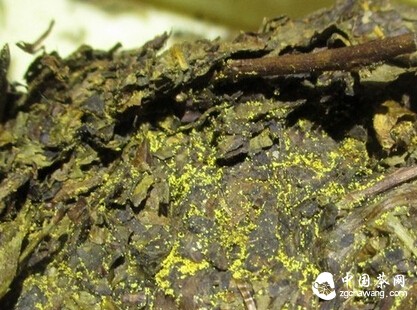
The Mysterious Golden Flowers of Anhua Dark Tea Fuzhuan Tea
In Anhua dark tea, generally only Fuzhuan tea has golden flowers, and some Qianliang tea, which uses the technology of Fuzhuan tea to produce golden flowers, also has some golden flowers. However, Huazhuan tea, Heizhuan tea, and Tianjian tea do not have golden flowers.
After talking for so long, what exactly are golden flowers? Regarding the golden flowers in Fuzhuan tea, in the past few decades, they were only found on thousand-year-old灵芝 (lingzhi or reishi mushrooms) on Earth. The microorganisms in golden flowers have only been discovered for less than 30 years. Through the separation and identification of Fuzhuan tea, about 500 kinds of compounds have been identified, of which more than 450 are organic compounds. Among them, Eurotium cristatum (golden flower) is particularly special, only found on Fuzhuan tea. Liu Zhonghua and others from Hunan Agricultural University used the latest extraction and separation technology to isolate various effective components of Fuzhuan tea, and with the help of internationally advanced high-throughput screening technology, they fully proved at the molecular level that Fuzhuan tea contains specific components with significant lipid-lowering, weight-loss, and blood sugar-reducing effects. They also discovered two new active substances unique to Fuzhuan tea – Fuzhuan tea elements A and B. Experiments have shown that various extract components of Fuzhuan tea can activate PPARY and PPARS, indicating that Fuzhuan tea has multiple pathways for lowering lipids and has good lipid-lowering and weight-loss functions.
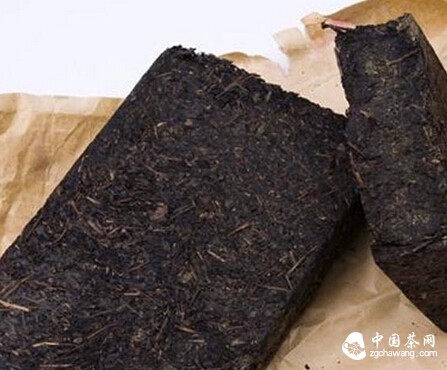
Characteristics of Fuzhuan tea: Fuzhuan tea is divided into special Fuzhuan (abbreviated as special Fuzhuan) and ordinary Fuzhuan (abbreviated as ordinary Fuzhuan), both of which are not graded. Appearance: The brick surface is flat, the edges and corners are distinct, the thickness is uniform, and the blooming of golden flowers is generally abundant; special Fuzhuan has a dark brown brick surface, while ordinary Fuzhuan has a yellowish-brown brick surface. Internal quality: The aroma is pure, and the infusion color is orange-yellow. Special Fuzhuan has a mellow and harmonious taste; ordinary Fuzhuan has a pure and harmonious taste without astringency. When brewing Fuzhuan tea, it is required that the infusion is red but not turbid, the aroma is clear but not coarse, the taste is rich but not astringent, with strong mouthfeel and good resistance to brewing. It is especially required that Eurotium cristatum (commonly known as "golden flowers") is generally abundant inside the brick, and when dry, it smells of a floral fragrance. Ethnic minorities in Xinjiang especially love Fuzhuan tea. They regard the amount of "golden flowers" as the only indicator for checking the quality of Fuzhuan tea. Tibetan compatriots in Qinghai and Tibet, as well as brotherly ethnic groups in Gansu, Ningxia, and other provinces, also need it, with Lanzhou as the distribution center, supplied from the main production area of Yiyang. When brewed, the infusion is red but not turbid and has good resistance to brewing. When boiled, it is required that the infusion is red but not turbid, the aroma is clear but not coarse, and the taste is rich but not astringent.
Fuzhuan tea has significant lipid-lowering, weight-loss, and blood sugar-reducing effects; long-term consumption of Fuzhuan tea has a good controlling effect on human blood lipids, blood sugar, and blood pressure, has a good regulating effect on body weight and body shape, and can significantly enhance human physique and delay aging.
Does Anhua Dark Tea All Contain Golden Flowers?
Generally, only Fuzhuan tea in Anhua dark tea has golden flowers, while Qianliang tea (which may develop golden flowers during storage), Heizhuan tea, and Tianjian tea do not have golden flowers. Other series of dark tea generally do not have golden flowers, and in very rare cases, a small amount of golden flowers may appear. Because the conditions for producing golden flowers are quite strict, apart from Anhua dark tea, they were only found on thousand-year-old lingzhi in the past. The amount of golden flowers is also an important basis for judging the quality of Anhua dark tea Fuzhuan tea. Speaking of this, many people will ask, what is the relationship between the amount of golden flowers in Anhua dark tea Fuzhuan tea and the quality of Fuzhuan tea?
Expert research shows that the golden flower fungus in Anhua dark tea produces organic acids during its growth, causing a decrease in theanine and sugar content, inducing the oxidative polymerization of catechins, thereby significantly reducing their content, and producing a large amount of theabrownins. As fermentation deepens, the fermentation liquid emits an increasingly rich and unique fungal floral aroma. These all prove that the golden flower fungus is the main reason for the unique quality formation of Fuzhuan tea.
The raw materials for processing Fuzhuan tea in Anhua dark tea are generally grades 3-4 of dark raw tea. The raw materials of dark tea are generally coarse and old, mostly with one bud and five or six leaves or more. However, the processed Fuzhuan tea has a mellow and harmonious taste and a pure aroma, almost without a coarse and old taste. This is inseparable from the action of the golden flower fungus on the tea components. Studies on the relationship between the golden flower fungus and the quality of Fuzhuan tea indicate that various enzymes produced by the golden flower fungus during its growth in the tea decompose substances such as cellulose, pectin, starch, protein, fat, and polyphenols in the raw materials, thereby improving the original quality.
Similarities and Differences Between Fuzhuan Tea, Tianjian Tea, and Heizhuan Tea in Anhua Dark Tea
Anhua dark tea includes multiple series such as Fuzhuan tea, Heizhuan tea, Tianjian tea, and Qianliang tea. But what are the differences between them?
The processing cycle of Fuzhuan tea is long, and the production process is complex, requiring more than thirty processes from raw tea to the finished product. Among them, blooming is a unique and very奇妙 (wonderful) process specific to Fuzhuan tea. That is, the pressed Fuzhuan tea bricks are stacked in order and neatly in a well-ventilated架空 (elevated) room. Without adding any additives, through effective control of temperature and humidity at different time stages of the Fuzhuan tea, under the action of natural fermentation and a series of microorganisms, a very beneficial golden granular "golden flower" is produced inside the Fuzhuan tea. "Golden flower" is not only a unique标志 (hallmark) that distinguishes Fuzhuan tea from other types of tea but also the main factor measuring the quality of Fuzhuan tea.
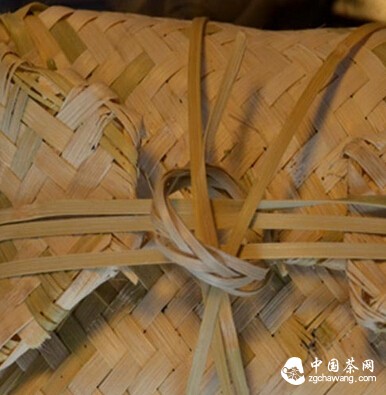
Tianjian uses high-grade dark raw tea as raw material, first-class processing technology, original ecological packaging, and unique health benefits, forming the value beauty of Tianjian tea; it was a royal tribute in the past and a treasure for people today. Tianjian and Gongjian were listed as tributes for royal consumption. The "Sanjian" (Three Tips) tea is produced using dark raw tea directly processed by pile fermentation. The taste of the tea after initial pile fermentation is more mellow, and the quality is more stable, gradually evolving into the main product form.
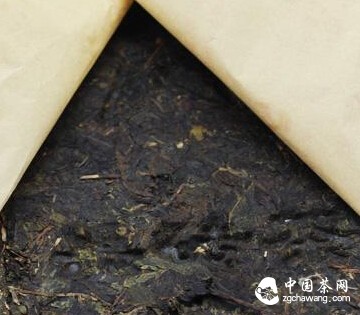
Heizhuan tea belongs to the category of dark tea. Its raw material is made from dark raw tea, the color is relatively black and moist, and it is formed into blocks, hence the name Heizhuan (black brick). The raw materials of Heizhuan tea are selected from high-quality dark raw tea from places like Anhua. According to the original proportion of surface tea and inner tea, it is pressed into blocks in one go. First, the raw materials undergo screening, shaping, sorting, and removal of impurities, and are blended according to a certain proportion. Then, it undergoes high-temperature steam sterilization, machine pressing for shaping, and slow drying. Finally, it is packaged into the shape of a brick block, completing the production of Heizhuan tea. Generally, Heizhuan tea is in the shape of a rectangular brick block, weighing about 4 jin (2 kg) per piece. The brick surface is relatively flat and smooth. Its tea aroma is pure, and the infusion color is yellowish-red slightly brown. Heizhuan tea can be stored for a long time; the longer it is aged, the higher its value, and the better the tea aroma.
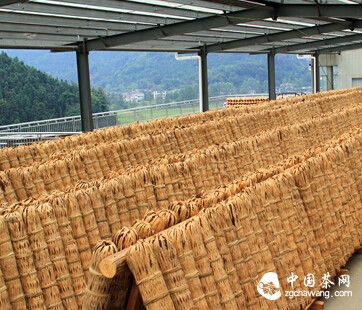
Qianliang tea is a traditional craft product that was discontinued in the 1950s. Mainly due to procurement in overseas markets, this treasure originating from the mountainous area of Anhua reappeared at the beginning of the 21st century and became popular in Guangdong and Southeast Asian markets. Its reputation is already no less than that of the currently popular Pu'er tea. It is hailed by authoritative Taiwanese tea books as "the classic of tea culture, the essence of tea history, and the ultimate product among teas." After the production of Huajuan tea stopped and disappeared from the market for many years, there was a fear that the processing technology of Huajuan tea would be lost. "Qianliang tea" is a traditional famous tea of Anhua, named because the net weight of tea leaves per roll (strand) equals one thousand liang (an old unit of weight). Because its outer bamboo basket packaging is in a lattice pattern, it is also known as Huajuan tea. Absorbing the essence of heaven and earth, gathering the essence of the sun and moon, sun-drying and night-dewing are key processes for the quality formation of "Qianliang tea."