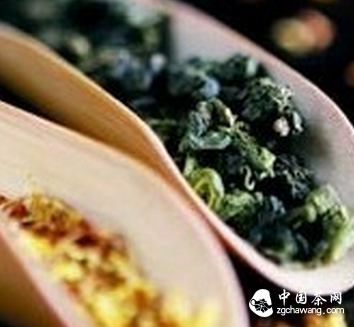
Tea lovers can have on their tea table at the same time: the Phoenix Dan Cong from Chaoshan, the Uva tea from Sri Lanka, the bamboo-tube tea from Yunnan, tea bricks, compressed tea cakes, and even the Hundred-Liang tea from Xiangxi in bamboo baskets, and the An tea in small baskets... As long as it is good tea, one must drink it to appreciate its merits.
Osmanthus is mostly produced in Guilin, Hangzhou and other places, and is an evergreen tree. Its fragrance is elegant, lasting, and not cloying, earning it the name "Nine Mile Fragrance." Osmanthus is warm in nature, and has the effects of warming the stomach, soothing the liver, benefiting the kidneys, and dispelling cold, making it suitable for dispersing dryness.
Using osmanthus to scent tea allows the tea base to fully absorb the osmanthus fragrance. When brewed, the aroma of osmanthus is delicate, the tea flavor lingers, and the teeth and cheeks retain the fragrance. In addition to refreshing the mind, it also nourishes the body. Among these combinations, the pairing of Tieguanyin (a type of oolong tea) and osmanthus is considered the most perfect. The osmanthus used must be carefully selected from the most fragrant "Golden Osmanthus." This interweaving of flower and tea gives birth to the world-famous Osmanthus Oolong.
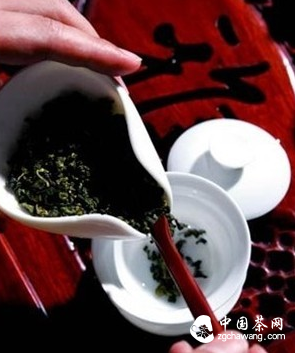
Brewing Step 1 for Osmanthus Oolong Tea: Place an appropriate amount of tea leaves into the tea bowl.
What is Scented Tea
Osmanthus tea is a precious type of scented tea made by scenting refined tea leaves with fresh osmanthus flowers. It is most famously produced in Guilin (Guangxi), Anxi (Fujian), Xianning (Hubei), Chengdu (Sichuan), and Chongqing. Guilin's Osmanthus Baking Green Tea and Anxi's Osmanthus Oolong are distinctive for using the rich fragrance of osmanthus to complement the mellow taste of the tea, commanding market prices ranging from 200 yuan to over 1,000 yuan per half a kilo (500 grams). High-quality Osmanthus Oolong can even sell for more than top-grade oolong tea.
Scenting (pronounced xūn, also yìn) means allowing the tea leaves to absorb the fragrance of the flowers. Because tea leaves are loose and porous, and contain palmitic acid and terpenes (which have the ability to absorb odors), this process of exhalation and inhalation allows the tea and floral fragrance to merge into one. The floral fragrance enhances the tea flavor, resulting in a sweet, mellow, and fragrant brew. Thus, a true scented tea is one where you smell the flower's fragrance but do not see the flower's shape.
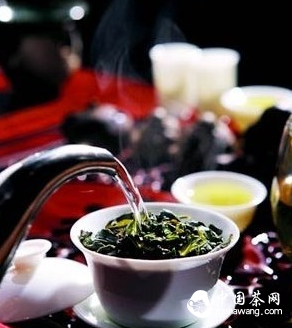
Brewing Step 2 for Osmanthus Oolong Tea: Pour boiling water into the bowl, cover it, and let it steep for a moment.
Scenting Oolong with Osmanthus
Osmanthus Oolong is mostly produced in Anxi, Fujian, the hometown of "Tieguanyin." It is mainly made using summer or autumn tea from the current or previous year, scented with fresh osmanthus flowers from the same year. It preserves the characteristics of oolong tea—thick, heavy strips and a brownish, moist color—while absorbing the elegant, lasting fragrance of osmanthus. When brewed, the liquor is orange-yellow and bright, the taste is mellow with a sweet aftertaste, and the tea fragrance is delicate and lingering.
During the scenting process, fresh, tender tea leaves (one bud and two leaves) are first carefully selected and processed into dry tea base using a "high-temperature, fast, and safe" new tea-making technique. Generally, approximately 30 kg of fresh osmanthus flowers are suitable for every 100 kg of refined oolong tea base, but this amount can be adjusted depending on the desired grade of the scented tea.
There are many varieties of osmanthus, but for making Osmanthus Oolong, "Golden Osmanthus" is considered superior due to its most intense and lasting fragrance and high quality. The blooming period of osmanthus coincides with National Day (early October). The optimal time for picking is when the flowers are in a tiger-claw shape, golden yellow, and just about to bloom. The entire process must be done gently: pick loosely, transport quickly, and absolutely avoid using bamboo poles to knock the flowers off the branches, as this would damage the petals and cause them to turn red. After picking, the flowers must be quickly taken back, impurities such as stems and leaves removed, and then scented promptly. First, spread a layer of tea base on a clean bamboo mat or white cloth, then evenly add a layer of fresh osmanthus according to the specified ratio. Repeat this process, layering tea and flowers, stacking them into a pile, with the top layer covered by the tea base. If the room temperature is low, cover the tea pile with a white cloth to maintain a stable temperature and encourage the flowers to release their fragrance. After the tea base has been absorbing the fragrance for 2–3 hours, and the temperature inside the pile rises to about 40°C, it is time to ventilate and cool the pile. When the tea temperature drops below 30°C, gather the pile again for a second round of scenting, allowing the tea base to absorb the fragrance evenly. When the osmanthus flowers become wilted and turn purplish-red, and the tea base feels soft and not sticky to the touch, the scenting process is complete. The spent flowers should be promptly sifted out, dried, and can then be mixed back into the tea.
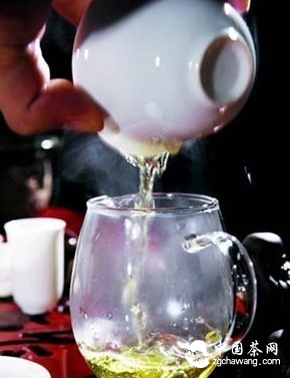
Brewing Step 3 for Osmanthus Oolong Tea: Pour the tea infusion into a fairness pitcher.
Tasting Osmanthus Oolong
Drinking Osmanthus Oolong tea follows the same method as brewing other oolong teas. The first step is, as always, to appreciate the aroma. After the initial rinse to awaken the leaves, lift the lid of the gaiwan (lidded bowl) vertically and place it under your nose, allowing the fragrance to rise along the walls of the lid. Just as a bee can detect changes in floral scent, the human nose can experience the subtle, underlying tea fragrance beneath the floral aroma. One is sweet, the other is pure and light. When these two materials are fused through scenting, they together evoke a joyful, seasonal taste.
Because the scenting process for most scented teas, while combining flower and tea, often causes both to lose some of their natural character—what tea connoisseurs call insufficient "tea flavor." Therefore, when brewing, it is recommended to use water at a full boil, pour it high, and steep for a short time. Combining fresh osmanthus with the scented Tieguanyin allows the fresh, sweet aroma of the osmanthus and the high, autumnal fragrance of the Tieguanyin to complement each other perfectly. This compensates for the lack of "tea flavor" often found in traditionally made Osmanthus Oolong. This way, when tasting, you can enjoy both the natural fragrance of osmanthus and the roast, fermented, and processed aromas of the Tieguanyin. Furthermore, the green, dancing leaves of the Tieguanyin dotted with osmanthus flowers enhance the tea's visual appeal.
Finally, regarding the tea flavor, no good tea can withstand repeated infusions. After four or five steepings, the osmanthus may still be present, but the oolong character may be gone. In fact, the best flavor of tea leaves is only obtained in the first two or three infusions; there is no need to seek more. Moreover, drinking tea is not the same as drinking water; it is about drinking the 'yun' (charm or resonance). A bright room cannot compare to a breezy lawn, and a rigid desk cannot match a stone table in a pavilion. Smelling the fragrance, tasting the tea, observing the liquor... As the water temperature changes, the tea liquor appears yellow-green or amber, presenting the richness of osmanthus and the 'Guanyin Charm' simultaneously, with a sweet, thick, and noblely exquisite taste. At this moment, the floral fragrance is the path, and the tea fragrance is the destination, misty and stirring like water and clouds.
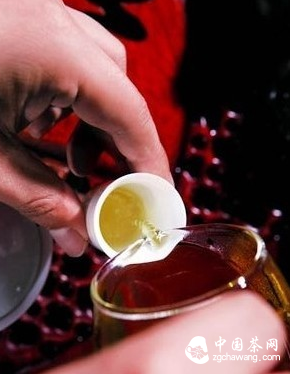
Brewing Step 4 for Osmanthus Oolong Tea: Pour the tea from the fairness pitcher into the aroma cup.
1. Teaware options include Zisha (purple clay) pots for brewing oolong tea, or white porcelain gaiwans (lidded bowls).
2. Osmanthus Oolong is a more outwardly fragrant tea. One potential drawback is that the osmanthus fragrance can be too strong, potentially masking the tea's own flavor. Therefore, it is quite suitable for beginners to taste. However, it has different grades. In good-quality Osmanthus Oolong, the osmanthus fragrance is not too overpowering; it offers both a strong floral aroma and retains the intrinsic tea fragrance of the oolong.
3. Scented tea leaves should be stored in a dry, cool place. The storage time should ideally not exceed one year.
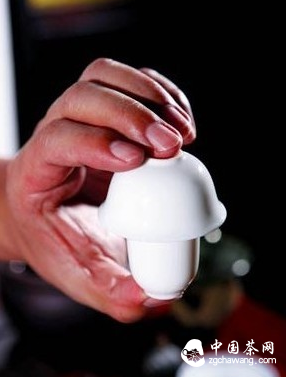
Brewing Step 5 for Osmanthus Oolong Tea: Cover the small cup with its lid.
Brewing Steps for Osmanthus Oolong Tea
1. Place an appropriate amount of tea leaves into the tea bowl.
2. Pour boiling water into the bowl, cover it, and let it steep for a moment.
3. Pour the tea infusion into a fairness pitcher.
4. Pour the tea from the fairness pitcher into the aroma cup.
5. Cover the small cup with its lid.
6. Quickly invert the cups to transfer the tea into the small tasting cup, then remove the aroma cup.
7. Smell the fragrance of the Osmanthus Oolong tea and enjoy the taste.
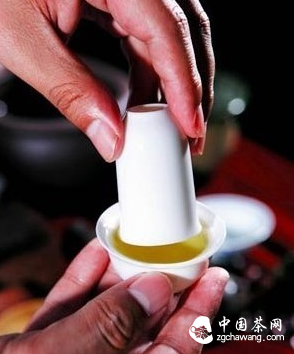
Brewing Step 6 for Osmanthus Oolong Tea: Quickly invert the cups to transfer the tea into the small tasting cup, then remove the aroma cup.