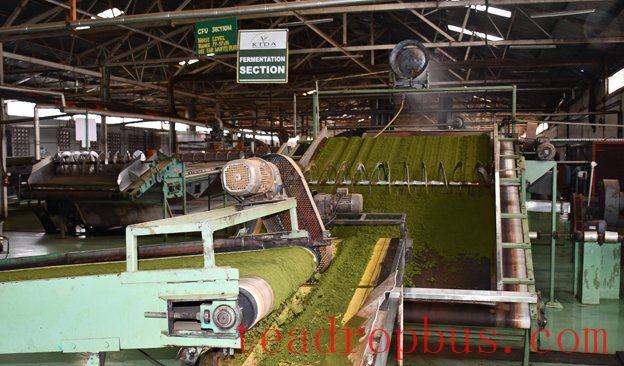
To capture more domestic value-addition, Kenya continues to implement tea reforms and plans to modernize its tea factories and processing centers. Photo credit: Government Advertising Agency, Kenya
The Kenyan government has launched an investment program to modernize its legacy tea factories located west of the Rift Valley to cut processing costs and boost efficiency. Spearheaded by the Ministry of Agriculture and the Tea Board of Kenya (TBK), this sweeping modernization drive aims to address long-standing infrastructural and processing bottlenecks.
Premium Machinery and Processing Services
The program is part of a wider restructuring of Kenya's smallholder tea sector. It is worth KES 3.5 billion ($27 million) and will refurbish 19 Kenya Tea Development Agency (KTDA) factories. Kenya exported 653,736 tons of tea in 2025, boosting the economy by KES 187 billion, but the country is far from optimizing the value of this product in the global markets. The government aims to ensure at least 40% of Kenya’s tea is value-added locally, rather than exported in bulk.
Under the program, KTDA factories will sign service level agreements to guarantee farmers high-quality services. The program committed KES 584 million towards modernizing 10 tea factories west of the Rift. This bold investment will deliver state‑of‑the‑art machinery, including automatic withering machines, CTC machinery, fluid-bed dryers, steam boilers, pre-sorters and packaging equipment, designed to enhance processing efficiency, improve tea quality, and secure better returns for farmers.
The largest investment, KES 79 million, is for Chebut Tea Factory in Nandi, for a steam boiler, a fluid-bed dryer (600 kgmt/hr), and epoxy flooring. Several factories in Kericho County — Toror, Tegat and Litein — are each receiving KES 65.8 million for automatic withering machines.
Payment Reforms and Quality Assurance
The program is also linked to a major change in green-leaf payments. The digital green leaf payment system is expected to be rolled out within three months. New payment rules are also intended to ensure 50% of farmers' dues are paid upfront, with the balance paid within three months. Agriculture Principal Secretary Kipronoh Rono announced an increase in the green-leaf price from KES 16/kg to KES 26/kg, with the government aiming to reach KES 100/kg by 2027.
Aligned with restructuring, the establishment of the Tea Quality Assurance Laboratory in Mombasa marks a pivotal shift in Kenya's tea sector. Driven by the TBK and the Ministry of Agriculture, this modern scientific testing laboratory is designed to overhaul traditional industry practices and maximize profits for smallholder farmers. The new facility will replace outdated tea tasting methods with science-based evaluation systems to ensure fairness and credibility in pricing Kenyan tea in global markets.
Also, the reform in the sector has granted 10 KTDA factories autonomy from their parent companies, a move expected to improve governance and efficiency. The TBK is expected to grant autonomy to seven more factories within the next two months.
Attracting Foreign Investors
Meanwhile, Kenya aims to attract Chinese investments in the tea factories. Willy Mutai, CEO of TBK, said: “Three Kenyan companies are already using Chinese technology in tea production while additional investments are under development. We are encouraging more Chinese investors to apply for export licenses and invest in tea processing, packaging and value-addition operations in Kenya.”
For the sector’s latest development, KTDA Management Services, on behalf of Mogogosiek Tea Factory Company Limited, invites proposals from suitably qualified and experienced international and national firms, joint ventures and/or consortiums for the Engineering, Procurement, Construction and Financing (EPC+F) of three tea processing satellite factories in Bomet County.