Geden is a Brown language term meaning "a very high place." As the name suggests, the Brown people live in Geden, and the Brown people are the ancestors who planted and cultivated Pu'er tea, indicating that Geden has a very long history of tea planting.
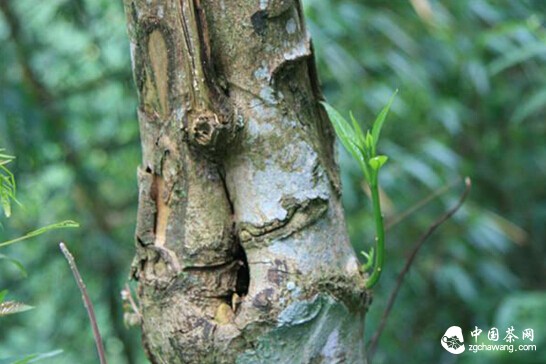
Geden is the smallest tea mountain among the six ancient tea mountains. It is closest to Kongming Mountain. Although small in area, it is quite famous because of a tea king tree. The "Simao Tingzhi" and "Pu'er Zhi" record: "There is a tea king tree in Geden, which is uniquely taller than all other tea trees. The locals, when picking tea, first offer wine and ceremonies to worship here."
As we mentioned when talking about Manzhuan (add WeChat dydy800 to view other tea mountain articles), Kongming is of extraordinary significance to the six ancient tea mountains. Geden also respects Kongming as the tea ancestor. The front of Kongming Mountain faces Geden Old Village. Moreover, there are so many large tea trees on the six ancient tea mountains, but only this tea king tree from Geden Tea Mountain entered the history books. One can imagine that its "unique tallness" must have been extremely distinctive.
Unfortunately, this tea king tree with a glorious history withered and died in the early years of the Republic of China. To this day, only a large pit remains where the tea king tree once grew. In the past, Geden tea farmers performed sacrificial ceremonies in front of this tea king tree every year when the spring tea harvest began. This is a custom that has been passed down to this day in many ancient tea mountains.
During the Qing Dynasty, the largest village in Geden was Geden Old Village. Geden Old Village was located on top of a small hill, with steep terrain, deep ravines on three sides, and leaning against a hillside on one side. It was a place easy to defend and hard to attack in ancient times. In fact, looking back at the history of tea mountains, many such tea mountain strongholds with relatively important economic or military positions were later basically destroyed by war and turmoil. For example, the political center at that time, Yibang. Geden once had hundreds of acres of ancient tea gardens. During the Xianfeng period of the Qing Dynasty, ethnic conflicts in Mangzhi Tea Mountain spread to Geden Tea Mountain. In the war and turmoil, hundreds of acres of ancient tea gardens in Geden were destroyed. Now, very few old tea trees remain on the ancient Geden tea mountain. The only ancient tree tea is distributed in places like Chafang, Yanglin, and Hongtupo. The tea garden areas are scattered, totaling less than 500 acres. Compared with other tea mountains, Geden's tea garden output is actually very small. But Geden's tea偏偏 has a unique and charming wild floral charm, so it also has a considerable fan base.
Tragic Geden
History is often strikingly similar. Both Geden and Yibang were destroyed by war and turmoil. Similarly, during their peak periods, they both had extremely glorious and震撼的历史.
The most prosperous period for Geden Old Village was during the Qianlong era. The old village once had two to three hundred households. Around the 20th year of Qianlong (1755), a large temple was built in Geden Old Village. It is unknown what temple it was. In the 46th year of Qianlong (1781), another Guandi Temple (Temple of Guan Yu) was built in Geden. The Guandi Temple was built at the three-way intersection from Geden to Yibang, half a kilometer from the old village. The Guandi Temple covered an area of more than 1,000 square meters and was built on three levels along the slope. The platform foundations are still relatively intact. On the second level platform, there is a large stele, a merit stele listing silver donations for the temple's construction. The text on the stele is very模糊, but upon careful identification, one can see engraved "Wan Jin Tong Lu" (Ten Thousand Gold Same Record), "Jiang Province, Hu Province, Yunnan Province" and the names of dozens of donors. From the stele text, it can be known that many donors were from Simao and Jingdong County. Judging from the stele content, this temple was built very exquisitely at that time, and the head of Guan Gong in the temple was even coated with gold powder.
Before the Daoguang era, the Geden tea mountain had over ten thousand acres of tea gardens. The tea gardens extended east from Geden Old Village to the Xikong Mountain of Yibang, and west to Niuguntang of Mangzhi. Tea mountain people say that in the past, Geden people were very wealthy, ostentatious, and somewhat arrogant.
Such a once flourishing Geden was gradually corroded in turmoil and war, weakened like a chronic illness. Today, in Geden, ancient tea trees are scattered, making picking difficult. It is fortunate that precisely because it is far from the hustle and bustle, the quality of the tea is guaranteed. But it is still very difficult to buy genuine Geden tea.
Geden tea taste: The Geden ancient tea garden is a mix of large and small leaf varieties. The taste has a very unique and strong wild floral charm. Bitterness and astringency are relatively weak. The sweet aftertaste and saliva production are very good, bright, fresh, and refreshing. The floral aroma is rich. The soup is smooth and delicate.
By Dong Yue (Founder of Nanming Jiaren, National Senior Tea Artist, personal communication WeChat: dydy800) The Dong Yue Talks Tea series articles are now simultaneously updated on well-known websites such as Sohu, Today's Headlines, Shuocha.com (ishuocha.com), Chinese Tea Network (zgchawang.com), and Banxia Tea Network.