Tea ceremony is the way of appreciating the beauty of tea. The tea ceremony is regarded as an art of brewing and drinking tea, a lifestyle etiquette with tea as the medium, and a way of self-cultivation through tea. Through preparing, admiring, smelling, and drinking tea, it enhances friendship, beautifies the heart, cultivates virtue, learns etiquette, and understands traditional virtues. It is a very beneficial harmonious ceremony. Drinking tea can calm the heart and mind, helping to cultivate sentiment and eliminate distractions. The spirit of the tea ceremony is the core of tea culture. The tea ceremony is known as the embodiment of Taoism. The tea ceremony originated in China and was later introduced to the West.
1. Origin
The tea ceremony originated in China. The Chinese were the first in the world to use tea drinking as a way of self-cultivation at least during the Tang Dynasty or earlier. The Tang Dynasty record "Fengshi Wenjian Ji" contains such a record: "The tea ceremony became popular, and all royal nobles and officials drank it." This is the earliest existing documentation of the tea ceremony. Thus, the earliest and most complete tea ceremony process was created by Lu Yu of the Tang Dynasty with his boiled tea ceremony.
2. Chinese Tea Ceremony
The tea ceremony is a behavioral art that expresses certain etiquette, character, artistic conception, aesthetic views, and spiritual thoughts through tea tasting activities. It is the combination of tea art and spirit, and expresses spirit through tea art. The main content of the Chinese tea ceremony emphasizes the beauty of five elements: tea leaves, water, heat, tea sets, and environment, accompanied by emotional conditions, seeking the highest enjoyment of "taste" and "heart." Tea culture belongs to the category of Chinese culture, which standardizes every detail of tea drinking with etiquette, emphasizing the beauty of artistic conception formed jointly by tea leaves, water, heat, tea sets, environment, and the drinker's cultivation and mood.
The connotation of tea culture is actually a specific manifestation of Chinese culture. Discussing tea culture must be combined with Han Chinese culture. The spiritual connotation of tea culture is a cultural phenomenon with distinct Chinese cultural characteristics formed through habits such as brewing, admiring, smelling, drinking, and tasting tea combined with the cultural内涵 of Chinese etiquette, which can also be said to be a phenomenon of etiquette.
3. Theory
Harmony between Heaven and Man
The Chinese tea ceremony absorbed the essence of Confucian and Taoist thoughts. Taoist theories injected the philosophical idea of "harmony between heaven and man" into the tea ceremony, establishing the soul of the tea ceremony. At the same time, it also provided aesthetic concepts that advocate nature, simplicity, and truth, as well as thoughts of valuing life, honoring life, and health preservation.
Because the Taoist philosophical idea of "harmony between heaven and man" is integrated into the spirit of the tea ceremony, Chinese tea lovers are filled with great love for nature and have a strong desire to return to and get close to nature. Therefore, Chinese tea lovers can best experience the passion of "feeling refreshed between heaven and earth" and the wonderful feeling of "feeling the heart of a crane in the distance" when achieving a "mysterious meeting between things and self" with nature.
Respecting Others
In the Chinese tea ceremony, the thought of respecting others is commonly seen in the naming of tea sets and the understanding of tea. Tea practitioners habitually call lidded cups with saucers "Three Talents Cups." The saucer represents "earth," the lid represents "heaven," and the cup represents "man," meaning heaven is great, earth is great, but man is greater. If the cup, saucer, and lid are all held together for tea tasting, this holding method is called "Union of the Three Talents."
Sitting in Forgetfulness
"Sitting in forgetfulness" is a method proposed by Taoism to achieve the state of "reaching extreme emptiness and guarding profound tranquility" in the tea ceremony. Influenced by Laozi's thoughts, the Chinese tea ceremony regards "tranquility" as one of the "Four Noble Truths." How can one achieve an empty spiritual state of "leaving no selfishness, no dust, and no delusion" when tasting tea? Taoism also provided a method for entering tranquility for the tea ceremony, which is called "sitting in forgetfulness," that is, forgetting one's physical body and forgetting one's intelligence. The tea ceremony promotes communication between man and nature, blurring the boundaries between things and self, and the aesthetic contemplation of "cleansing the mysterious mirror" and "clarifying the heart and savoring the image," all of which can be achieved through "sitting in forgetfulness."
No Self
The Taoist attitude of not being bound by fame and doctrine, acting purely naturally, and being open-minded and free is also the way of life of the Chinese tea ceremony. What Taoism calls "no self" is what the tea ceremony pursues as "no me." No me does not mean eliminating the self physically, but spiritually eliminating the opposition between things and self, achieving harmony with nature and containing all things in the heart. "No me" is the highest pursuit of mental state in the Chinese tea ceremony. In recent years, tea practitioners from both sides of the Taiwan Strait have frequently jointly held international "No Me" tea ceremonies, with Japanese and Korean tea practitioners also actively participating. This is a beneficial attempt to reach the state of "no me."
4. Procedure
Washing the tea:
Pour boiling water into the pot and quickly pour it out.
Brewing:
Pour boiling water into the pot again. During the pouring process, the spout "nods" three times, which is called "Phoenix nodding three times," showing respect to guests. "Spring breeze brushing the face": The water should be higher than the pot mouth, and use the lid to brush away tea dust.
Sealing the pot:
Cover the pot lid and pour boiling water all over the pot body.
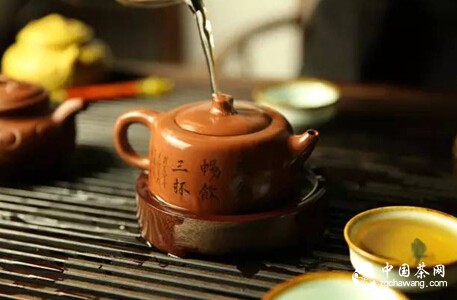
Dividing the cups:
Use tea tweezers to group the aroma-smelling cups and tasting cups, and place them on the tea tray. "Jade liquid returning to the pot": Pour the tea soup from the pot into the fairness cup, so that everyone can taste tea with consistent color, aroma, and taste.
Dividing the tea:
Pour the tea soup into the aroma-smelling cups, filling the tea to 70% full.
Serving tea:
Serve tea to guests.
Smelling the aroma:
Guests pour the tea soup into the tasting cups and gently smell the remaining aroma in the aroma-smelling cups.
Tasting the tea:
Guests use three fingers to take the tasting cup and sip slowly in three mouthfuls. With the accompaniment of guzheng music, the main brewer uses fire to incense. Wash hands, first introduce the tea into the lotus, invite guests to appreciate the tea, and then appreciate the utensils: tea tasting emphasizes using Jingdezhen porcelain and Yixing purple clay teapots. Heating the cups and warming the pot involves pouring boiling water into the purple clay teapot, fairness cup, aroma-smelling cups, and tasting cups to clean the utensils and raise the temperature. "Oolong entering the palace": Put Oolong tea into the teapot.
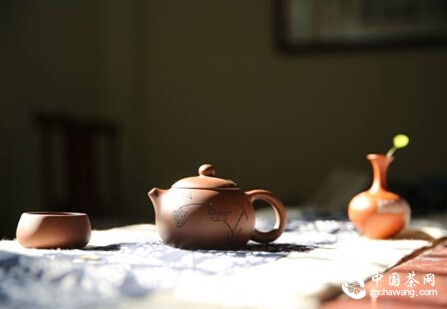
Brewing tea is originally a very simple thing, simple enough to be done with just two actions: putting tea leaves and pouring water. However, in the tea ceremony, that set of rituals is too complex or too particular, and ordinary people certainly won't make such a big deal out of this daily small matter.
In fact, the Chinese tea ceremony did not just satisfy itself with the invention of self-cultivation through tea and the standardization of rituals, but more boldly explored the true meaning of tea drinking for human health. It creatively combined tea with various natural ingredients such as traditional Chinese medicine, greatly enhancing the role of tea drinking in medical health care and giving it a larger development space. This is the most practical aspect of the Chinese tea ceremony and why it has been valued for thousands of years.