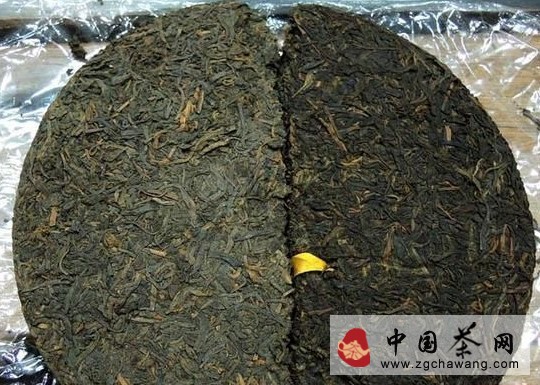
The emergence of "technical storage" methods aims to conceal the flaws of wet-stored tea. It not only significantly shortens the "de-storage" time but also makes wet-stored tea appear more like "clean" dry-stored tea, enhancing the market competitiveness of aged tea. However, the question remains: what exactly is this mysterious agent?
Recently, at the premises of a seasoned tea enthusiast in Dongguan, Old Tea Ghost encountered the legendary "technical storage" aged tea.
The tea enthusiast showed Old Tea Ghost an aged tea cake split into two halves. One half was untreated—its color was grayish, dull, and it carried a noticeable storage odor. The other half, treated with "technical storage," had dark, shiny, intact leaves, appearing radiant and glamorous. All off-flavors in the tea cake had mysteriously vanished, as if it had been "refurbished."
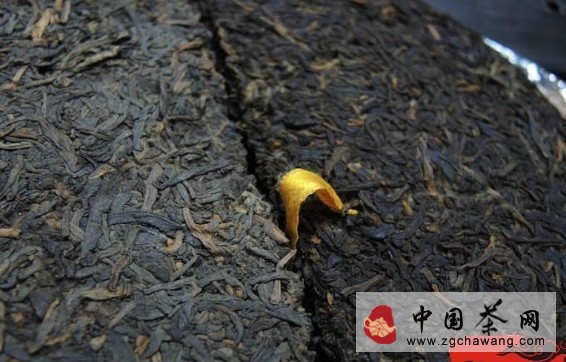
(The right side is the tea cake refurbished with "technical storage" spray, forming a stark contrast with the left half.)
"Storage processing" is an open secret in the Pu-erh tea world. A batch of new tea, after undergoing "storage processing," can be transformed into "aged tea with years," sold at desirable prices through certain channels. Following concepts like wet storage and dry storage, the newly emerged "technical storage" is gaining momentum.
Those who have tasted wet-stored tea know that due to exposure to high-temperature, high-humidity environments, the tea surface often develops a white frost (mold) and carries a heavy storage odor, making it easy for connoisseurs to detect. Before wet-stored tea enters the market, the traditional approach is to first conduct "de-storage"—using methods like storage in purple clay jars and ventilation to reduce the storage odor and off-flavors as much as possible, making it suitable for drinking. However, this process is lengthy, often taking months or even over a year.
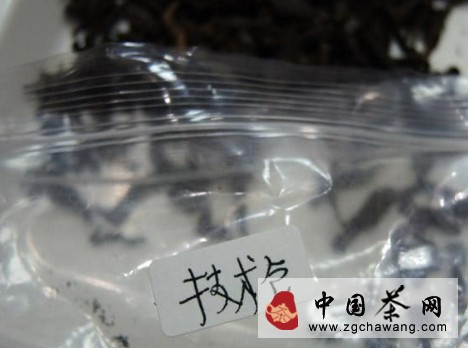
The emergence of "technical storage" methods aims to conceal the flaws of wet-stored tea. It not only significantly shortens the "de-storage" time but also makes wet-stored tea appear more like "clean" dry-stored tea, enhancing the market competitiveness of aged tea.
But the question is: what exactly is this mysterious agent? Could its "powerful function" of quickly removing mold spots and off-flavors from aged tea endanger the health of consumers? This so-called "technical storage" secret technique inevitably brings to mind the tactics of unscrupulous vendors using formaldehyde to soak seafood—improving the appearance of goods but causing endless harm.
In the current booming tea market, some will inevitably resort to unscrupulous methods for quick profits. To cater to some people's preference for aged tea, "storage processing" techniques emerged; to quickly turn wet-stored tea into dry-stored tea, the spray-based "technical storage" was invented.
Due to the lack of authoritative technical standards for identifying aged tea and almost non-existent quality control, finding a reliable aged tea is as challenging as "hunting for treasures" at Panjiayuan Market. Compared to artificial "storage processing," the use of chemical agents in "technical storage" is far more terrifying.
Old Tea Ghost believes that tea is ultimately for drinking. Without truly understanding the composition and mechanism of the "technical storage" agent, it's best to stay as far away as possible from such superficially glamorous "aged tea." Don't risk becoming a "lab rat" for the sake of tasting something novel.
Source: Old Tea Ghost