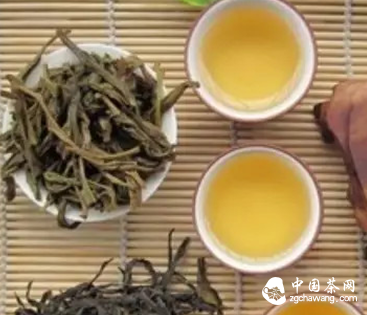
Liu Xun of the Qing Dynasty, in his work "Moments of Leisure Collection," wrote: "Among rock teas, the highest grade is called Old Cong Xiao Zhong, next is Xiao Zhong, then Xiao Zhong Gongfu, then Gongfu, then Gongfu Scented Tea..." This indicates that during the Qing Dynasty, "Gongfu" referred to the names of teas, all of which were relatively precious.
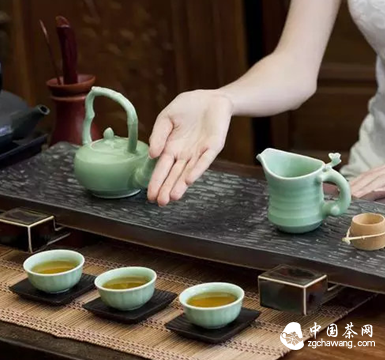
During the Republican period, Xiao Yishan's "General History of the Qing Dynasty" recorded: "Portugal and the Netherlands engaged in trade with our country earlier... Black tea (including Gongfu tea, Wuyi tea, Xiao Zhong tea, Baihao, etc.)." Here, Gongfu tea refers to a variety of black tea.
Therefore, the meaning of "Gongfu Tea" is—a good tea produced by spending time, effort, and labor.
Previously, both Wuyi Rock Tea and black tea had varieties called "Gongfu Tea," but today, "Gongfu" has largely separated from rock tea and specifically refers to black tea, most commonly categorized by region, such as Min Hong Gongfu, Qimen Gongfu, Xiuning Gongfu, Sichuan Hong Gongfu, Yunnan Hong Gongfu, and so on.
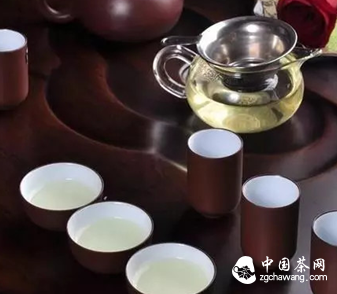
So what does "Kungfu Tea" refer to?
Literally, "kungfu" refers to skill or technique. "Kungfu Tea" thus refers to the art and method of brewing and preparing tea, emphasizing the way of drinking. The most famous is undoubtedly Chaozhou "Kungfu Tea."
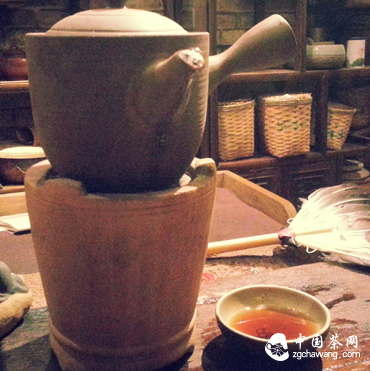
Chaozhou "Kungfu Tea" requires over ten types of tea utensils just for the set, with several being particularly distinctive, such as the charcoal stove, feather fan, and olive charcoal, using traditional charcoal burning to boil water, sometimes accompanied by special steel chopsticks to stir the charcoal.
The teapots used in Chaozhou "Kungfu Tea" are mostly Zhuni pots, also called Chaozhou pots or hand-pulled pots. They are bright red and glossy, producing a crisp, metallic sound when tapped, with fine and even clay texture, making them very suitable for brewing tea. If you have the chance, you can try the hand-pulling technique used to make Zhuni pots.
Notably, the Zhuni pots chosen for "Kungfu Tea" are quite small, some even about the size of an orange, with a drum-shaped body, called "chong guan" or "su guan" in the Chaozhou dialect.
As for "Kungfu Tea," the "kungfu" is naturally reflected in the brewing process. From lighting the fire, boiling water, and warming the cups, to brewing the tea, pouring water over the pot, and serving the tea, although not as formalized as Japanese tea ceremony, performing the actions crisply and seamlessly is a skill that cannot be mastered in a day or two.
Take the step called "na cha" (receiving the tea) in Chaozhou "Kungfu Tea"—before putting the tea leaves into the pot, the coarse and fine leaves must be separated. The coarsest leaves go at the bottom of the pot, the tender and fine ones in the middle, and the larger coarse leaves on top. It is said that this way the brewed tea will be balanced in bitterness and sweetness and will not clog the pot.
Complete Kungfu Tea Set
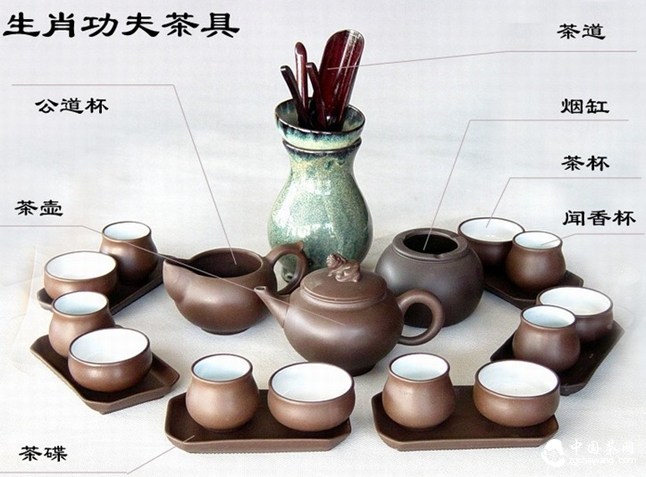
The most famous places for brewing Kungfu tea are Fujian, Chaozhou, and Taiwan. The oolong teas from these three places differ in production method, flavor, and brewing techniques, but the basic skills are similar because they all practice Kungfu tea. If the fundamental skills are not complete, the true flavor of the tea cannot emerge. The charm and意境 would then be like a castle in the air. The tea set includes a lidded bowl (gaiwan), a fairness pitcher (cha hai), aroma-smelling cups, teacups, a tea strainer, tea tongs, tea saucers, a teapot, a tea tray, and a tea cloth. This refers to the set used for brewing oolong tea, like Tieguanyin. Of course, some other types of Kungfu tea, such as ground tea (lei cha), use different utensils.
Main Utensils for Kungfu Tea
1. Lidded bowl (Gaiwan) ceramic set: A tea set consisting of a lid, a saucer, and a bowl.
2. Fairness pitcher (Cha Hai/Gongdao Bei): Also called a tea decanter or fairness cup. Shaped like a spoutless, open-mouthed teapot.
3. Aroma-smelling cup: Used for smelling the aroma, more slender than tasting cups, a unique utensil for oolong tea (like Tieguanyin).
4. Teapot: Made of purple clay (zisha) or red clay (zhuni).
5. Tea tray: Wide and flat, can be made of bamboo or wood; plastic is best avoided as it may have odors.
6. Tea spoon and tea holder (cha he): A measuring tool for dry tea before it enters the pot.
7. Stove and kettle: Can be electric or alcohol-burning, as long as they don't produce odors when heating. Essential, as most Kungfu tea requires boiling water.
8. Cups: Thin-walled white porcelain cups do not affect the tea's color or taste and are easy to clean.
9. Tea storage caddy: A paper caddy inside a sealed bag is most convenient and economical; the paper blocks light, and the bag seals in aroma and moisture.
Only with all the above can it be considered Kungfu tea. Traditional Chaozhou Kungfu tea typically uses only three cups, regardless of the number of guests. The first cup of tea is always served to the guest on the far left first, regardless of their status, age, or gender. After each cup is drunk, it is rinsed with hot tea water, and then the still-warm cup is passed to the next person. Isn't this custom teaching us to always maintain a virtuous character, to be united, friendly, and mutually respectful towards everyone around us?