Those who have not wept deeply at night are not qualified to speak of life; those who have not fallen to the dust and blossomed are not qualified to speak of love; and tea leaves that have not been bitten by insects cannot be called Oriental Beauty.—Xiang Gu Jiang
In the tea world, there is a famous legend: Many years ago, a Taiwanese tea farmer discovered that his tea plants had been extensively bitten by insects. The leaves grew poorly, with many spots and curling edges. Unwilling to accept a total loss, he still harvested these "inferior" fresh leaves, processed them into oolong tea following the normal procedure, and took them to a tea merchant to sell.
Unexpectedly, upon tasting, the tea merchant found the tea to be mellow and sweet, with a ripe fruity and honey-like aroma, surpassing even the best teas of the time. He then paid a high price to purchase it. The tea farmer returned home joyfully to boast, but his neighbors and fellow villagers did not believe him, thinking he was exaggerating. In Hakka dialect, exaggerating is called "peng feng," and thus the name "Peng Feng Tea" (or "Pong Feng Tea") spread quickly.
A subsequent famous legend about Peng Feng Tea is: After this tea gained fame far and wide, it was presented to Queen Victoria by a British tea merchant. The queen brewed it in a crystal cup and saw the colorful tea leaves dancing in the water, like the dreamy and graceful dance of Chinese maidens. After tasting it, she praised it highly and bestowed the name "Oriental Beauty Tea."
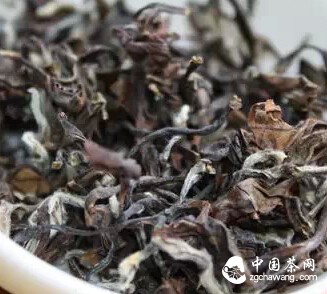
Produced in Taiwan, Oriental Beauty Tea is a semi-fermented oolong tea with a unique fruity and honey-like aroma.
Whether these two legends are historical facts or fabrications is not important; what matters is that they have endowed Oriental Beauty Tea with rich cultural significance. And indeed, the unique quality of this tea can be said to be created by small insect bites.
This small insect is called the tea small green leafhopper, a very small cicada with a light green body that is difficult to spot hiding among green leaves. They are highly resilient and can reproduce up to 14 generations a year. Tea plants are one of their preferred hosts. They insert their mosquito-like piercing-sucking mouthparts into the tender new buds to suck the sap. This sap is equivalent to the plant's blood, responsible for transporting nutrients. The "blood loss" causes the tea buds to become malnourished, leading to stunted growth or even cessation. Brownish spots appear at the bite sites, the buds shrink and curl, and in severe cases, they may fall off.
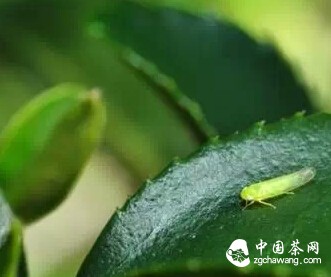
Tea small green leafhoppers on tea leaves.
For the tea plant, these leafhoppers are certainly enemies. When plants are attacked by pests, they often launch defensive measures: some directly secrete toxic substances to combat the pests, while others try to attract the enemies of their enemies for help. The tea plant adopts the latter strategy. After being bitten by the tea small green leafhopper, it initiates a defense response, releasing a series of aromatic compounds based on jasmonic acid to attract the leafhopper's natural predators. These aromatic substances, along with other compounds produced by the tea plant's activated defense system, undergo the deep oxidation process of oolong tea production, resulting in the fruity and honey-like aroma of Oriental Beauty Tea.
This process sounds simple, but producing high-quality Oriental Beauty Tea is not easy. First, it requires specific tea plant varieties that readily produce those aromatic compounds; in practice, the best is a variety called 'Qingxin Damao.' Second, suitable regions and seasons for both this tea variety and the tea small green leafhopper are needed, but insect population fluctuations are highly unpredictable, making it difficult for farmers to control. Third, to allow leafhopper activity, pesticides cannot be used; however, without pesticides, other insects can also thrive, and the defense responses triggered by other insects do not produce the desired aromatic compounds. Therefore, the harvesting cost of Oriental Beauty Tea is high, its yield is unstable, and its quality varies—naturally, high-quality Oriental Beauty Tea is rare and precious.
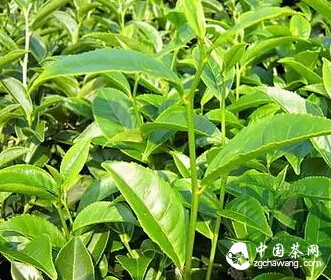
'Qingxin Damao,' a tea plant variety currently mainly cultivated in areas like northern Taiwan's Taoyuan, Hsinchu, and Miaoli counties.
From a biochemical perspective, although Oriental Beauty Tea is "bitten" out by the tea small green leafhopper, its role is merely to stimulate the tea plant to activate its defense system. The substances that bring the aroma are still produced by the tea plant itself. Moreover, this stimulation is likely not triggered by the act of "biting" itself—other insects also bite, but the compounds they induce do not have this fruity honey aroma. It is generally believed that the activation of the tea plant's defense system is triggered by specific components in the saliva of the tea small green leafhopper—somewhat similar to how ethylene triggers the initiation of fruit ripening.
If people could identify these active components in the leafhopper's saliva, they might be able to directly apply them to "trick" the tea plant into thinking the leafhoppers have arrived, thereby activating the defense system to produce raw material for Oriental Beauty Tea. Of course, even if such an idea were realized, and even if the taste could be replicated or improved, because it is not created by insect bites, it would only be an "imitation," lacking the market appeal of being "traditional" and "authentic."
Naturally, a more advanced approach would be to fully understand how the defense system activated by leafhopper bites operates and then enhance this biochemical pathway directly through genetic modification. This fundamental method would be highly efficient and could avoid the visual defects caused by stunted leaf growth after insect bites. In terms of product evaluation based on compound composition, such tea could be superior to that produced by insect bites. However, the market for specific tea varieties is inherently limited, and adding "genetically modified" would face resistance from many people, so this idea will likely remain theoretical.
The substances that give Oriental Beauty Tea its special flavor are also influenced by other growing conditions besides insect bites and tea variety. By selecting appropriate tea varieties, planting them in specific regions, and applying specific tea processing techniques, it is possible to achieve a fruity honey aroma similar to Oriental Beauty Tea. On the market, there are also some products of this kind—but, of course, they cannot be called Oriental Beauty.