The "Newly Compiled General Annals of Yunnan" records: "The name Pu-erh (tea) holds a special position among Chinese teas, far surpassing those from Anhui, Fujian, Zhejiang, and other regions. Pu-erh tea belongs to the Yunnan large-leaf tea category, divided into five classes and twelve varieties. The Purple Bud tea class includes two varieties: Large Purple Bud tea and Small Purple Bud tea."
Purple Bud is a variant within Yunnan's ancient population, a large-leaf tea variety. The buds are purple, and typically the first three leaves are purple, after which the leaves become dark green. Small quantities are found in high-altitude areas like Menghai, Yiwu, and Lincang, with Lincang's being relatively better. Purple Bud is similar to primitive wild tea. Its sun-dried Mao Cha produces a golden-yellow liquor, is substantial and thick in quality, with a full-bodied taste and long-lasting aftertaste, its character lying between cultivated wild tea and old garden tea. It can be processed directly into Pu-erh for consumption. Due to low yield, its price is relatively high.
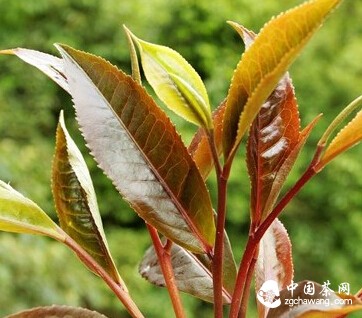
Purple Bud must be distinguished from Zijuan. Zijuan is suitable for making green tea, is a medium-small leaf variety, with dry tea leaves being purple, the liquor also being purple, aroma pure, taste strong and intense. The tea plant also has purple buds, purple stems, and purple leaves. Wild Purple Bud tea trees grow in the primeval forests of western Yunnan, at altitudes above 1800 meters. Harvesting begins in early March and ends by mid-month, resulting in a long growth period but a short picking window, making the quantity extremely limited.
Wild Purple Bud tea tree young leaves are purplish-red, while old leaves are green. Sun-dried Mao Cha made from wild Purple Bud tea has a half-green, half-purple dry leaf appearance. The purple leaf parts, when brewed, show a purple leaf bottom, which is a distinctive characteristic of wild Purple Bud tea. Qizi cake tea made from wild Purple Bud tea has a cake body covered in golden pekoe, glossy and oily. When brewed, it releases a unique delicate fragrance, with a fresh, sweet, and refreshing taste, and a bright yellow liquor color. Its aroma and taste are distinct from ordinary sun-dried green tea.
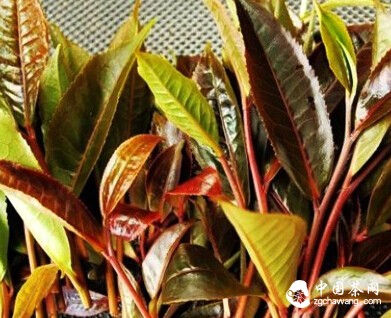
The essence of "purple tea" is a type of tea plant variant: During the pollination process of seed-propagated tea trees, the embryo carries some genes from the mother plant, while pollen carries genes from different father plants. The combination forms seeds with various gene combinations, leading to variations in the next generation, such as red leaves, green leaves, large leaves, small leaves, round leaves, long leaves, sparse serration, dense serration, etc. Yunnan has a large number of color-variant tea trees, often accounting for over 20-30% of the trees in a tea forest, with each tree having different characteristics and taste. Common variant colors include purplish-red, yellow, white, etc., with purplish-red being the most frequent. Species variation can go in two directions; some qualities may improve, while others may deteriorate.
The terms "purple tea" or "purple bud" are customary names in tea regions without scientific classification or basis. Usually, "purple tea" only appears purplish-red when the young leaves first sprout and revert to green after developing to the third or fourth leaf.
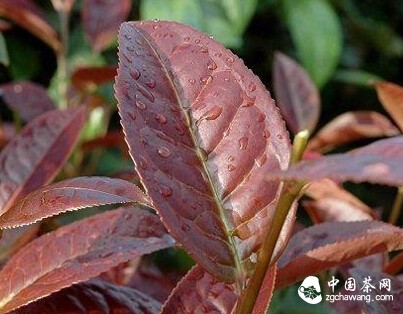
Among Yunnan's improved tea varieties, there is also a purple tea—Zijuan. Its characteristics include willow-shaped leaves, smooth leaf surface, shallow, blunt, and sparse leaf serrations, and thin leaves. The made tea has a thin taste, pronounced aroma, and strong刺激性. In recent years, as the concept of "purple tea" has gained popularity and become a marketable feature, many manufacturers have been selling this variety as the purple tea from primitive plant variations.