【Main Text】Pu-erh tea is divided into raw and ripe types. Many people assume by the names that raw tea naturally transforms into ripe tea over time, but this is not actually the case. So, do you understand the distinction between raw and ripe Pu-erh? Do you know their differences in processing, appearance, and flavor? Do you know whether you are more suited to drinking raw or ripe tea... If you're not entirely clear, read on to find the answers you're looking for.
1. Definition of Raw Pu-erh and Ripe Pu-erh
The general production process of Pu-erh tea is as follows: Freshly picked tea leaves undergo fixation, rolling, and drying to become 'mao qing' (Dian Qing). At this stage, the tea has an intense and overpowering character, which is generally not palatable to most people. Depending on the subsequent processing of the 'mao qing' tea, Pu-erh tea is then categorized into two main systems: raw tea and ripe tea (there are also semi-fermented teas that blend both).
Ripe Tea: Refers to 'mao qing' tea that undergoes the 'wo dui' (wet piling) process. This artificial accelerated fermentation uses warm, moist conditions to promote non-enzymatic auto-oxidation of polyphenolic compounds, transforming the tea's inherent substances. It reduces bitterness and astringency, mellows the flavor, eliminates grassy odors, shortens the aging stage, and makes the tea drinkable earlier. This technology was first developed by the Kunming Tea Factory in 1973, drawing inspiration from dark tea processing techniques. Research on 'wo dui' by the Yunnan Institute of Microbiology earned the Yunnan Provincial Science and Technology Progress Third Prize in 1985.
Raw Tea: Raw tea refers to 'mao qing' tea that does not undergo 'wo dui' but matures entirely through natural transformation. This is the traditional historical method. The natural ripening process is quite slow, taking at least ten years or more depending on storage conditions. The longer the time, the more complete the enzymatic and non-enzymatic oxidation of polyphenolic compounds within the tea, resulting in a mellower and more stable aged aroma, while the lively essence, known as 'tea qi' by tea connoisseurs, remains vibrant.
2. Differences Between Raw Pu-erh and Ripe Pu-erh
1. Name
Ripe Tea: Commonly called ripe cake, brick, tuo.
Raw Tea: Commonly called raw cake, brick, tuo, or green cake.
2. Appearance (using cake tea as an example)
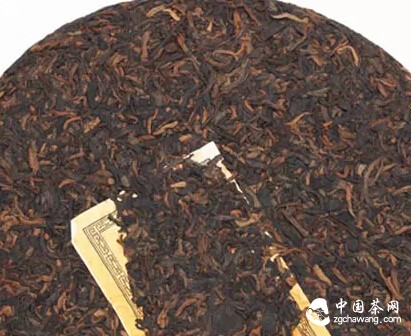
Ripe Tea: The tea leaves in the cake are black or reddish-brown. Some bud tea appears dark golden. It has a strong 'wo dui' aroma, similar to an earthy smell. Lightly fermented tea may have a scent similar to longan, while heavily fermented tea has a damp, grassy mat smell.
Raw Tea: The tea leaves in the cake are primarily green or dark green, with some turning yellowish-red. White parts are buds.
3. Production Process
Ripe Tea: Sun-dried large-leaf tea varietal 'mao qing' from Yunnan undergoes artificial 'wo dui' fermentation. After screening and grading, it is made into various loose teas and compressed teas.
Raw Tea: Sun-dried large-leaf tea varietal 'mao qing' from Yunnan is directly made into various loose teas and compressed teas after screening and grading.
4. Color
Ripe Tea: Brown, chestnut color. Heavy fermentation can result in a blackish hue. Tea buds are golden or dark golden.
Raw Tea: Green, dark green, or yellowish-green. Tea buds are white and pekoe is visible.
5. Tea Nature
Ripe Tea: Warm nature.
Raw Tea: Slightly cooling nature.
6. Liquor Color
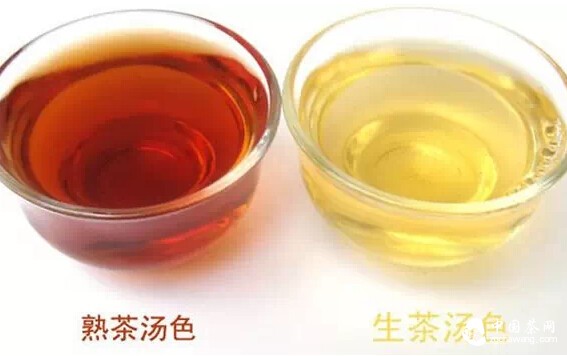
Ripe Tea: Chestnut red or dark red, slightly translucent. Many tea friends mistakenly call ripe tea black tea because of this.
Raw Tea: Greenish-yellow or golden yellow, relatively translucent.
7. Taste
Ripe Tea: Basically no bitterness or astringency. Entry is mellow, smooth, with natural sweetness (hui gan) and saliva-inducing (sheng jin) sensation. New tea has a 'pile taste' and a slight watery note.
Raw Tea: Strong taste, pronounced 'tea qi,' clear and fragrant liquor, bitter with astringency. However, good tea turns bitterness into sweetness and astringency induces salivation. If bitterness and astringency linger unpleasantly in the mouth, the tea quality is poor or it is not authentic Pu-erh.
8. Spent Leaves
Ripe Tea: For lightly fermented tea, the spent leaves are reddish-brown but not very pliable. For heavily fermented tea, spent leaves are mostly dark brown or black, hard, and brittle.
Raw Tea: For newly made tea, spent leaves are mainly yellowish-green or dark green, highly active, relatively pliable, and elastic. Good tea has uniform color, well-defined shape, and leaves that remain largely intact when unfurled (though this is not the primary criterion and depends on tea origin and type).
9. Main Effects
Ripe Tea: Has notable weight loss effects! Ripe Pu-erh undergoes light fermentation, cultivating a large amount of bacteria beneficial to the human body. Its tea nature is mild, warming, and nourishing to the stomach. According to traditional Chinese medicine theory, ripe Pu-erh is basically warm-natured, making it the most suitable tea for women to drink.
Raw Tea: Has notable weight loss effects! Raw Pu-erh has a strong 'tea qi' and high content of tea polyphenols, making it a good beverage for cancer prevention. Drinking raw Pu-erh during the day is very refreshing, providing a clear sense of purification, and it has a relatively noticeable effect on promoting vascular health.
10. How to Choose
Ripe Tea: Ripe Pu-erh has a mild tea nature, can warm the stomach, the liquor is red, smooth, rich, and mellow, basically without bitterness. Drinking it at night won't cause sleeplessness.
Raw Tea: Raw tea has a stronger, more stimulating nature. Raw tea can clear heat and reduce internal heat, suitable for summer drinking. Moreover, it has the characteristic of improving in quality the longer it is stored.
Some people prefer the fresh aroma and potency of raw tea, while others like the mellow thickness and smoothness of ripe tea. The specific choice ultimately depends on personal preference. After all, drinking tea is a highly personal matter, and it is meant to be an enjoyment. Having to listen to others' opinions before enjoying it seems rather pointless.