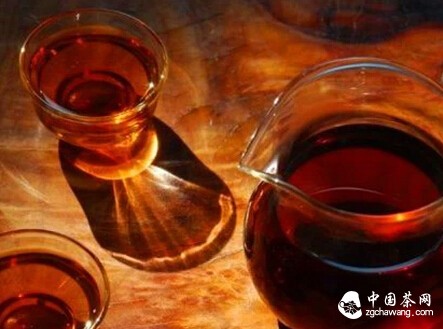
Ripe tea is a relatively difficult type of tea to brew. If you are not careful, the flavor will be weak, the soup will be thin, and there may be unpleasant odors. What's more, even tea that has been stored well can produce a soup that makes the throat dry, tight, and uncomfortable. This is truly puzzling.
In order to make ripe tea taste better, the author conducted a series of experiments on vessels, water, brewing techniques, and other related issues. Some insights and experiences were gained. Here, I would like to discuss them with fellow tea enthusiasts.
My general approach is as follows: First, analyze the tea's character and identify its features; second, based on its character, set brewing goals, striving to follow its natural tendencies and enhance strengths while avoiding weaknesses; third, consider what methods can be used to achieve these goals; finally, through practice, further analyze, verify, and adjust. Below, I will first elaborate on these points one by one, and finally, I will demonstrate the entire brewing process once.
I. Analyze the tea's character.
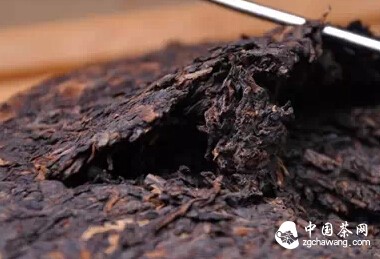
In terms of aroma. New ripe tea has a pile-fermentation odor, but good tea will develop a floral honey or even aged aroma in the middle to later stages. Old ripe tea has a storage smell, a withered leaf smell, but good old tea can develop an excellent aged aroma or even a medicinal aroma in the middle to later stages.
In terms of flavor. New ripe tea has little刺激性 or astringency. However, its soup texture is quite good. When brewed properly, it can present a sticky and sandy texture similar to bean soup. Old ripe tea has a clearer soup, a lighter flavor, but can have a very smooth, oily mouthfeel. When brewed properly, it can even reach a state of "hua" (transformation).
Overall, ripe tea is not rich in content and generally is not very耐泡 (durable to multiple infusions).
II. Set goals based on the tea's character.
First few infusions: Suppress odors (coarse and mixed pile or storage odors), enhance the sticky, thick, oily soup texture, and tilt the balance of aroma to water towards the latter. Aim to brew a good soup that is not strong in aroma but soft, sticky, and smooth. At the same time, try to control the concentration of the first few infusions to protect the performance of the later infusions and improve the overall durability.
Middle infusions: When the aroma begins to turn "mellow," appropriately stimulate the fragrance. Pursue a balanced coordination of aroma and soup. Brew a good tea with both aroma and water, where fragrance and flavor blend.
Last few infusions: The flavor and soup texture substances have been almost completely extracted. When the soup texture can no longer be guaranteed, fully stimulate the aroma. Brew a cup of sweet water with high fragrance and a smooth mouthfeel.

III. Choose methods toward the goals
1. Choose a purple clay pot made of thick, low-sintered clay. Make full use of the various physical characteristics of the purple clay pot, which are beneficial for adsorbing and suppressing miscellaneous odors, as well as for透气 and heat retention of the leaves. At the same time, a pot shape with a wide mouth, large belly, and short body, such as Fanggu or Shibiao, is more conducive to controlling water pouring and water temperature, as well as dispersing miscellaneous odors. Finally, the teapot must have a fast and smooth water outflow. The concentration of ripe tea changes rapidly with steeping time, and the leaves easily block the spout; a teapot that drains slowly makes it difficult to control the strength of the tea soup.
2. Use mineral water with a higher pH (7–8) for brewing. The matter of water for tea requires a separate article for detailed discussion.
3. Properly醒茶 (wake up the tea). Waking up the tea refers to changing the storage environment of the tea before brewing. For example, pry the tea off the cake and place it in a clay jar for a period of time. Allow the tea to适当接触空气 and adjust its internal moisture content.
4. Preheat the pot with steam (水烘) before brewing. There are three common methods of preheating with steam, listed as follows:
First: Open the lid and pour hot water over the pot body (choose a suitable pot shape).
Second: Open the lid and place the pot on a rack inside a container of boiling water, steaming it like a bun.
Third: Open the lid and place the pot on the rim of the opening of a container of boiling water, steaming it.
5. Control the brewing water temperature.
Generally speaking, lowering the water temperature will weaken all aromas; increasing the water temperature will strengthen all aromas. In particular, continuous high-temperature steeping is the only way to stimulate the aged aroma of old tea. A purple clay pot itself has strong heat retention, and you can also cover the lid and continuously pour boiling water over the pot to increase the steeping temperature. A gaiwan has poor heat retention, and the leaves inside cool very quickly when not submerged in water. Therefore, to maintain the leaf temperature, there is an important technique: after pouring out the tea, first fill the gaiwan with water for the next infusion, and then use the fairness cup to pour tea for the guests. The specific operation will be discussed in detail in the actual brewing section later.
6. Control the stability of the water stream.
The technique is a key point, and here it is discussed. Generally speaking: Aroma depends on冲击 (forceful pouring), soup depends on吊 (gentle, suspended pouring). That is, if you want the tea soup to be highly aromatic, pour water quickly and forcefully, letting the leaves tumble and churn in the vessel, fully rubbing against the water—but this will sacrifice the soup texture; if you want the tea soup to be soft and smooth, let the water stream pour slowly and steadily at one point into the brewing vessel—but this will sacrifice the aroma.
This口诀 is quite general. The way of brewing is a way of balance. In practice, many adjustments need to be made according to different tea characters and different processing techniques. But overall, it is quite practical in brewing ripe tea. Below, we analyze the main effects of five basic water pouring methods on brewing.
High impact: Long and thick water stream. The water cools less in the air, the time needed to fill the gaiwan is short, and the agitation between water and leaves is the strongest.
High suspended pour: Long and thin water stream. The water cools the most in the air, the time needed to fill the gaiwan is long, and the agitation between water and leaves is less.
Low suspended pour: Short and thin water stream. The water cools less in the air, the time needed to fill the gaiwan is long, and the agitation between water and leaves is the least. Spinning water: Moving the spout of the water boiler while pouring. Its main function is to increase the agitation between water and leaves, while also improving the uniformity of water contact with all parts of the tea. Not spinning: keeping the spout fixed at one point to pour water, called定点吊水 (fixed-point suspended pour).
To ensure the coordination and fusion of the mouthfeel and avoid a散乱 (scattered) soup, there are two tips for spinning water.
First, spin a full circle, and when stopping the water, return exactly to the starting point. This requires adjusting the rotation speed according to the pouring speed. If the water stream is thin, spin slowly; if the water stream is thick, spin quickly.
Second, during the rotation, keep the water stream stable—constant thickness, height, and a smooth, even stream is ideal.
7. Choice of water boiler. To control the water stream, a boiler with a well-designed spout is essential. Regardless of price or material, priority should be given to a boiler that can produce a smooth and stable water stream, and allow for随心所欲 (free) control of the stream's thickness, slowness, and speed.
In the actual brewing demonstration below, for convenience, I will use a gaiwan instead of a purple clay pot. A gaiwan is more difficult to control than a purple clay pot, and therefore trains the technique better. If controlled properly, a gaiwan can also produce a delicious mouthfeel, like tea soup from a purple clay pot.
IV. Actual brewing demonstration
1. Place the tea: Control the tea-to-water ratio to lay a good foundation for strength.
110ml gaiwan, put in 7 grams of tea. This amount basically ensures a proper ratio. Individuals can adjust according to taste. Also adjust the steeping time for each infusion accordingly. For example, those who want more infusions can increase the tea amount and try to pour out quickly in the first few infusions.
2. Preheat with steam: Remove miscellaneous odors.
Follow the methods in point 4 of the previous section, choose for yourself. Preheating with steam has some limitations. First, a gaiwan is not very suitable for steaming, and second, it wastes water. Whether you preheat with steam or not, we can still suppress miscellaneous odors and improve the taste through brewing techniques.
3. Rinse the tea: Wet the leaves, clean the surface.
From the rinsing step onwards, please pour water gently. You can spin or suspend, but the water flow must be gentle and stable. Do not let the leaves tumble violently. If rinsing twice, for the first rinse you can slightly raise the pouring point, make the water stream thinner, and lower the water temperature. For the second rinse, you can lower the pouring point and raise the water temperature. After rinsing, drain the tea base as thoroughly as possible.
When rinsing, you generally need to warm the cups. But since rinsing has a cleaning purpose, it is not advisable to use the rinse water to warm the cups. I personally recommend directly using boiling water from the boiler to scald the cups. Both visually and practically, it is cleaner.
Tip: While rinsing and warming the cups, leave the lid of the brewing vessel open to facilitate the escape of miscellaneous odors and to allow the leaves to cool down.
4. First three infusions: Suppress miscellaneous odors, enhance soup texture.
Basic method: Fixed-point suspended pour, slowly注入. Minimize the relative movement between water and tea. When pouring slowly and steadily enough, you will notice that the water in the gaiwan is very light in color, unlike when you pour forcefully, which immediately churns up the reddish-brown tea soup and even the dregs.
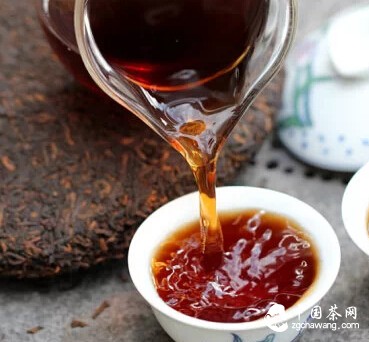
When pouring out the tea, it is recommended to use a fairness cup. This way, the color and flavor substances will recombine in the fairness cup. You will find that the tea soup from slow suspended pouring is very soft, sticky, but has almost no aroma.
After each infusion, it is recommended to drain the tea base completely. Leaving the tea soup in the pot for the next infusion may increase the number of infusions, but it will change the rhythm and coordination of the extraction of flavor substances, adding many variables to the brewing.
5. Middle three to five infusions: Balance aroma and water, coordinated融合.
Basic method: Slowly spin the water, pour steadily. Do not pour forcefully. Only by controlling the water temperature and the relative movement of water and tea at a reasonable level can we balance aroma and water and achieve coordination. In the picture below, the left is the tea soup from the fourth infusion, pouring forcefully while spinning, with a 4-second pour and 26-second steep; the right is the tea soup from the third infusion of the same tea, pouring slowly and steadily while spinning, with a 9-second pour and 21-second steep. It can be clearly seen that the left tea soup is dark, dull, and cloudy, while the right is light, bright, and clear. The difference is enormous, almost unbelievable that it is the same tea, only by adjusting the pouring technique.
Therefore, spinning steadily, though simple to say, is quite a technical skill. For a general reference, you can look at the technique shown in point 6 of the third section above. But in actual tea brewing, how to spin? How fast? How thick is the water stream? How high is the pouring point? All these require the brewer to adjust according to the tea's character and the drinker's taste preferences.
6. Last three infusions: High aroma, smooth water, sweet but light flavor.
Basic method: Pour rapidly and forcefully, maintain a high temperature in the leaves. The pour can be high or low, fixed-point or spinning. The important thing is to impact and tumble the leaves while maintaining a high water temperature to fully stimulate the aged aroma.
When the tea reaches the tail infusions, to extract more substances and enhance the aged aroma, we need to increase the steeping water temperature. At this point, contrary to the initial stage, we not only keep the lid on to avoid cooling and dispersing aromas, but also pour water immediately after pouring out the tea to maintain the high temperature of the steeped leaves. A purple clay pot, due to its poor thermal conductivity, has a natural advantage in maintaining leaf temperature. A gaiwan, however, cools very quickly, so the following sequence of actions is used: Start heating the water when preparing to pour out the tea → Start pouring out the tea when the water is about to boil → After the tea is completely poured out, first pour water into the gaiwan for the next infusion → After steeping, then pick up the fairness cup to distribute the tea.
This is the technique mentioned in point 5 of the third section above.
7. During the entire brewing process, do not shake, stir, or move the leaves. Doing so will make the tea soup cloudy and may also make the flavor weak and watery. Similarly, keep the water stream steady at all times. Even when pouring forcefully, keep the stream smooth and even.
V. Additional remarks.
Tea makers emphasize looking at the tea to determine the processing method; tea drinkers similarly emphasize looking at the tea to determine the brewing method. Using the same technique to brew from white tea to dark tea, from the first infusion to the last, cannot produce a beautifully coordinated tea soup, and it could be said to "waste good tea." Adapt to the situation, seek harmony. Focus on the big picture while letting go of minor details, and target your efforts accordingly. Continuously observe and adjust according to the actual situation—this is the true nature of a tea person.
A calm state of mind brings gentle movements, and gentle movements bring a harmonious flavor. The deliberation and practice of tea brewing movements are like a form of修行 (cultivation), which helps the brewer achieve a good state of mind, and then bring forth good tea soup. The way of tea (Chadao), using tea to enter the Way. This article is just a rough stone to attract jade, hoping to exchange ideas and make progress together with fellow tea enthusiasts.