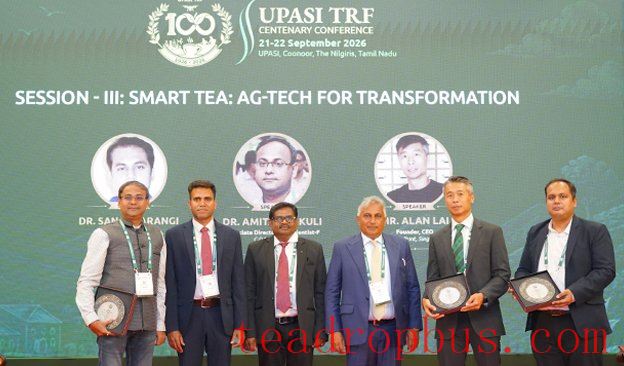
For the first time, digital grading tools helped judge tea samples at the Golden Leaf India Awards. Photo credit: Profile Print
Few things in tea feel as personal as a taster’s palate. Generations of experience stand behind every grade, so the idea of software joining the tasting table understandably raises concern. Yet the conversation is moving from replacement to collaboration. Singapore-based ProfilePrint, led by founder Alan Lai, applies AI to a famously subjective craft, and its recent role at an Indian competition offers a glimpse of how objectivity and artistry might coexist. The more useful question is no longer whether machines can outperform experts, but what each does best.
How AI Tea Grading Works
ProfilePrint captures a tea sample’s molecular fingerprint and applies models trained on experienced professionals' grading standards. It predicts the attributes tasters already score: dry-leaf appearance, infused-leaf appearance, color, strength, taste, and briskness, mirroring United Planters’ Association of South India’s (UPASI) objective scoring system. Experienced tasters remain essential for context and nuance.
In an interview with STiR Coffee and Tea, Lai stated, “The future of tea tasting is not human versus AI. The master taster remains the source of the standard; AI allows that standard to be preserved, repeated consistently, and applied at a scale that would otherwise be impossible.”
Putting AI to the Test at UPASI
The UPASI Tea Research Foundation, celebrating 100 years in 2026, worked with ProfilePrint from April to June to train models on its own grading standards for CTC and Orthodox teas. Blind-sample validation produced mean absolute errors of roughly 0.26 to 0.37 points on a 10-point scale, according to UPASI and ProfilePrint. ProfilePrint believes the Coonoor competition was a first for tea.
“What happened at the Golden Leaf India Awards was significant because AI moved out of the laboratory and into the actual judging room,” Lai explained. “It helped screen the entries and then evaluated the finalists alongside experienced tea professionals using the same grading framework. That is when technology stops being a concept and becomes part of the industry’s workflow.” This is the first tea competition to use AI this way.
Digital Quality Standards for Tea
Today, tea quality often depends on physical samples moving between producers, brokers, traders, and buyers. Digitized standards could give producers an early read at source and let buyers shortlist before ordering samples, with gains for logistics, waste, and traceability. ProfilePrint is deployed at more than 80 locations on six continents and is exploring wider digital tea standards with UPASI.
“People often ask what the future of AI in tea will look like,” said Lai. “My answer is: the future is already here. The next step is not simply faster tasting; it is creating trusted digital quality standards that can travel across the supply chain, from the estate and factory to the auctioneer, trader, and buyer, so that quality can be understood earlier, samples can move less, and experts can focus their time where human judgment matters most.”
The tea table is unlikely to lose its tasters. What is changing is the information that surrounds them. As digital grading matures, it offers a consistent baseline that sharpens decisions without removing the human palate that gave rise to the standards in the first place. For estates, auctioneers, and buyers, the practical question is no longer whether to choose between machine and master, but how to design workflows that give each a clear role. If the early results from Coonoor are any guide, the most credible future for tea quality is a shared one.