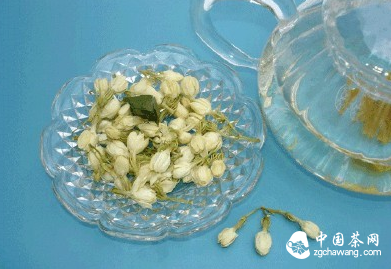
Beijing doesn't produce tea, but it's well-known that old Beijingers love drinking jasmine tea. Whether in winter or summer, rich or poor, the fragrance of jasmine tea always moistens the throats of old Beijingers. Years of tea-tasting habits have refined Beijingers' palates. The intermingling of jasmine's fragrance and tea aroma, rich and subtle, complex and lingering, solidifies old Beijingers' fragrant memory of jasmine tea. Before September arrives, new jasmine tea has already begun being hyped, with industry terms like "Top-grade new jasmine tea for 100 yuan" and "Secret recipe process with seven scentings" flooding the streets. What exactly makes the best jasmine tea, and how is jasmine tea actually made?
● China's Six Major Tea Categories Don't Include Flower Tea
Chinese tea leaves are divided into six categories: white tea, green tea, black tea, yellow tea, oolong tea, and dark tea (pu'er tea). The jasmine tea we drink daily isn't among them. Simply put, jasmine tea is made by scenting green tea bases with jasmine flowers. Therefore, jasmine tea belongs under the green tea category.
Making premium jasmine tea requires carefully selecting tea bases, choosing high-quality roasted green tea as raw material. The highest quality jasmine tea bases are all premium green teas harvested before Qingming Festival, using "low-temperature slow roasting" to create tea bases that most easily absorb fragrance.
● Difference Between Jasmine Tea Bases and Green Tea
First, their production processes are the same, both requiring fixation, rolling, and roasting steps, which is why jasmine tea is categorized under green tea. Their main differences are in four aspects.
1. Commonly consumed green teas are mostly from Jiangsu and Zhejiang regions, while jasmine tea bases are mostly Fujian green teas. Because Fujian green teas have weaker freshness but are more mellow, making them easier to absorb floral scents.
2. Compared to green tea, tea bases have shorter rolling time. This makes the tea leaves looser and easier to absorb floral fragrance.
3. During roasting, the heat shouldn't be too strong.
4. Finished green tea has 7% water content, while tea bases have below 5%, leaving room for water absorption during scenting.
● How Much Jasmine is Needed to Scent One Pound of Tea
For the highest grade jasmine tea priced around 1000 yuan per pound, making 100 pounds requires 650-700 pounds of jasmine flowers for scenting. Using the best jasmine flowers from the summer heat for about eight to nine scenting cycles, these jasmine flowers must be picked at 3 PM on the same day, selecting buds that are about to bloom. When the flowers bloom around 7-8 PM, they begin mixing with tea bases for scenting. For jasmine tea priced above 300 yuan, making 100 pounds requires 400 pounds of jasmine flowers for scenting, with about seven scenting cycles. These flowers might not be summer flowers, and the flower quantity isn't as much.
Even the commonly mentioned 15 yuan per pound tea dust undergoes the same scenting process. However, tea dust is just the broken tea leaves sifted from regular jasmine tea. From this perspective, basically all正规 tea shops sell jasmine tea that's at least "seven scentings and one separation." Hype about scenting processes lacks quality basis.
● How Jasmine Tea is Made
While everyone loves jasmine tea, few know the complex process of making it.
First, selecting jasmine flowers and tea bases suitable for blending flower tea is arduous. Carefully choose jasmine flower buds about to bloom, with appropriate fragrance concentration and high freshness; tea bases are transported thousands of miles from Fujian, Zhejiang, Anhui等地 to places like Fuding and Heng County, all picked before Qingming or around Grain Rain. These teas suffer less pest damage and undergo strict inspection - failing any requirement disqualifies them as tea bases.
Good jasmine tea can be called artwork integrating tea beauty and floral fragrance. The key step is scenting and blending. Fresh flowers release fragrance, tea bases absorb it - eight releases and eight absorptions, uniting flowers and tea. Jasmine flowers decompose aromatic substances through enzymes, temperature, moisture, oxygen, etc., continuously releasing fragrance as physiological changes occur and flowers bloom. Tea base absorption happens through physical adsorption, simultaneously absorbing much moisture during fragrance absorption. Water penetration causes chemical adsorption, and under warm, humid conditions, complex chemical changes occur - tea soup gradually changes from green to yellow-bright, taste transforms from light-astringent to rich-mellow, forming jasmine tea's unique fragrance, color, and taste.
● Tea Fragrance Cannot Contain Any Smoky or Burnt Taste
Appearance-wise, jasmine tea materials should have good tenderness, with single buds being optimal, others include one bud one leaf, two leaves, or many tender buds. Shape should have tight, thin, even strips with beautiful appearance. After brewing, the lines are elegant like petals dancing in the cup; color should be tender green, yellow-green with good luster. After brewing, fragrance should be fresh, lingering, persistent; tea soup yellow-green bright; brewed leaves even, tender, soft. Fragrance-wise, jasmine tea should have rich, fresh, persistent aroma that withstands multiple brews. Unlike some jasmine teas with thin, non-persistent fragrance - fragrant in first brew but no scent in second brew, with low concentration. Taste-wise, jasmine tea should have mellow flavor, fresh and smooth when brewed, with no smoky, burnt, or other strange tastes in the tea fragrance - only jasmine's aroma and tea's fragrance remain between lips and teeth.
● Don't Hype the Scenting Process - Good Jasmine Tea Arrives in September
Truly good jasmine tea uses summer jasmine flowers for scenting, as summer jasmine has the best quality and strongest fragrance. Buds about to bloom must be picked during harvesting, and scenting only occurs when flowers bloom at night. Scenting timing relies entirely on technicians' experience. But measuring jasmine tea quality isn't just about scenting cycles - it's about what kind of jasmine flowers are used and flower quantity per scenting. Thousand-yuan-per-pound premium jasmine tea uses summer jasmine flowers in 1:9 ratio for scenting. The craftsmanship of truly good jasmine tea is extremely complex - the tea we drink is far more precious than imagined.