The three white teas in tea: Fuding White Tea, Anji White Tea, and Moonlight White. The concept of "three white teas" is most easily confused. The concept of "white tea" has two meanings: one refers to "white leaf tea" formed by chlorophyll variation, and the other refers to the "white tea category" among the six major tea classes. A brief description of the "three white teas" is as follows:
Fuding White Tea
Fuding White Tea, belonging to the white tea category, is mainly produced in the Fuding area of Fujian Province and is one of the six major tea classes. The production process of Fuding White Tea is meticulous, and the drying and firing are extremely difficult to master. According to different picking standards, it is divided into: Baihao Yinzhen, Baimudan, Gongmei, and Shoumei. Fuding White Tea is durable for storage, and the longer it is aged, the higher its medicinal and economic value.

Fuding White Tea: The buds are plump and covered with white hairs. The buds are shorter than those of Moonlight White and plumper than those of Anji White Tea.
The efficacy of Fuding White Tea includes protecting the heart, warming the stomach, detoxifying, relieving heat, breaking down fat, sobering up from alcohol, lowering blood sugar, and reducing liver fire. Zhou Lianggong's "Min Xiao Ji" from the Qing Dynasty records: "Baihao Yinzhen is produced in the Hongxue Cave of Taimu Mountain. It is cold in nature and has the same efficacy as rhinoceros horn. It is a holy medicine for treating measles." In the producing areas, it is customary to drink old white tea to relieve heat during midsummer. Fuding White Tea is rich in anthocyanins and tea polyphenols, which have the effects of eliminating free radicals and delaying aging. Fuding White Tea is commonly known as "women's tea" and is considered an internal cosmetic, with slimming and beautifying effects. White tea has a miraculous effect on reducing fever from colds, comparable to antibiotics. Particularly unique is that the polyphenols and esters in white tea can promote the synthesis of insulin, thus effectively preventing and assisting in the treatment of diabetes.
Yunnan Moonlight White
Moonlight White, also known as Moonlight Beauty, belongs to the Pu'er category and was newly created around 2005. It is mainly produced in the Simao area of Yunnan Province. Moonlight White first must be pan-fired (kill-green), and then air-dried. The finished tea leaves have a black surface and a white back, with white buds that are bright like a crescent moon, hence the name "Moonlight White," also known as "Moonlight Beauty." The production process of Moonlight White is similar to that of Fuding White Tea and is a characteristic tea among Pu'er teas. Its quality belongs to Yunnan Pu'er tea and is a distinctive tea within Pu'er. The orchid and honey fragrance of Moonlight White is similar to the aroma of oolong tea, and its taste ranges between raw Pu'er and oolong tea. Moonlight White should not be stored for too long, generally 2-5 years, as its aroma will gradually weaken with storage.

Yunnan Moonlight White: The buds are slender, resembling a beauty. Compared to Fuding White Tea, the buds are slightly longer and have slightly fewer hairs than Fuding White Tea.
The efficacy of Moonlight White tea includes cooling, reducing internal heat, eliminating acne, regulating endocrine, and unblocking meridians. Additionally, this tea has more prominent effects on beautifying and moisturizing the skin, and reducing fat and weight loss. The tea polyphenols, lipopolysaccharides, amino acids, and caffeine it contains can not only reduce weight but also decrease cholesterol and triglycerides. The alcohol acid contained in Moonlight White can make the skin dense and reduce wrinkles.
Anji White Tea
Anji White Tea belongs to the white leaf tea category; its quality is green tea, not the white tea category. It is a white leaf tea processed with green tea techniques. Produced in Anji County, Zhejiang Province, the tea leaves of Anji White Tea are air-dried, then heated for kill-green, and finally dried. After brewing, Anji White Tea has green stems and white leaves, yellowish tea soup, and a fresh, rich aroma. Anji White Tea is rich in amino acids and nutrients. Anji White Tea has beautifying effects and is elegantly named "Beauty Tea." The shelf life of Anji White Tea, if properly stored, is about 18 months.
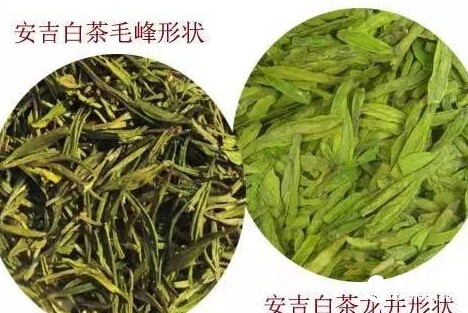
Anji White Tea: The strips are straight and the buds are thin, evenly fresh green. The buds and strips have no hairs, which is different from Fuding White Tea and Yunnan Moonlight White.
The efficacy of Anji White Tea includes GABA (aminobutyric acid), which can lower blood pressure, blood lipids, and blood sugar. Tea polyphenols can prevent cancer and fight cancer. Tea tannins can increase blood vessel toughness, making blood vessels less likely to rupture. Tannic acid has a bactericidal effect and effectively prevents oral odor. Diphenylamine can protect the liver and stomach. Fatty acids can remove fat, relieve greasiness, and slim and beautify the skin.