Tea enthusiasts have long inquired about the differences between Purple Jade and Purple Bud Pu'er. Honestly, I didn't understand them clearly at first either, until I specifically consulted professors from tea colleges to resolve my doubts, gradually distinguishing them clearly. Today, let's详细了解the differences between Purple Bud and Purple Jade.
The biggest difference between Purple Bud Pu'er Tea and Purple Jade tea simply put is: Purple Bud results from genetic mutation caused by climate and seasonal changes, occurring naturally. Purple Jade, however, is artificially bred and domesticated.
Traditional Purple Bud refers to mutated buds in large-leaf ancient arbor trees due to seasons and origin. Few trees in a tea forest exhibit purple buds, and even on a single ancient tree, purple buds are scarce. In Simao's large-leaf tea varieties, because some ethnic minorities use tea seeds for seedlings, tea tree mutations occurred, giving rise to Pu'er Purple Bud tea.
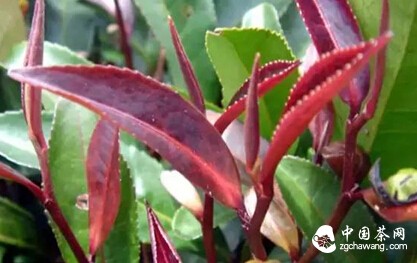
This tea was previously often cut down by farmers because its color was different. Purple buds, purple leaves, and purple stems affect the production and appearance of Green Tea, thus hindering the development of Purple Bud tea.
Precisely because Purple Bud tea belongs to ancient arbors, i.e., old tree tea, the picking cost is relatively high, and the yield is very scarce. Rarity adds value, therefore, in the eyes of many tea industry insiders, it is the preferred collectible.
The formation and accumulation of purple bud leaves are closely related to the growth state of the tea tree and environmental conditions. Stronger light and other natural conditions can increase anthocyanin content, causing the tea tree buds and leaves to appear purplish-red. Among the native mutant species, there is a type where the bud head is purple, usually up to the third leaf are purple, after which the mature leaves revert to dark green.
Purple Jade originates from the Yunnan large-leaf population variety. In 1985, a mutant individual tea plant was discovered among 600,000 plants of the Yunnan large-leaf population variety tea garden at the Tea Research Institute of Yunnan Academy of Agricultural Sciences. The buds, leaves, and stems of this tea plant were all purple. The roasted green tea processed from its fresh leaves had purple dry tea leaves and purple soup color, with a pure aroma and strong taste. Experts began using it as base material in 1986, employing the single plant selection method through multiple generations of breeding, forming a new tea plant variety. Because the tender shoots of this tea plant have purple buds, leaves, and stems, and the processed roasted green tea has both dry leaves and tea soup that are purple, it was specifically named 'Purple Jade'.
The main characteristics of the Purple Jade variety are: relatively high bitterness and astringency. Its tender shoots' buds, leaves, and stems are all purple. The dry leaves of the green tea are purplish-black, and the soup color is purple. The 'Purple Jade' plant is relatively tall, small arborescent type, large leaf category, medium bud species. Tree posture semi-open, branching location relatively high, branching density medium, leaf color green, leaf shape willow-leaf shaped, tender shoots' buds, leaves, and stems are all purple, buds and leaves relatively plump and strong, many fine hairs, strong bud nurturing ability, medium sprouting density. 'Purple Jade' is suitable for planting in areas with altitude 1000---2000 meters, annual average temperature 15 degrees Celsius, absolute minimum temperature above minus 5 degrees Celsius, suitable for planting Yunnan large-leaf tea. It prefers warm, humid climate and fertile soil, suitable soil PH value between 4.5----5.5.
Purple Jade tea tree spring bud germination period is in late February, late March -- early April is the peak period for one bud and three leaves. Strong bud nurturing ability, medium sprouting density, purple buds and leaves, relatively plump and strong, many fine hairs, strong tenderness retention. The weight of 100 buds with one bud and three leaves is 115 grams. The roasted green tea processed from Purple Jade tea tree fresh leaves has tight, thin, and long strips, purplish-black color, possesses a special herbal medicine aroma, and purple soup color. In 1991, the Yunnan Institute of Materia Medica conducted multiple blood pressure lowering experiments using household cats weighing 2.5----3.5kg. The results showed that the blood pressure lowering幅度of Purple Jade roasted green tea was 35.53%, better than Yunnan large-leaf roasted green tea (29.04%). Currently, based on the development of Purple Jade blood pressure lowering Health Tea, the Yunnan Tea Research Institute is increasing the propagation of the Purple Jade tea plant variety and expects to develop and utilize it in areas such as weight loss and blood sugar reduction.
Among the group's original mutant species, there is a type where the bud head is purple, usually up to the third leaf are purple, after which the mature leaves revert to dark green. Local farmers in the Menghai area call it Purple Bud. Purple Bud tea is named according to the color characteristics of the tender bud leaves used as raw material. It is the finished or semi-finished product formed after processing the tea leaves picked from tea trees whose tender buds and leaves are purple.
Purple Bud Pu'er tea was a tribute item in ancient times, a variant of the tea plant. This product uses tea trees with ages between 500----1400 years. The tea plant variety is unique, and the quantity is small. Harvested only once a year, refined according to traditional工艺. Modern research has proven that Purple Bud tea contains rare blood-purifying factors, not only possessing the traditional health benefits of Pu'er tea but also particularly highlighting the effects of softening blood vessels and purifying blood. Purple Bud tea also has a very good blood pressure-lowering effect, with a reduction幅度of 35.53%. After drinking this tea, blood pressure can remain stable for up to 20 hours. The anthocyanins contained in Purple Bud tea have good effects for weight loss, anti-aging, and radiation protection. Its soup is clear and bright, with a honey-like aroma that pleases the senses. The anthocyanin content in Purple Bud tea is much higher than in normal buds and leaves. Anthocyanin is a component of tea polyphenols. Its formation and accumulation are closely related to the growth state of the tea tree and environmental conditions. Stronger light and other natural conditions can increase its content, causing the tea tree buds and leaves to appear purplish-red. Purple tea contains higher levels of ester-type catechins than ordinary tea trees, so the sun-dried raw tea produced has a stronger bitter and astringent taste,褐green soup color, and indigo blue leaf bottom. Although the taste is more bitter and astringent, scientific research shows that the anthocyanins contained in Purple Bud tea are very beneficial to human physiological health. Anthocyanin is a water-soluble plant pigment belonging to the flavonoid compounds. In the United States, anthocyanins are also used in health products for their保健functions of weight loss, anti-aging, and anti-radiation, making it a good health beverage for people who work in front of computers for long periods.
Purple Jade is an improved variety. Its aroma is pronounced, while the taste is somewhat light with明显的bitterness. There is a gap compared to the original species Purple Bud, but many people mistake it for Purple Bud. The tea plant is prone to genetic variation. As long as it is pollinated and produces seedlings from seeds, it usually容易mutates. Among the group's original mutant species, there is a type where the bud head is purple, usually up to the third leaf are purple, after which the mature leaves revert to dark green. Farmers in the Menghai area call it Purple Bud.
The biggest difference between Purple Jade and Purple Bud lies in the leaf shape and venation. Purple Jade is a small to medium leaf species, with dark green and deep leaf color, prominent veins similar to cultivated wild tea. Additionally, the raw tea soup of Purple Jade is purple, with a thin texture and明显的bitterness; the raw tea soup of Purple Bud is golden yellow, with a厚重texture, full and饱满taste, sufficient aftertaste, and tea quality介于cultivated wild tea and wild-grown tea.