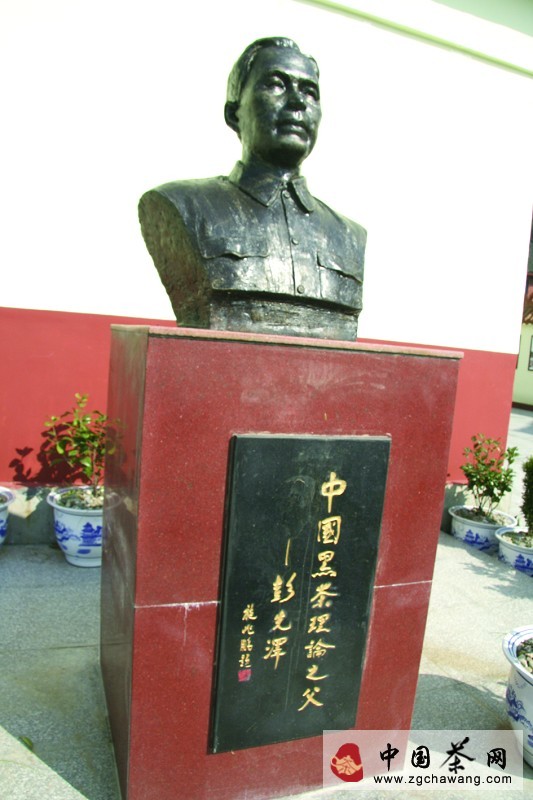
Peng Xianze (1902-1951) was from Xiao'yan, Anhua. He attended Changjun High School and later graduated from Jining Middle School in Shandong. In 1919, he studied in Japan for eight years at Tokyo Imperial University's Agricultural Science Practical Department and Agricultural Science Undergraduate Department, focusing on rice research and conducting investigations in Korea.
He returned to China in 1927 and taught for eight years at institutions including the Agriculture Department of Changsha Xiuye School, Jiangsu Huaiyin Agricultural School, and Zhejiang University College of Agriculture (as a professor). His compiled work 'Rice Cultivation' was included as one of the university series published by Zhejiang University and The Commercial Press.
After the outbreak of the War of Resistance Against Japan, he left Zhejiang for Hunan, serving as Deputy Director of the Hunan Tea Management Office. He was responsible for tea loans, supervising production, purchasing, transportation, sales, and export settlement. Concurrently, he held positions as Director of the Tea Crops Group at the Provincial Agricultural Improvement Department, Director of the Tea Department at Xiuye Agricultural School, and Director of the Anhua Tea Farm. From 1944 to 1946, he also served as a professor at Keqiang College.
During the war, with transportation cut off, brick tea was scarce in the northwest market, leading to a large surplus of Anhua dark tea. Peng Xianze twice detoured through Guizhou and Sichuan to reach Qinghai and Gansu, exploring new routes for tea transportation north and negotiating tea sales with northwestern provinces. After this long journey, he extensively researched the issue of pressing Anhua dark tea into bricks, formulated specific plans, and strongly advocated for establishing a brick tea pressing factory in Anhua. In December 1939, the proposal passed the provincial government standing committee. He then raised funds, purchased raw materials, customized brick presses in Xiangtan, selected Jiangnanping as the factory site, and prepared for pressing technology and equipment installation.
For centuries, most Anhua dark tea could only be used as raw material, shipped to Jingyang, Shaanxi, to be pressed into bricks for the northwest market. Pressing bricks in Anhua was considered impossible for three reasons: unsuitable water quality in Anhua, lack of technology, and the humid climate causing mold. After scientific research, Peng published an article titled 'Refuting the Claim that Bricks Cannot Be Pressed in Anhua' in newspapers, garnering widespread attention. In March 1940, he oversaw the trial production of brick tea. After repeated experiments, success was finally achieved. Sample bricks were sent to the China Tea Company in Chongqing for inspection and were deemed 'suitable for Soviet trade.' The first batch of 2000 cases was produced. Subsequent inspection by the Hengyang Branch of the Commodity Inspection Bureau under the Ministry of Economic Affairs confirmed that 'the moisture and ash content of the brick tea comply with legal standards,' and an export certificate was issued.
The successful trial production of Anhua dark tea bricks ended the long-standing pattern where dark tea was produced in Anhua but pressed into bricks in Jingyang. In 1941, to develop barter trade with the Soviet Union, brick tea production was placed under the leadership of the Construction Department, and the factory was renamed 'Hunan Brick Tea Factory.' Peng continued as factory director and leased 'Dehe Yunji Tea Firm' to establish a branch factory in Taoyuan to expand production. In July of the same year, the first batch of 100,000 brick tea pieces arrived in Lanzhou, receiving positive feedback from all sides. From then on, Anhua dark tea bricks sold well in northwestern provinces.
In 1942, through a joint venture between the China Tea Company and the Hunan Provincial Government, it was renamed 'State-Owned China Tea Company Hunan Brick Tea Factory.' Peng remained in charge of factory operations. With raised capital of 3 million yuan, the factory expanded to 9 tea firms and 12 workshops. The number of presses increased from 6 to 50. Many graduates from the Tea Science Department of Fudan University and the Tea Department of Xiuye Agricultural School were hired to strengthen technical capabilities. In October, the Youzhou branch factory was added for large-scale brick tea pressing. From 1940 to 1949, a total of 6,666,300 pieces of brick tea were produced, benefiting the Anhua tea region during and after the war.
During the difficult years of the War of Resistance Against Japan, Peng Xianze devoted nearly a decade to the research, development, and management of dark tea bricks. From theoretical exploration to technical improvements, packaging design to tool innovation, staff training to market development, he endured hardships and persistently pursued his goals—his spirit was truly commendable. To open up the northwest market and survey transportation routes, he traveled to Lanzhou twice in 1941 and 1944 for on-site investigations, signing supply contracts with representatives from Gansu, Mongolia, and the Soviet Union. He wrote 'A Journey of Ten Thousand Miles to the Northwest,' published in the quarterly 'Hunan Brick Tea.' By 1948, he had published works such as 'Introduction to Tea,' 'Tea Administration,' 'Anhua Dark Tea,' and 'Anhua Dark Brick Tea,' and edited publications like 'Furong Monthly,' 'Xiang Tea,' and 'Anhua Tea Company Series.' He was the first to explore both the theory and practice of dark tea, making significant contributions to the development of Hunan's tea industry.
After the founding of the People's Republic of China, Peng Xianze served as the first director of the Anhua Brick Tea Factory. In March 1951, Mr. Peng Xianze was unfortunately and wrongly executed as a capitalist in Baishaxi, Anhua, at the age of 49. He was not rehabilitated until July 1983.