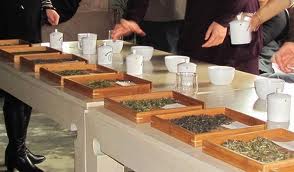
Tea sensory evaluation is the work of judging the color, aroma, taste, and shape of tea leaves through human sensory organs such as smell, taste, vision, and touch to determine their quality, grade, and value. Therefore, it requires evaluators to have keen sensory organs and strong discernment. Currently, the grading, classification, and pricing of tea worldwide still rely primarily on sensory evaluation. Physicochemical analysis can only serve as a reference during sensory assessment and cannot be the basis for determining tea grade or price. Thus, a tea evaluator should regard themselves as an 'instrument' for testing tea quality, taking care in daily life to maintain this 'instrument' and keep their visual, olfactory, and gustatory senses highly sensitive. Tea sensory evaluation is a technically demanding task. In addition to requiring sharp discernment and rich practical experience, it also necessitates a proper tasting environment, standardized tasting utensils, and a scientific, feasible evaluation procedure to minimize external influences and achieve accurate results.
I. Environmental and Facility Requirements for Tea Sensory Evaluation Rooms
The tea sensory evaluation environment includes both indoor and outdoor conditions, with strict requirements for the room's orientation, natural light collection, and atmospheric environment. Additionally, there are strict, unified standards for tea tasting tables, evaluation utensils, and water used for tasting.
(I) Environmental Requirements for Tea Sensory Evaluation Rooms
1. External Environmental Conditions
Tea sensory evaluation rooms should be established in quiet, fresh-air areas away from noisy urban settings to avoid the impact of嘈杂的环境 and污浊的空气 on the sensitivity of evaluators' sensory organs.
2. Indoor Environmental Conditions
The sensory evaluation room should be free of杂气味, quiet, tidy, and maintained at a comfortable temperature and humidity. The room must have充足明亮,均匀一致 lighting. Walls and ceilings should be painted white to create柔和明亮光线.
The evaluation room should have windows facing north (背南面北), with no obstacles outside blocking light. Avoid direct强光直射 to maintain stable lighting conditions.
(II) Facility Requirements for Tea Sensory Evaluation Rooms
Facilities in the evaluation room should be simple and practical. Typically, it includes equipment such as tea tasting tables and sample tea cabinets.
1. Tea Tasting Tables
Tea tasting tables are divided into dry evaluation tables and wet evaluation tables.
The dry evaluation table is for assessing the dry leaf appearance. It is generally 900 mm high, 600 mm wide, with length as needed. The surface is painted a non-reflective black and placed near the north-facing window.
The wet evaluation table is for assessing the infused liquor (infusion). It is generally 850 mm high, 450 mm wide, 1500 mm long. The surface is painted a non-reflective乳白色 and placed approximately 1000 mm behind the dry evaluation table.
2. Sample Tea Cabinets/Shelves
Tea evaluation utensils should be专用品 with consistent specifications to minimize objective errors. Common utensils include:
(1) Evaluation Cups and Bowls. Made of纯白瓷, with consistent thickness, size, and color for cups and bowls.
1. Evaluation cup and bowl for红,绿,黄,White Tea毛茶. Cup: height 73 mm, outer diameter 75 mm, inner diameter 71 mm, capacity 200 ml. The lid has a small hole. The rim opposite the handle has a锯齿形 or月牙形缺口,中心深3 mm,方便沥出茶汤 into the bowl. Bowl: height 58 mm, top outer diameter 98 mm, inner diameter 94 mm, capacity 200 ml.
2. Evaluation cup and bowl for红,绿,黄,白茶成品茶及花茶. Cup: height 65 mm, outer diameter 66 mm, inner diameter 62 mm, capacity 150 ml. The lid has a small hole. The rim opposite the handle has a锯齿形缺口,中心深3 mm. Bowl: height 58 mm, top outer diameter 98 mm, inner diameter 94 mm, capacity 200 ml.
(2) Tea Tasting Trays.
1. Square tray made of odorless wood or plywood. Outer edge 240 mm, inner edge 230 mm, side height 33 mm. One corner has a缺口 for pouring tea. Painted non-reflective乳白色.
2. Sample Dividing Tray. Made of wood or plywood, square. Inner edge 320 mm, side height 35 mm. Opposite corners have缺口. Painted non-reflective乳白色.
3. Sample Tea Baskets. Woven bamboo, round, diameter 500 mm, side height 40 mm.
4. Infused Leaf (叶底) Trays. Small black wooden trays or white enamel trays. Wooden tray: square, 100 mm side, 15 mm height. Enamel tray: rectangular, 200 mm long, 130 mm wide, 20 mm high. Generally used for examining毛茶叶底.
Tea tasting trays and baskets should be numbered sequentially.
4. Water Requirements for Tea Evaluation
The quality of water used significantly impacts the汤色,香气, and滋味 of tea. Poor water quality can adversely affect the aroma, taste, and liquor color.
(1) Water Selection. Any fresh rainwater, tap water, well water, or surface water meeting the following conditions can be used for evaluation.
1. Physicochemical and卫生指标 must comply with中华人民共和国GB5149 〈生活饮用水卫生标准〉. A PH between 5.5-6.5 is preferable.
2. Water should be colorless, transparent, free of沉淀, and不含杂质.
3. Deep well water, natural mineral water, purified water, and flowing stream water are generally better for tea evaluation.
4.普通自来水 can be treated with methods like filtration to remove impurities like铁锈 and improve purity.
(2) Water Temperature. Water for brewing tea should be boiling at 100°C and used immediately upon reaching a rolling boil. Using water that has been boiled for too long or re-boiled water from a thermos can affect the freshness of the茶汤滋味. Using water that is not fully boiled will not maximize the extraction of water-soluble compounds from the tea, affecting the accuracy of aroma and taste assessment.