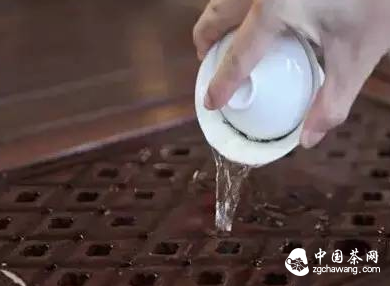
There is a common phenomenon: when brewing tea, people pour out the first infusion with a "swish—" as if it has become a habit. Next, Alliance Jun will comprehensively analyze the first infusion for you, telling you that "discarding the first infusion" is actually a big lie in the tea world.
 Claim One:
The first infusion can wash away pesticide residues.
Due to the特殊性 of tea leaves, they cannot be washed like fruits and vegetables, so many tea friends use the first infusion to "wash" pesticide residues. However, most pesticides are脂溶性 substances, and hot water can only dissolve and dilute a very small amount. It is simply impossible to wash away pesticide residues with just the first infusion. If you are still "obsessed" with pesticide residues, the only suggestion is to buy organic tea.
Claim Two:
The first infusion doesn't taste good anyway, so it's fine to discard it.
This statement mainly refers to the first infusion from the perspective of "warming and rinsing," believing that the "warming infusion" does not reach the optimal drinking口感, so it doesn't matter to discard it. This practice is not agreed with because the maximum析出 of beneficial substances in tea occurs in the first infusion, especially for green tea. I once saw someone brewing Junshan Yinzhen and discarding the first infusion just because there were fine hairs in the tea soup, which was a great pity because that is the most stunning infusion in the茶汤 of this famous yellow tea.
Claim Three:
The first infusion is used to wash away impurities and dust.
This statement is, of course, aimed at teas that have been stored for a certain period. The first infusion does indeed have a rinsing function, and it doesn't have to be drunk, but calling it "the useless infusion" is somewhat biased because, as the first infusion, it contains a lot of quality information about the tea, making it highly expressive.
For example: if you taste a faint dust味 or异味 (like a rotten vegetable smell or sandalwood smell) after sipping the first infusion, it indicates that the tea's storage space was not clean or hygienic enough; if you taste a burnt味, it means there were工艺 problems during the tea's production, such as over-roasting or scorching; if you taste a slight霉味, it means the tea was exposed to some moisture during storage; if there are broken tea leaves and渣 floating in the tea soup, it indicates a lower原料 grade or poor tea-breaking skills... Someone once jokingly called the first infusion the "black box" of Pu'er tea, containing much information that merchants are unwilling to tell you. So next time you buy Pu'er tea, perhaps take a small sip of the first infusion and carefully品味 any abnormal flavors. This method works very well.
Who taught us to start rinsing the first infusion?
So where did this concept of "no matter what, you have to rinse the first infusion before brewing tea" come from?
First: It can be said to be people's erroneous perception of tea cleanliness. In ancient times, due to low technical conditions in production processes and transportation over long distances, a very small number of teas did indeed have cleanliness issues. However,发展到 today, as long as tea is produced according to national standards, there are basically no hygiene problems. Think from another angle: if tea is dirty, should we also wash coffee grounds before drinking coffee or boil红酒 before drinking wine? It is said that traditional红酒 production工序 even requires stepping on grapes with feet. Are there dirty teas? Yes! But as long as the tea is produced by standard manufacturers, hygiene issues generally do not exist.
Second: Believing that the first infusion can wash away pesticide residues, as mentioned earlier.
Third: The amplification by some unprofessional tea ceremony performers. During performances, to complete the entire steps and process of tea brewing, they almost always demonstrate the first infusion,无形之中 amplifying and升华 its role. Thus, people imitate the performers' methods for brewing tea, losing the ability to "analyze specific situations specifically."
Finally: Sales techniques by merchants. As mentioned earlier, the first infusion often contains much information about the tea's condition, especially for耐泡 teas like Pu'er. Therefore, to allow you to taste the "best汤感," many merchants rinse the first infusion, some even rinsing 2, 3, or even 4 times. Over time, everyone thinks this is the correct step in brewing tea, but it is actually the merchants' action of rinsing away unfavorable information about the tea.
Summary: The first infusion is not as complicated as you think. Regarding the first infusion, teas can actually be简单 divided into three categories.
Category One: Teas in their natural state or with较低做型程度
Here, "natural state" refers to tea products presented in their own form, like花茶 and white tea; "teas with较小做型程度" refers to most green teas, black teas, and yellow teas. For them, you drink the tea's own flavor, so there is no need to discard the first infusion. Especially for some famous green teas, the most beautiful aroma and freshness of the tea leaves are all in the first infusion.
Category Two: Teas with较高做型程度
For example,球形乌龙 or teas like Pu'er,沱茶,砖茶, etc. Due to their special shapes, the tea leaves undergo a "slow舒展" process during steeping. Therefore, the first infusion is often used to温润 the tea leaves, and this infusion is completely drinkable. It's just that in formal settings, since the tea soup has not reached its optimal drinking state, the温润泡 is not served to guests.
Category Three: Teas with陈化时间
This category refers to aged teas represented by Pu'er tea. The first infusion often serves as a "warming" function and, more importantly, an "awakening" function. For teas with storage issues, many people rinse multiple times in an attempt to掩盖 the negative effects of storage. Therefore, as mentioned earlier, in such cases, it is not recommended to drink the first infusion. However, you can assess its "health" status by smelling the dry leaves, observing the color of the first infusion茶汤, smelling its aroma, or even taking a small sip and spitting it out.