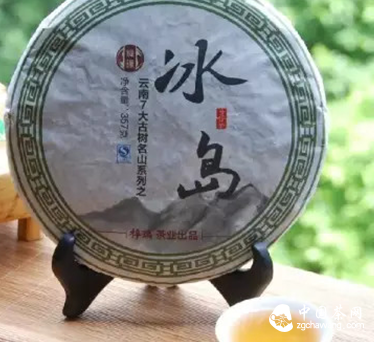
The deeper one loves ancient tree tea, the deeper the understanding becomes.
Appearance Description:
The old tea trees in Bingdao (Ice Island) village grow luxuriantly, with stout branches, leaves, and buds. The largest leaves sprouting from the tree base are even larger than a palm (22 cm long, 9.5 cm wide). This is typical Mengku large-leaf arbor tea, featuring long, large leaves in a dark green color. The leaf texture is thick, soft, and fleshy, with a raised back and prominent veins. Another major characteristic of ancient tree tea is its strong tenderness retention; the buds and leaves remain plump and substantial. Even one bud with four leaves stays tender, unlike some improved varieties where one bud with two leaves already appears old (with hard leaves and stems). Most old tea trees in Bingdao village are lush and green, aged yet vibrant, not frail. The fresh leaves are not as hard and brittle as those from many new tea gardens. The dry tea strips are thick, and the buds are stout.
Ice Island Style:
Strips: Dry tea has thick strips and stout buds. Liquor Color: The tea soup is golden and translucent. Aroma: The fragrance is lifting, rich, and high-pitched. Sweet Aftertaste: Persistent and long-lasting. A noticeable sensation is felt from both cheeks, gums, to the tongue root, throat. Texture: The "water path" (shui lu) is delicate. Tea Rhyme: Gentle yet carries strength. Taste: Very low astringency and bitterness, a full-bodied taste, thick and substantial soup, rich in content. Strong penetrating power, evident tension, with a particularly pleasant refreshing sensation. Throat Rhyme: The rhyme permeates, sweetness lingers, saliva is generated, creating an unwillingness to be disturbed. Saliva Production: Continuous saliva production in both cheeks, feeling like two small streams. Brewing Endurance: Relatively resistant to multiple infusions. Spent Leaves: Yellow-green and bright, with clear strips.
Overall Tasting Experience:
Upon entry, the bitterness and astringency are extremely low, almost imperceptible. A faint coolness gradually emerges in the throat area. Saliva continuously produces in both cheeks, feeling like two small streams, slowly transforming into saliva production in the middle and rear parts of the tongue and cheeks. Initially, almost no tea taste is perceived upon entry; the tea flavor gradually extends from the throat to the entire mouth. The saliva-inducing effect is明显 and持久, mainly集中在 the cheek areas. The tea soup has a sugary aroma, high concentration (fullness), with a high fragrance on the lid and bottom of the cup. After the cup cools, a hint of rock sugar aroma can be detected.
The fragrance is elegant and lingering. The taste is substantial, with little astringency and light bitterness that dissipates instantly on the tip of the tongue. Saliva production is particularly fast, even faster than in Ban Zhang tea. The aroma is very special among Pu-erh teas, very pure, with a slight honey fragrance.
Ice Island tea truly lives up to its name; it's like drinking a cup of ice water—very平淡 at first, but then the entire mouth fills with a cool tea flavor. The sweet aftertaste lingers at the tongue root, and saliva continuously produces in both cheeks.
Authentic Ice Island tea carries a distinct rock sugar flavor. Without this flavor, no matter how good it tastes, it is not Ice Island tea.
Counterfeit Ice Island tea lacks the sweet aftertaste and the continuous sensation of saliva production in the cheeks. While the high aroma of Ice Island can be imitated, the unique effects of genuine Ice Island's saliva production and sweet aftertaste, as well as its extremely low bitterness and astringency, cannot be replicated.
In Ice Island, it is customary to use tea seeds to培育实生苗 for developing tea gardens.