Where is "Pre-Qingming Tea" produced?
Many people vaguely believe that Pre-Qingming Tea is tea picked and produced on the Qingming Festival. Actually, that's not the case. Pre-Qingming Tea is a term used in the Jiangnan tea region along the Yangtze River basin in China, referring to spring tea picked according to the solar term. It mainly includes areas such as Zhejiang, Hunan, Jiangxi, southern Anhui, southern Jiangsu, and southern Hubei. The main categories of Pre-Qingming Tea are green tea and a small amount of red tea, while teas like Tieguanyin, Dahongpao, and Pu'er do not have a Pre-Qingming version.
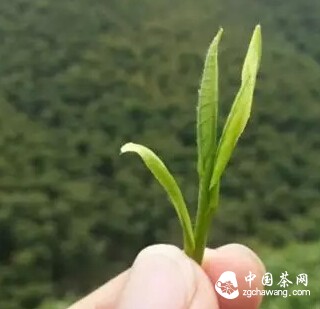
The Value of "Pre-Qingming Tea"
The distribution of tea-producing regions in China can be divided into the Southwest Tea Region (including Guizhou, Yunnan, Sichuan), the South China Tea Region (including Guangdong, Guangxi, Fujian, Taiwan, Hainan, etc.), the North China Tea Region (including Henan, Shaanxi, Gansu, Shandong, and northern Anhui, northern Jiangsu, northern Hubei, etc.), and the Jiangnan Tea Region. Among them, the Jiangnan Tea Region is the main tea-producing area in China, with an annual output accounting for about two-thirds of the national total. Some traditional Chinese famous teas like West Lake Longjing, Dongting Biluochun, and Huangshan Maofeng are all produced in this region.
From this perspective, consumers can easily identify Pre-Qingming Tea. Its main producing area is the Jiangnan Tea Region. Spring tea from regions like Yunnan, Guizhou, Sichuan, Guangxi, Fujian, and Hainan, even if picked before Qingming, cannot be called Pre-Qingming Tea. This is because most areas in the Southwest and South China Tea Regions are located in southern China, where temperatures rise early in spring. Tea picking often starts around the traditional Chinese Spring Festival, and by Qingming, picking has been ongoing for nearly two months. In the North China Tea Region, due to climate reasons (e.g., Henan, Shandong), tea picking often starts after Qingming, so there is no Pre-Qingming Tea there either. Similarly, "Pre-Rain Tea" refers to tea picked in the Jiangnan Tea Region after Qingming and before Grain Rain.
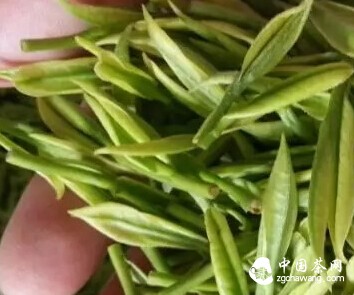
Why is "Pre-Qingming Tea" Expensive? Where Does Its Value Lie?
Rarity Makes It Precious:
In the Jiangnan tea region, temperatures are generally low before Qingming. Tea bushes usually begin to sprout around the "Spring Equinox" and picking starts before "Qingming." Due to limited sprouting and slow growth rate, the yield meeting picking standards is very low. Typically, a very skilled tea picker can only pick half a jin (250g) of fresh leaves per day. It takes 4 jin of fresh leaves to make 1 jin of dry tea. Finally, it undergoes screening and refining.
It has been verified that each jin of dry tea usually contains over 60,000 buds. Rarity makes it precious, thus the value of "Pre-Qingming Tea" is demonstrated.
Rich in Nutrients:
In the Jiangnan tea region, tea bushes remain dormant for a long time in winter. After the spring tea season is completed, tea farmers are mainly busy with tea garden management, including pruning, fertilizing, and mulching. During the long winter, nutrients accumulate fully within the tea bush. Coupled with low temperatures in early spring, the growth rate is slow. Therefore, the number of sprouts is high, buds are dense, robust, tender, and leaves are thick. Furthermore, the tea leaves during this period are rich in internal substances, have high water extract content, and high chlorophyll content, especially chlorophyll A, resulting in green and lustrous dried green tea. When brewed, the leaves stand upright, looking very pleasing and offering excellent visual appeal. Moreover, the amino acid content is relatively higher compared to later teas. The content of volatile components with fresh or chestnut-like aromas is higher, while the content of bitter-tasting tea polyphenols is relatively lower, making the tea fragrant and mellow in taste.
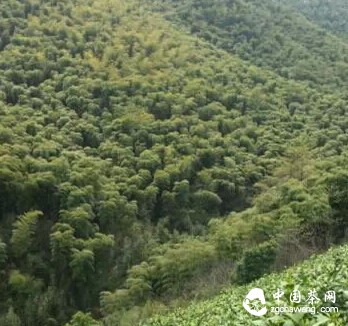
Healthy and Pollution-Free:
Before Qingming, temperatures are low, and generally there are no pest problems, so pesticides are not needed. The tea is pollution-free. Therefore, spring tea, especially early spring tea, is often the best in quality for green tea throughout the year. Hence, many high-end famous teas, such as West Lake Longjing, Dongting Biluochun, Huangshan Maofeng, Lushan Yunwu, etc., are all picked and processed in the early spring, particularly Pre-Qingming tea, which is the premium among famous teas, becoming the favored "darling" of tea enthusiasts.
Only Once a Year:
Pre-Qingming Tea comes only once a year. Be good to yourself; good tea is not for gifting but for enjoying yourself.
How to Choose "Pre-Qingming Tea"
As ordinary consumers, to buy authentic and high-quality Pre-Qingming Tea, first, you must go to branded, reputable tea shops. Branded stores have a credibility foundation and won't easily risk selling counterfeits.
Second, pay attention to the tea's origin. For example, only green tea and some red teas have Pre-Qingming versions, and only areas like Zhejiang, Hunan, Jiangxi, southern Anhui, southern Jiangsu, and southern Hubei produce Pre-Qingming Tea.
Third, if you have basic tea-tasting knowledge, be sure to sit down and taste when buying Pre-Qingming Tea. Before brewing, observe the tea's appearance and color, and smell its aroma. Spring tea leaves are usually tightly wrapped, plump, and thick, some with many fine hairs, bright in color, and fresh in aroma. Then, after brewing, further judge by smelling the aroma, tasting the flavor, and observing the brewed leaves. New tea sinks quickly when brewed, with a strong and lasting aroma and a mellow taste; green tea has a yellowish-green liquor, red tea has a bright reddish liquor with a golden ring; the brewed leaves are soft, thick, and mostly normal buds and leaves. In terms of taste, Pre-Qingming Tea must be very smooth, without strong bitterness or astringency.
Finally, you can also follow Tea Encyclopedia's journey to find spring tea. We travel to various places and will promptly recommend the compared and found spring teas on our platform.
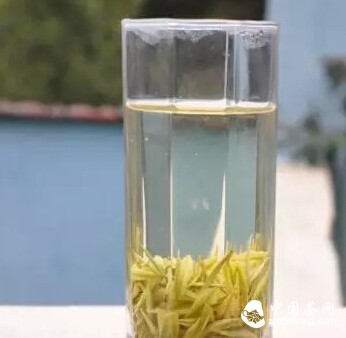
Brewing "Pre-Qingming Tea"
There are specifics on how to brew "Pre-Qingming Tea." Drinking spring tea is not about the newer, the better. It's best not to drink freshly processed Pre-Qingming Tea immediately.
Let it rest for one to two weeks first; the flavor will be better (this is why Tea Encyclopedia's recommended Shifeng Longjing tea is recommended a few days after Qingming—it needs "aging" storage for some days). New tea often has a "fire" taste. If brewed immediately, it can make your throat feel dry after drinking, and the taste isn't as fresh. Additionally, newly processed tea still contains residual moisture, which is not conducive to storage. After proper storage, not only can the "fire" taste be removed, but the moisture content in the dry tea can also be reduced.
Do not use boiling water to brew Pre-Qingming Tea. Since Pre-Qingming Tea is relatively tender, water around 85°C is generally suitable. The more tender and greener the tea, the lower the brewing water temperature should be. This way, the brewed tea liquor can be bright green and clear, with a fresh and brisk taste, and the nutrients in the tea are less likely to be destroyed.
As often said, high water temperature "scalds" the tea leaves. It's best to pour boiling water into one cup first, then pour it into the teacup for brewing. This makes it easy to control the water temperature. For tender Pre-Qingming Biluochun tea, you should add water first, then put in the tea leaves.
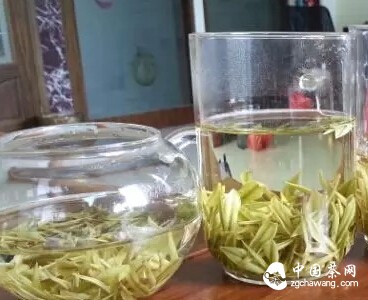
It's best to use a glass cup for brewing. Pre-Qingming Tea requires not only green liquor, fresh taste, and rich aroma but also beautiful shape. Longjing dry tea should be flat, level, and straight; Biluochun dry tea should be "curled like a snail." After brewing, watching the tea buds and leaves slowly unfurl and float up and down in the glass cup is also a special enjoyment.
How to Distinguish Between "Pre-Qingming Tea" and "Pre-Rain Tea"?
In recent years, people have had a preference when buying tea: to buy the earliest and most tender tea, even only those made from single buds. Actually, that's not necessarily true. High-quality tea is not always better the tenderer it is. Bud tea made from picking tender, tiny single tea buds is indeed beautiful in appearance, but in terms of the richness of internal substances, it is inferior to tea with one bud and one or two leaves. Taking Longjing tea with its long history as an example, the raw material for its top-grade tea is one bud and one or two leaves, never picking single buds as raw material (the Pre-Qingming Shifeng Longjing recommended by Tea Encyclopedia recently is also not single buds, nor the most tender one-bud-one-leaf just unfolding, and its appearance is not the most beautiful).
The social推崇 for "Pre-Qingming Tea" is more about its abstract concept than practical value, more about aesthetic significance than drinking value. The vanity of tea drinkers plays an important role. Because "Pre-Qingming Tea" is scarce and precious, being able to drink it is often a symbol of status and taste.
Actually, although "Pre-Rain Tea" is not as tender as "Pre-Qingming Tea," due to higher temperatures during this period, bud and leaf growth is relatively faster, and accumulated internal substances are richer. Therefore, "Pre-Rain Tea" often has a fresh, strong taste and good endurance for multiple infusions. Tea picked during this period is neither too early nor too late, just right, capturing the essence of the season, the spirit of the time, and is also good tea with high cost-effectiveness.
Furthermore, influenced by climate, variety, and cultivation management conditions, the tea picking time varies each year.
Generally speaking, it gradually delays from south to north, with a difference of 3-4 months between south and north. Additionally, even within the same tea region, or even the same tea garden, picking times may differ by 5-20 days due to differences in altitude and water/fertilizer management. Therefore, when buying tea, you cannot judge tea quality solely by the picking season. In tea gardens with high temperatures, picking might have occurred 2-3 times before Qingming, but in some places with higher altitudes or more northern locations, not a single picking might have occurred even after Qingming. If one simply judges tea quality by the chronological order of picking time, wouldn't that be ridiculous!
"Pre-Qingming Tea": early and tender, good-looking, prestigious; "Pre-Rain Tea": tasty, flavorful, affordable. It's just about different consumer pursuits.