New Tea vs. Old Tea:
New tea and old tea are relative terms. Conventionally, tea made from the first few batches of fresh leaves picked from tea trees in spring of the current year is called new tea.
The "rush for the new" by tea purchasing departments, the "new tea arrival" by sales departments, and consumers' "tasting the new" all refer to the earliest batches of tea processed each year. However, some also refer to all tea processed from leaves picked in the current year as new tea; while tea processed from leaves picked the previous year or even earlier, even if stored properly and in good condition, is generally called old tea.
For most tea varieties, new tea is naturally considered better than old tea.
"Drink tea when it's new, drink wine when it's old" is a summary of long-term tea drinking experience. As mentioned in Song Dynasty's Tang Geng's "Dou Cha Ji": "I hear that for tea, regardless of its form, freshness is valued; for water, regardless of its source, liveliness is valued." The color, aroma, taste, and appearance of new tea give a fresh feeling, described as "crisp and fragrant." Tea stored for a year or more, whether in color or taste, always has a sense of "sunken aroma and dull flavor." This is because during storage, under the influence of light, heat, moisture, and air, some acids, esters, alcohols, and vitamins in the tea undergo slow oxidation or condensation, forming other compounds unrelated to tea quality, while the content of desirable effective components relatively decreases. Ultimately, this leads the tea's color, aroma, taste, and appearance to develop in a direction unfavorable to its quality, resulting in stale odor, stale taste, and dull color.
However, not all teas are better when new. Some tea varieties actually improve with proper storage. For example, some newly processed famous teas, such as West Lake Longjing, Qiqiang, Dongting Biluochun, Mogan Huangya, Guzhu Zisun, etc., if stored in a lime jar for 1-2 months, will still have clear and bright liquor, fresh and mellow taste, and green, moist, and vibrant leaves. Moreover, unstored tea has a slight grassy smell, while short-term stored tea has a pure and clean fragrance.
Another example is Fujian's Wuyi Rock Tea (Yancha), where tea stored for a year often has a more rich aroma and mellow taste. Hunan's Dark Tea (Heicha), Hubei's Fuzhuan Tea, Guangxi's Liubao Tea, Yunnan's Pu-erh Tea, etc., if stored properly, not only do not deteriorate but can even improve in quality. This is because during the storage of these teas, two main scents form: one is the aged aroma from slow maturation, and the other is a musty aroma from a small amount of microbial activity. These two scents blend harmoniously, resulting in a new aroma that is welcomed.
Thus, in reality, while new tea is better for most varieties, there are also old teas that are not inferior to, or even better than, new tea. This raises the question: how to distinguish new tea from old tea? It can be identified from the following aspects:
(1) Color: During storage, due to the action of oxygen and light in the air, some pigment substances that constitute the tea's color undergo slow automatic decomposition. For example, the decomposition of chlorophyll in green tea causes the color to gradually change from the bright emerald green of new tea to a dull grayish-yellow-green. The oxidation of ascorbic acid (vitamin C), which is relatively abundant in green tea, produces theaflavins, turning the tea liquor yellowish-brown and unclear. For black tea, the oxidation, decomposition, or polymerization of theaflavins, which greatly affect its quality, along with the auto-oxidation of tea polyphenols, causes black tea to change from the black and glossy appearance of new tea to grayish-brown.
(2) Taste: In old tea, due to the oxidation of esters producing volatile aldehydes or water-insoluble condensation products, the water-soluble effective components decrease, making the tea taste change from mellow to bland. Simultaneously, the oxidation, deamination, and decarboxylation of amino acids weaken the fresh, brisk taste, making it "sluggish."
(3) Aroma: In old tea, due to the oxidation, condensation, and slow volatilization of aromatic substances, the tea's fragrance changes from fresh and clear to low and dull.
The above differences apply to many tea varieties. Moreover, with good storage conditions, these differences become relatively smaller. As for some teas whose quality does not degrade after storage, that is another matter.
Example: Three Types of Maojian Tea
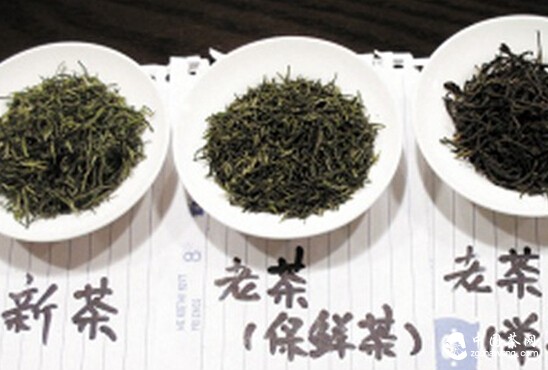
Take out three small white dishes containing three types of Maojian tea: newly released spring tea, preserved old tea (stored in a refrigerator or保鲜库), and常温 stored old tea (stored at room temperature).
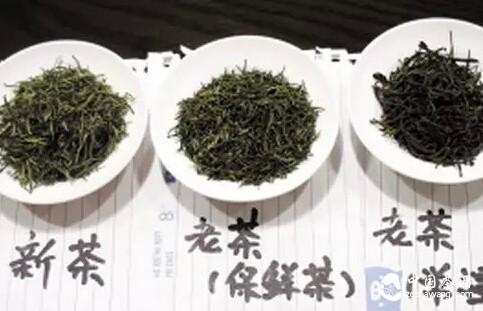
Although all are Maojian, the color difference among the three is quite obvious. The bright green one is the newly released spring tea, the blackish-yellow one is the常温 stored tea, and the one in between is the preserved tea. The harder ones to distinguish are the preserved tea and the new spring tea. New spring tea has more fine hairs (pekoe), plump, thick, and glossy leaves. High-quality preserved tea appears slightly dull in color.
New tea has a strong, fresh, and持久 tea aroma; preserved tea's aroma is less intense than new tea's, lacking the fresh note;常温 stored tea has a very faint aroma.
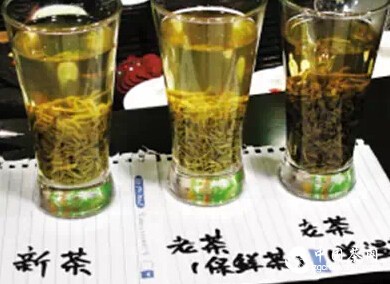
After steeping for 3 minutes,观察 the liquor: the常温 stored tea liquor appears yellowish and dark, without obvious green; the preserved tea and new tea liquor are翠绿 and fresh.仔细观察, the steeped new tea leaves are green with a hint of yellow, while the preserved tea leaves are slightly inferior.
Spring Tea, Summer Tea, and Autumn Tea
Due to the influence of seasonal climate factors like temperature, rainfall, and sunlight during the annual growth cycle, and differences in the tea plant's own nutritional conditions, the natural quality of tea processed in different seasons changes accordingly.
"Spring tea is bitter, summer tea is astringent, for good drinking, choose autumn tea (referring to autumn harvest)" is a概括 of the natural quality of seasonal teas.
In the main tea-producing areas of the middle and lower reaches of the Yangtze River with distinct seasons, the划分 of spring, summer, and autumn tea is generally based on seasonal changes combined with the intermittent growth of new tea shoots. Typically, spring tea refers to tea picked and processed before the end of May of the current year; summer tea refers to tea picked and processed from early June to early July; tea picked after mid-July of the current year is considered autumn tea.
Due to different picking seasons, the appearance and internal quality of the processed tea have obvious differences. For green tea, due to moderate spring temperatures, abundant rainfall, and the tea plant's rest and recuperation during the previous autumn and winter, spring shoots are plump,翠绿 in color, soft in texture, with many fine hairs on young leaves. Substances related to quality, especially amino acids, corresponding total nitrogen, and various vitamins, are富集. This not only makes green tea taste fresh and brisk with a strong aroma but also gives it good health benefits. Therefore, spring tea, especially early spring tea, is often the period with the best green tea quality in a year. Many famous teas, such as high-grade Longjing, Biluochun, Huangshan Maofeng, Gaoqiao Yinzhen, Junshan Yinzhen, Guzhu Zisun, etc., are all finely processed from young spring leaves.
Thus, historical Chinese documents often record "valuing spring tea as superior." Poems from various dynasties praise "spring tea as the best."
In summer, due to hot weather, tea shoot growth is rapid, reducing the content of water-extractable substances in the tea liquor, especially amino acids and total nitrogen. This makes the tea liquor less fresh and brisk than spring tea, and the aroma less intense.
Conversely, the content of astringent components like anthocyanins, caffeine, and tea polyphenols is higher than in spring tea. This not only increases purple芽叶 but also causes uneven成品茶 color and a more bitter and astringent taste.
Autumn climate conditions are between spring and summer. After growth and picking in spring and summer, the new shoots have relatively fewer internal substances. Leaves vary in size, become brittle, and turn yellowish. The taste and aroma of autumn tea appear more平和.
Regarding black tea quality, since summer tea has higher tea polyphenol content, it is beneficial for forming more black tea pigments. Therefore, black tea made from summer tea has a redder and more lustrous dry leaf and liquor color, and a stronger taste. However, the significant reduction in amino acids in summer tea is不利 for forming black tea's fresh and brisk taste.
The quality characteristics of spring, summer, and autumn tea are described below for reference when purchasing tea.
Dry Inspection: Mainly judge from the tea's appearance, color, and aroma. For black and green tea, tightly rolled strips or tightly rounded beads (for珠茶); black tea with a black and glossy appearance, green tea with a green and glossy appearance; tea leaves that are plump, heavy, and substantial, or with many fine hairs; and a rich and lasting aroma indicate spring tea quality. Loosely rolled strips or loose beads; black tea with a reddish-brown appearance, green tea with a grayish or dull black appearance; light, broad leaves, thin and long stems; and a slightly coarse aroma indicate summer tea quality. Leaves of varying sizes, thin and small leaves; green tea with a yellowish-green color, black tea with a dark red color; and a平和 aroma indicate autumn tea quality.
Additionally, occasional flowers or fruits mixed in the tea can help判断. If发现茶 tree幼果,估计鲜果 size similar to mung beans, it can be judged as spring tea, as tea plants usually flower and授精 from September to November, and spring tea period coincides with幼果开始成长. If茶果 size is like prayer beads, it can be judged as summer tea. By autumn tea,茶鲜果 is almost as large as longan and generally not easily mixed in tea leaves. However,茶 tree flower buds form around July-August, and flowering peaks again from September. Therefore, tea夹杂有 flower buds or flowers is autumn tea. But通常, during tea processing, after screening and sorting, flowers and fruits are rarely mixed in. Therefore, comprehensive analysis is necessary to avoid片面性.
Wet Inspection: This involves steeping and审评, further judging by smelling the aroma, tasting, and observing the infused leaves. If leaves sink quickly during steeping, aroma is strong and lasting, taste is mellow; green tea liquor is green with a hint of yellow, black tea liquor is bright red with a golden ring; infused leaves are soft, thick, and substantial with many normal芽叶; leaf veins are fine and dense, leaf edge serrations are not obvious—this is spring tea.
If leaves sink slowly during steeping, aroma is not high; green tea tastes bitter and astringent, liquor is bluish-green, infused leaves contain铜绿色芽叶; black tea taste is not thick and somewhat astringent, liquor is reddish-dark, infused leaves are relatively bright red; regardless of black or green tea, infused leaves appear thin and somewhat hard, with many opposite leaves (对夹叶), coarse veins, and obvious leaf edge serrations—this is summer tea. If aroma is not high, taste is bland, infused leaves contain铜绿色芽叶, leaves vary in size, many opposite leaves, and obvious leaf edge serrations—this belongs to autumn tea.