Tea competition, as the name suggests, is a contest to judge the quality of tea, also known as tea battle or tea duel. It began in the Tang Dynasty and flourished in the Song Dynasty, becoming a refined pastime beloved by all social classes. Along with incense burning, flower arranging, and painting hanging, it was regarded as one of the "Four Arts" of the Song Dynasty.
Tea competition was a popular leisure activity in ancient times, originating in the Jianzhou region of Fujian. In the Tang Dynasty, it was called "tea battle," and it was not until the Song Dynasty that it was renamed tea competition. In ancient tea competitions, when new tea began to hit the market, tea farmers and merchants would gather to taste and rank the quality of the new tea.
Participants in the tea competition would each present their treasured teas, taste them in turn, and determine the winner. The competition included evaluating the color and aroma of the tea leaves, the fragrance and taste of the tea soup, the quality of tea sets, and the mastery of brewing heat and timing. The competition involved collective tasting, and the one with the highest quality tea would win.
According to records from the Song and Ming dynasties, tea competition generally included three aspects: judging the tea, performing tea drinking games, and creating tea painting.
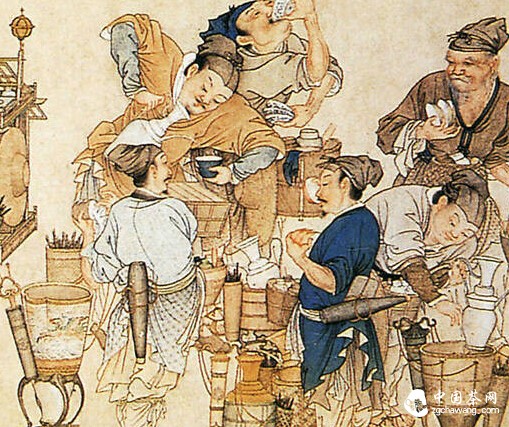
「Judging the Tea」
In judging the tea, the "freshness" of the tea was most valued. Therefore, during the Qingming Festival each year, when new tea first appeared, it was the ideal time for competition. Water, on the other hand, was prized for being "fresh and lively."
The first criterion was the color of the tea soup: whether the tea soup was bright white. Pure white was the best, while blue-white, gray-white, and yellow-white were inferior. Pure white tea soup indicated that the tea leaves were tender and properly processed; a bluish tint indicated insufficient steaming; a yellowish tint indicated delayed picking; a grayish tint indicated over-steaming.
The second criterion was the appearance of water marks. The earlier or later the water marks appeared was the basis for judging the tea soup quality. In the Song Dynasty, compressed tea cakes were commonly used. During preparation, the tea cake was first roasted and ground finely, and if the tea brewing, water pouring, and whisking were done skillfully, the foam would appear even and fine, even clinging tightly to the teacup rim, a phenomenon called "biting the cup." The longer the foam "bit the cup," the less likely water marks would appear at the junction of the tea soup and the cup. The one with the latest appearance of water marks would win.
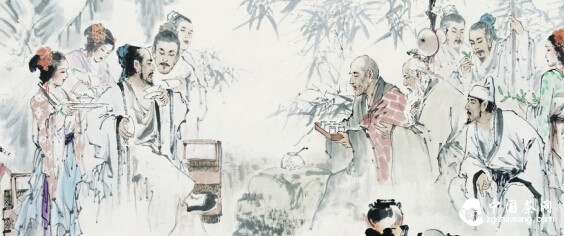
「Tea Drinking Games」
Just as there are drinking games for alcohol, there are naturally tea games for tea. Tea games were a product of the flourishing tea competitions in the Song Dynasty, and the originator of tea games is said to be the famous Song Dynasty female poet Li Qingzhao.
When Li Qingzhao and her husband Zhao Mingcheng lived frugally in Qingzhou, dedicating themselves to scholarship, every time they obtained a good book, they would collate and reorganize it together. During a tea brewing session, she had a sudden inspiration and created a tea game quite different from drinking games: they would quiz each other on classic texts, asking and answering questions, and the one who answered correctly could drink tea as a celebration.
Nalan Xingde once used Li Qingzhao's tea game allusion in his poem "Silk-Washing Stream," writing: "Drunk, I fear to wake her from her spring sleep; betting on books, we spilled tea with its lingering fragrance. In those days, we thought it was nothing special."
「Tea Painting」
Tea painting was the most profound aspect of tea competition. Due to the passage of time and the lack of inheritors, its mystery remains unsolved to this day. Only in historical records do we find descriptions such as, "Using a special technique, the patterns and lines of the tea soup form images of birds, animals, insects, fish, flowers, and grass, as delicate as a painting." This means that the tea soup in the cup instantly displayed magnificent and varied scenes, like flowers, birds, fish, insects, or ink paintings, sparking endless imagination.
Several centuries have passed, and the once-prosperous tea competitions of the Song Dynasty have vanished into the gentle smoke of tea. Yet the tea grinders once held by the ancients, the teapots warmed on stoves, and the teacups touched by lips still enchant today's tea culture enthusiasts. Tasting tea is not about form but about a state of mind, as the saying goes: "It washes away weariness for all ages, offering a unique pleasure in appreciating tea."
The criteria for winning a tea competition were twofold: the color of the tea soup and the condition of the foam. The color of the tea soup was judged on a standard where pure white was best, and blue-white, gray-white, and yellow-white were inferior. The foam refers to the bubbles that formed on the surface of the tea soup. The color of the foam was closely related to the color of the tea soup, so bright white was also preferred for the foam. Additionally, the timing of the water marks appearing after the foam rose was crucial: early appearance meant defeat, and late appearance meant victory.
The venue for tea competitions was usually chosen in relatively large tea shops. These shops were generally divided into front and back sections: the front hall was spacious and served as the storefront, while the back hall was smaller and had a small kitchen for brewing tea. Some also had rooms where the shop owner's family lived. Of course, some neighbors or workers who were fond of this hobby would gather in small groups to discuss tea, and sometimes a competition would spontaneously take place. Some people with elegant rooms at home, gardens with lush trees, or homes near rivers or West Lake would serve as excellent venues for tea competitions.
Tea competitions were often held during the Qingming Festival, as new tea had just appeared and was most suitable for evaluation. Participants were all tea enthusiasts who formed groups freely, ranging from a dozen or more to as few as five or six. During the competition, there were also many neighbors watching the excitement. If the competition was held in a tea shop, nearby shop owners or employees would take turns to join in, especially customers who were there to buy tea, eager to witness the event.
In modern life, there are also occasional tea competition events. Today's tea competitions mainly aim to provide a platform for tea enthusiasts to exchange tea culture. On such platforms, tea lovers can not only enjoy the fragrance and culture of tea but also enhance their abilities in distinguishing and storing tea through communication.