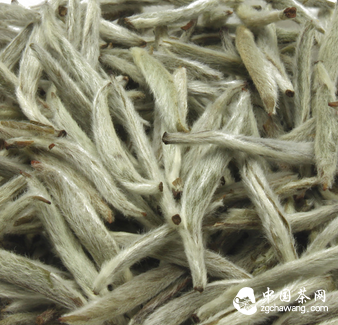
Shape Terminology
Plump Pekoe: Refers to a white tea with many downy buds, with leaves attached to the stem. The bud resembles the heart of a flower, so it is called "pekoe." It describes the buds of white tea as plump, tender, and rich in down.
Downy: Abundant, white, and lustrous down.
Visible Down: The white down on buds and leaves is commonly called "white down." When the bud tips are high in content and have abundant white down, it is referred to as "visible down." The down color of white tea can be silvery white or grayish white.
Uniform and Neat: Uniform means even, and neat means orderly. It refers to the upper, middle, and lower sections of the tea being similar in size, thickness, length, and weight, with uniform tenderness and maturity, and free from stems, stalks, fibers, and foreign matter.
Taste Evaluation
Fresh and Rich: "Fresh" indicates a clean and refreshing taste, while "rich" means the liquor is full of substances, with a strong and fresh flavor, a pleasant throat feel, and a lingering aroma with vitality.
Fresh and Brisk: Clean, refreshing, and lively, but with a lower concentration than "fresh and rich."
Sweet and Brisk: Clean, refreshing, with a sweet sensation and vitality.
Mellow and Thick: Rich and palatable, with a slightly sweet aftertaste. It can also be described as "mellow and brisk."
Mellow and Smooth: The flavor is refreshing with a hint of sweetness, but the fresh taste is not strong, and the stimulation is mild.
Coarse and Thin: The taste is weak, dull, and rough on the throat.
Weak: The flavor is thin, soft, and lacks vitality.
Bitter and Astringent: The taste is strong but not fresh or mellow. The tea liquor leaves a numb sensation on the palate, similar to eating a raw persimmon.
Watery: The taste is light, impure, and weak.
Off-Flavor: Undesirable flavors such as scorched, smoky, stale, sour, musty, and others.
Aroma Evaluation
Downy Aroma: A characteristic aroma of Fuding white tea, referring to the fragrance of tender white down. For example, the aroma of Baihao Yinzhen is a subtle downy fragrance.
Fresh and Strong: The aroma is strong, fresh, and long-lasting.
Fresh and Delicate: The aroma is high, clean, delicate, and pleasantly fresh. It is a special aroma of tender buds and leaves, similar to downy fragrance.
Clear and High: The aroma is clear, high, and refreshing, lingering in the nose. It indicates relatively tender and fresh tea leaves.
Delicate Fragrance: The aroma is pure, soft, and not overpowering, gradually releasing and creating a pleasant sensation.
Fresh and Brisk: The aroma is fresh, lively, and refreshing after sniffing.
Fresh and Sweet: Fresh with a sweet fragrance.
Sweet and Pure: The aroma is not very high but has a sweet sensation.
Pure and Mild: The aroma is pure, neither too high nor too low, with no off or mixed odors. It can also be described as "pure and harmonious."
Dull and Heavy: Although the aroma has a certain concentration, it feels dull and unpleasant.
Coarse and Light: The aroma is low with a rough quality similar to old tea, also known as "coarse and aged."
Muddy: Mixed with other odors, giving a heavy and unpleasant feeling.
High-Fire: The aroma produced by a relatively high baking and drying temperature, where the heat is acceptable but the duration is too long, resulting in a fully dried tea with a high-fire scent.
Old-Fire and Scorched: Caused by improper firing temperature during tea processing. A slight burnt tea aroma is called "old-fire," while a severe one is called "scorched."
Stuffy: An unpleasant stuffy smell that occurs when white tea is piled too long after panning or when drying is not timely.
Off-Aroma: Scorched, smoky, stale, sour, musty, oily, metallic, woody, or other unpleasant and unusual odors. It is generally necessary to specify the type of odor.