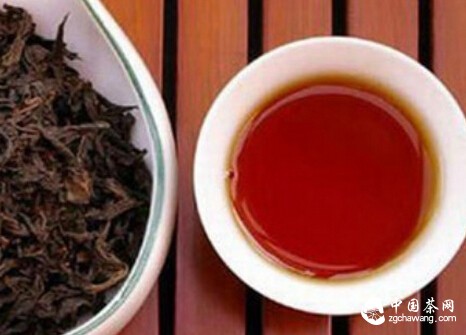
“Da Hong Pao” is a highly controversial topic today, involving many aspects of Wuyi Mountain rock tea and even deeper issues within Chinese tea studies. I am not an industry insider, let alone an expert—just a tea drinker. So I can only try to briefly introduce what I know. Ultimately, you must rely on your own experience and verification. Consider this my casual rambling.
1. The commonly referred to Da Hong Pao refers to the six existing tea trees on the stone wall of Jiulong Nest at Tianxin Rock, Wuyi Mountain. Starting from the first tree above the stone inscription, they are numbered in order: the upper four (historically called the originals) are 1, 2, 3, and 4; the middle layer is 5; and the bottom layer is 6. Although these six trees belong to the same type, they are the result of long-term natural hybridization from the sexually propagated Wuyi vegetable tea population, so individual differences exist. They can be roughly divided into three different strains: No. 3 and 4, No. 2 and 6, and No. 1 and 5. I won’t go into the differences among these three strains or their historical stories.
2. Da Hong Pao was originally a single-bush rock tea and one of the four (or five) famous tea varieties of Wuyi Mountain. It is an outstanding single bush evolved from the widely grown Qidan tea variety in Wuyi Mountain. Historical records show that Da Hong Pao grew in multiple locations in Wuyi Mountain: 1. Jiulong Nest at Tianxin Rock (recorded in Jiang Shunan’s travel notes in 1921); 2. Tianyou Rock (recorded in Jiang Shunan’s travel notes in 1921); 3. Zhulian Cave (recorded in transactions during the Jiaqing period of the Qing Dynasty). It is said there were more than these three locations.
3. After the founding of the People’s Republic of China, research institutions successfully achieved asexual propagation through long-term research, and now it is widely planted throughout the Wuyi Mountain area. However, due to different mountain site conditions, the tea’s flavor and quality also vary.
4. Driven by development needs and profit interests (preceded by the hype around Longjing tea and Tieguanyin), internal debates and conflicts arose within the rock tea community. Externally, those who originally sold rock tea began rebranding it as Da Hong Pao. At the same time, concepts such as pure-strain Da Hong Pao (asexually propagated variety) and commercial Da Hong Pao (blended Da Hong Pao) emerged, causing considerable confusion.
5. Currently, the so-called Da Hong Pao widely circulating on the market comes in two types: one is asexually propagated, but it depends on where it was grown; the other is blended (further divided into two subtypes: one where the formula includes Da Hong Pao tea leaves, and the other where it does not, but the aroma, taste, and mouthfeel are similar and have their own characteristics). Additionally, Qidan tea grown in other mountain sites is also sometimes sold as Da Hong Pao.
In short, when a merchant claims to sell Da Hong Pao, you need to clarify which specific type of Da Hong Pao they are referring to.