Tea is Divided into Six Categories, Oxidation is the Soul! Is 'Fermentation' a Misused Concept?
Tea is one of the world's three major beverages, and China is the birthplace of tea. Different regions, different processes, and different traditions create a myriad of teas. In reality, all these teas, with their vastly different appearances and flavors, come from plants of the same family and genus—different varieties of the tea tree, whose differences in botanical classification are minimal. Tea industry taxonomists classify tea into six categories based on "different processing methods" or "degrees of fermentation": green tea, yellow tea, white tea, oolong tea (also known as qingcha), black tea (hongcha), and dark tea (heicha). Some scholars also refer to teas as "non-fermented," "lightly fermented," "micro-fermented," "semi-fermented," or "fully fermented."
Although this classification standard is widely accepted in the tea industry, the term "fermentation" is a misused concept. In biochemistry, fermentation is a biochemical process involving microorganisms. Among the various tea-making processes, only dark tea involves microorganisms and thus undergoes true "fermentation." The other teas undergo "oxidation" and "color change" rather than "fermentation." Therefore, the true basis of this six-category classification system is "oxidation."
Green tea is the category with the most famous varieties and the most extensive research. Freshly picked tender buds or leaves from the tea tree are called tea leaves (or tea plant material). Compared to other plant leaves, tea leaves are rich in polyphenols and caffeine. Like other green plants, they also contain a large amount of chlorophyll and polyphenol oxidase. In fresh tea leaves, the green color of chlorophyll dominates. However, chlorophyll is unstable and easily decomposes, losing its green color—after which the colors of other pigments become visible. On the other hand, tea polyphenols are also unstable and are easily oxidized by the plant's own polyphenol oxidase, polymerizing into substances like theaflavins and thearubigins. The core goal of making green tea is to preserve the green color. The key is to quickly "kill" the polyphenol oxidase after picking, thereby preventing the oxidation of tea polyphenols. This goal is achieved through "fixation" (shaqing)—high-temperature treatment deactivates the polyphenol oxidase, so the tea polyphenols are not oxidized. Then, rapid drying "fixes" the state of the tea leaves, resulting in green tea.
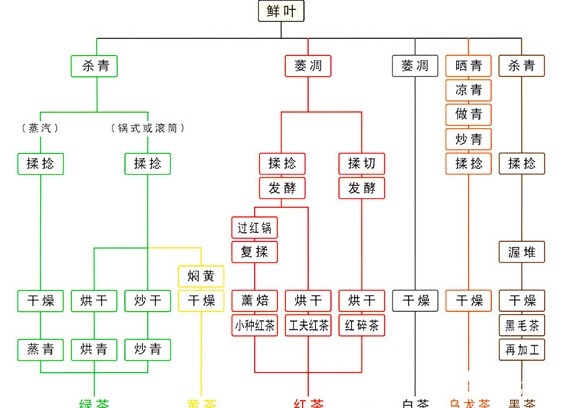
If, after fixation, the leaves are not dried promptly, chlorophyll may also decompose and lose its green color, allowing the xanthophyll and carotenoids in the leaves to become visible. These pigments are more stable than chlorophyll, so the tea leaves appear yellow. For green tea, this is considered a defective product. However, by refining this process to fully reveal the yellow xanthophylls and carotenoids, a yellowish tea is produced, which brews a pale yellow liquor. "Yellow leaves, yellow liquor" gives rise to yellow tea. In the production of yellow tea, this refined process is called "yellowing" (menhuang), which uses the heat and moisture after fixation to turn the leaves yellow. Green tea "fixes" the state of the fresh leaves, also locking in the "grassy" flavor. After yellowing, this "grassy smell" disappears—for some, this removal enhances the overall flavor profile of the tea liquor.
While green tea processing requires "rapid drying," yellow tea takes the opposite approach—not only avoiding rapid drying but also artificially promoting the consequences of delayed drying. White tea, in contrast, completely abandons the "fixation" operation. The core process of white tea is "withering." The fresh tea leaves are left under natural conditions, allowing their polyphenol oxidase, peroxidase, and other enzymes to act. In strictly regulated white tea production, the withering period can last up to 60 hours. Sunny weather and dry, mild north winds provide suitable temperatures and circulating dry air, allowing the moisture in the leaves to dissipate gradually. Due to water loss, organelles containing polyphenol oxidase and peroxidase disintegrate, releasing these enzymes to function. By adjusting the thickness of the spread-out leaves, the temperature can be regulated, allowing enzyme activity to increase in a controlled manner. Besides polyphenol oxidase and peroxidase, fresh leaves contain other enzymes, such as various hydrolases. During withering, by controlling temperature and the rate of water loss, the activity of these enzymes is either utilized or suppressed, producing different components such as theaflavins, amino acids, and soluble sugars. These components create the unique flavor of white tea. After sufficient withering, when the leaves are 80–90% dry, they enter the drying stage, reducing the moisture content to about 6%, resulting in finished white tea. Under storage conditions of low temperature, low humidity, low oxygen, light protection, no heavy pressure, and no off-odors, white tea undergoes slow enzymatic oxidation further. This yields "aged white tea," which has a sweet, thick liquor and a distinctive flavor, highly favored by white tea enthusiasts.
Compared to white tea, the oxidation in oolong tea is more intense and thorough. In addition to the "enzymatic oxidation" during withering, oolong tea undergoes further artificially promoted "auto-oxidation"—in the tea industry, this operation is called "shaking green" (zuoqing). This involves using mechanical force to cause varying degrees of damage to the leaves, where the damaged parts undergo vigorous oxidation with oxygen in the air, resulting in localized reddening. Oolong tea only requires "partial oxidation," so after a certain degree of shaking, it needs to be "fixed" (shaqing), like green tea, to terminate the oxidation process. By controlling the conditions of shaking and fixation, oolong tea ultimately develops its wide range of floral aromas and a taste that balances astringency with sweetness, offering a thick, mellow, and lingering finish. "Partial oxidation" is a broad concept; it can be very slight, such as in Fujian's Anxi Tieguanyin, or fairly extensive, as in Taiwan's Oriental Beauty.
Corresponding to the "partial oxidation" of oolong tea, black tea (hongcha) is "fully oxidized." Therefore, it does not require fixation but instead needs "rolling" (rounian) and "fermenting" (wohong) to achieve complete oxidation. Rolling breaks the leaf cells, releasing the juices, which then undergo full oxidation with oxygen. Tea polyphenols are oxidized into theaflavins and thearubigins, and most carbohydrates are hydrolyzed into soluble sugars, producing the distinctive aroma and taste characteristic of most black teas.
Dark tea (heicha) is called "post-fermented tea" because it treats the oxidation in other teas as "pre-fermentation." A representative variety of dark tea is Yunnan's Pu-erh tea. In terms of processing, the initial production of Pu-erh raw material (maocha) is very similar to green tea: the fresh leaves are fixed, rolled, and dried to produce maocha. At this point, the enzymes in the tea are no longer active. Through different "post-fermentation" treatments, maocha can be transformed into "ripe Pu-erh tea" or "raw Pu-erh tea." The core operation for ripe tea is "pile fermentation" (wodui)—allowing the maocha to be in conditions of temperature and humidity suitable for microbial growth, causing a large proliferation of microorganisms on the leaves. This process is true "fermentation." These microorganisms are mainly beneficial molds and bacteria. Their metabolism produces various enzymes that convert many components in the maocha into new substances. For example, tea polyphenols are oxidized into theaflavins and thearubigins, fibers are hydrolyzed into sugars, proteins are hydrolyzed into amino acids and peptides, and caffeine undergoes complex transformations or binds with other substances. These changes are far more complex and varied than the oxidation in other tea categories, resulting in a red, thick liquor and a sweet, rich, substantial mouthfeel. "Raw Pu-erh tea" does not undergo pile fermentation. Instead, the maocha is steamed, pressed into shape, dried, and then stored as the finished product. During storage, the temperature and humidity conditions are not ideal for microbial growth, but some hardy molds and bacteria still manage to survive and reproduce on the maocha, slowly fermenting under these challenging conditions. This fermentation is more susceptible to various factors, leading to the ever-changing and diverse nature of raw Pu-erh tea, and giving rise to the legend that Pu-erh "gets better with age."
To this day, tea production is still largely small-scale. Some processes using modern industrial equipment primarily simulate traditional techniques. Control during production still mainly relies on experience. Differences in tea tree variety, growing environment, and picking season result in different fresh leaf characteristics. Different processing methods, as well as different control of operating conditions within the same process, lead to varying degrees of oxidation and transformation of the components in the tea. These differences make standardization of tea relatively low—from another perspective, they result in a vast array of diverse and unique products.