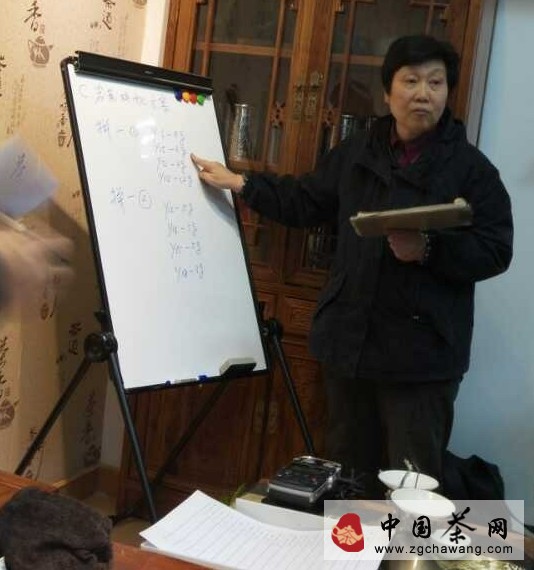
Q: Are there any special requirements for brewing aged tea?
Cai Rongzhang: First check if the tea has a damp smell. If so, spread the required amount on odorless cotton paper and leave it in a ventilated, dry place for one day. If it's too dry and astringent, place it in a more humid area until it reaches your desired condition. This is refinement before brewing.
Typically, aged tea requires high temperature water - let the water boil longer or use a tightly covered, heavy-lidded kettle. If the aged tea is particularly bitter, don't use excessively high water temperature.
Use less tea leaves, allowing the first infusion to steep for about 1 minute. The second infusion often needs to be poured out quickly (usually 10 seconds).
Do not perform a rinsing infusion, otherwise aged tea enthusiasts might criticize you.
Q: What are the characteristics of tea regions in northern China?
A: China's northernmost tea region, also called the Jiangbei tea region, refers to areas south of the Yangtze River, north of the Qinling Mountains and Huai River, west of the Daba Mountains, and east of the Shandong Peninsula, including southern Gansu, southern Shaanxi, southern Hubei, southern Henan, northern Anhui, northern Jiangsu, and southeastern Shandong. These regions have complex terrain with mostly yellow-brown soil, some with brown soil, and slightly higher pH levels in many tea areas. Compared to other tea regions, these areas have lower temperatures, less accumulated heat, shorter tea shoot growth periods, and serious frost damage in some regions. However, the significant temperature differences between day and night in many Jiangbei tea regions help form good natural quality in tea trees, suitable for making fragrant and strong green teas. Most tea trees here are medium and small-leaved shrub types.
Q: What tree type does old bush Shui Xian tea belong to, which doesn't look exactly like either arbor or shrub?
A: Tea trees like old bush Shui Xian belong to the small arbor type. Small arbor tea trees are intermediate between arbor and shrub types, having a relatively obvious main trunk and higher branching positions. In natural growth state, the tree crown is mostly upright and tall with well-developed root systems.
Q: When do tea leaves generally fall?
A: Tea leaf shedding occurs scattered throughout various months continuously. However, in normal years, different tea varieties shed leaves at different periods. The most leaf fall occurs in April-May, while leaf shedding and new leaf growth are roughly similar. The time when new leaves increase most is also when old leaves fall most.
Q: I really like teas with fruity aromas. What substances cause this fruity fragrance?
A: Substances in tea that create fruity aromas include: benzyl alcohol, geranial, benzaldehyde, methyl salicylate, phenethyl acetate, linalyl acetate, trans-2-hexenyl acetate, and nerolidol.
Q: Some say drinking good quality tea can open meridians. Which medical books mention this?
A: Regarding tea's meridian attribution, according to "Tangye Bencao," it enters the "Hand and Foot Jueyin Meridians" (Hand Jueyin belongs to "Pericardium," Foot Jueyin belongs to Liver). According to "Leigong Paozhi Yaoxing Jie," it enters all five meridians: Heart, Liver, Spleen, Lung, and Kidney. The five organs are the core of traditional Chinese medicine's visceral theory (generally called "Zang Xiang"). Tea's ability to enter all five meridians indicates very extensive efficacy.
Q: There's an aged green brick tea in Hubei. Can you introduce it?
A: Aged green brick tea is produced in Zhaoliqiao, Hubei. It's a brick-shaped steamed and compressed dark tea, sized 34x17x4 cm, mainly sold to Inner Mongolia and other regions. Made from aged green tea material through screening, pressing, drying, and packaging processes.
Q: When did Huangshan Maofeng originate, and what are its characteristics?
A: Huangshan has a long tea production history, becoming famous by the mid-Ming Dynasty. Huangshan Yunwu was the predecessor of Huangshan Maofeng, while Huangshan Maofeng was created by Xie Yutai Tea House during the Guangxu period of the Qing Dynasty. Huangshan Maofeng uses delicate picking standards - premium grade uses one bud one leaf just unfolding; grades 1-3 use one bud one leaf, one bud two leaves just unfolding; one bud one-two leaves; and one bud two-three leaves just unfolding respectively. Premium Huangshan Maofeng represents the pinnacle of China's Maofeng teas, resembling sparrow tongues, even and sturdy with visible buds and pekoe, ivory-colored with golden fish leaves, plump and clustered. The "golden yellow" and "ivory color" are two distinct features differentiating premium Huangshan Maofeng from other Maofeng teas.
Q: Which tea varieties sprout earliest, and which sprout latest?
A: China has numerous tea varieties. Depending on regional climate conditions, some like Wuniuzao and Baihaozao can be harvested after Spring Equinox, while others like Zhenghe Dabaicha and Huangshan Zhong aren't harvested until nearly wheat ripening time.
Q: Is looser soil or harder soil better for growing tea?
A: Loose soil with good ventilation and drainage promotes developed root systems and lush branches, suitable for tea growth. Heavy clay soil with poor ventilation and drainage hinders root development, resulting in poor canopy growth. Sandy loam is generally best for soil texture. Excessively sandy soil has weak water retention, low soil moisture storage, making branches vulnerable during drought or cold. Overly clayey soil, while having strong water retention, has poor soil ventilation, leading to underdeveloped root systems and weak absorption capacity.
Q: Why are tea trees pruned? What pruning methods exist?
A: Pruning appropriately regulates tea tree growth, development, and nutrient distribution, promoting vigorous growth and shaping high-yield tree forms. Based on different methods, pruning includes training pruning, light pruning, deep pruning, heavy pruning, and collar pruning.
Q: Why do some black teas have messy-looking brewed leaves?
A: This is often due to insufficient uniformity during raw material picking. Tender leaves dehydrate slowly during processing, easily roll into tight strips with good tips, and ferment easily to redden. Older leaves dehydrate quickly, don't easily form strips when rolled at the same time, creating more fragments and red flakes with yellow pieces, fermenting with difficulty to change color, resulting in greenish and dark pieces in brewed leaves. During drying, uneven tenderness causes varying water content and uneven dryness, leading to poor uniformity in raw tea and unattractive brewed leaves.
Q: How is Baozhong tea made?
A: Baozhong tea is divided into strip-type and semi-ball type based on appearance characteristics. Strip-type Baozhong doesn't emphasize buds and pekoe but seeks tightly rolled, beautiful strips. It can be rolled slightly heavier, often using double rolling to completely curl and tightly form strips, then loosened and dried. Semi-ball type Baozhong (like Taiwan Dongding tea and Songbai Changqing tea) undergoes initial rolling after pan-firing, initial drying, and ball rolling (cloth wrapping rolling and re-pan-firing) in three steps.
Q: What are the "four factors" mentioned in evaluation?
A: During evaluation, dry tea is assessed first before brewing. The former examines four factors of appearance: tenderness, strip tightness, color, and cleanliness, comparing with standards to preliminarily determine quality. The latter examines four factors of inner quality: liquor color, aroma, taste, and brewed leaves, comparing with standard samples to decide tea quality level and grade adjustments. Then based on scores and comments for each appearance and inner quality factor, the tea grade is determined.
Q: How to judge if scented tea has relatively good aroma?
A: The aroma contained in scented tea is very important, with three quality indicators: First, aroma freshness and liveliness - meaning how fresh and lively the aroma is, opposite to stale, stuffy, unpleasant aroma. Second, aroma concentration - meaning the depth of aroma intensity, opposite to weak, shallow aroma. Generally, after three scenting processes, the floral scent can fully absorb into the tea, creating relatively strong and lasting aroma. Third, aroma purity - meaning pure aroma without miscellaneous notes, and how well it harmonizes with tea taste, opposite to mixed odors, strange smells, and stuffy turbid aromas.