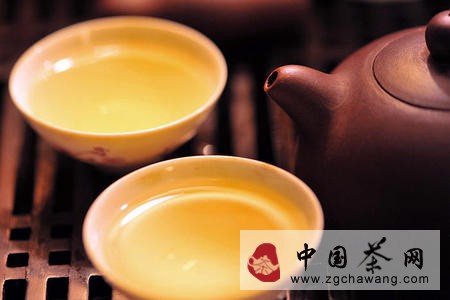
Wuyishan's Da Hong Pao is renowned, yet few know about Wuyishan Rock Tea. Entering the authentic Rock Tea Village, one is immersed in a rich tea atmosphere.
Upon entering Yu Shengliang's home, a massive root-carved tea table dominates the living room, complete with teapots, cups, spoons, various tea leaves, and snacks. "Let me brew some aged Rock Tea for you to taste. Rock Tea improves with age, losing its fire and becoming more mellow," Yu said as he boiled water. Outside the floor-to-ceiling windows, one side features clusters of green bamboo, while the other is a lush tea mountain.
What is Rock Tea? "Because Wuyishan's tea trees grow on rocks," explained Yu, a senior tea evaluator. "See, beneath the soil at the roots, it's not deep before you hit rock—the unique Danxia地貌 of Wuyishan. The soil formed from long-weathered rocks has distinct PH properties. Tea trees here don't grow tall, and the leaves have a unique flavor we call 'rock rhyme,' or 'rock bone floral scent'!"
Yu's family has a long tea-making history: "I'm the sixth generation. Rock Tea Village's tea history is even longer, over 800 years. Song Dynasty poet Fan Zhongyan wrote a poem about tea competitions, describing the stories here."
In his poem, Fan Zhongyan highly praised Wuyishan Rock Tea's quality. Recently, this folk tea competition custom has become more lively, evolving into a standardized event, a platform for technical exchange, and a channel for brand promotion.
From August 18 to 22 this year, over 150 households in Rock Tea Village entered 327 premium Rock Tea samples, a nearly 65% increase from last year. In the village, under shaded trees, dozens of long wooden tables were set up with tasting cups lined up, divided into Da Hong Pao, Rougui, Shuixian, and variety series. Judges included特邀 tea experts, participants, and tea merchants from outside the city. Tea merchants from Beijing, Shanghai, Fuzhou, and elsewhere came seeking famous teas.
After five consecutive competitions, the events have boosted economic benefits. Once "hidden in the mountains unknown," Rock Tea has not only found markets but also seen rising prices. Previously, many had unsold tea stockpiles; now, demand outstrips supply, with this year's tea almost sold out by August. Over half of Rock Tea Village households have started their own tea factories, with top earners reaching millions annually. This year's competition champions in four series were acquired by Fuzhou Junyue Tea Co., Ltd. for 720,000 yuan.
Multiple award-winner Yu Shengliang established Qingtian Rock Tea Factory, upgrading from manual labor to mechanized production. He now has six comprehensive shaking-green machines, one large dryer, one small dryer, and two aroma-enhancing machines, hiring over 40 workers during tea-picking seasons.
"I believe the competition's most significant benefit is ecological," Yu said. "The environment greatly impacts tea quality. Using sparrows, tea caterpillars, and other biological chains for pest control allows tea to meet organic standards; increased vegetation shades excessive sunlight, maintaining humidity for tea growth and raising negative oxygen ion levels."
"To get better prices, villagers are increasingly aware of protecting the environment, reducing damage, consciously using organic fertilizers, manual weeding, and biological pest control. Wuyishan's mountains are greener, water clearer, and wildlife more abundant." Yu smiled, gazing at three bowl-thick bamboo "planted" inside his house. "When building, I特意 enclosed these bamboos—couldn't bear to cut them down."