Table of Contents:
1. Classification of Tea Tree Buds
2. Tea Buds and the Quality of Tea Leaves
The stems, leaves, and flowers on tea trees all develop from tea buds, which are the embryonic forms of new shoots and flowers during the tea tree's developmental process. Most varieties of young buds and leaves are tender yellow, oily, and covered with fine hairs. As the leaves age, their color changes from yellow to green, and the fine hairs fall off.
1. Classification of Tea Tree Buds
The young shoots that develop after tea buds sprout are called new shoots. Depending on the number of leaves that unfold, they can be classified as one-bud-one-leaf shoots, one-bud-two-leaf shoots, etc. The harvested tea leaves are then used as raw materials for tea production, such as one-bud-one-leaf or one-bud-two-leaf teas. The size, color, and amount of fine hairs on tea buds vary depending on the variety and environmental conditions, with the characteristics of the variety, temperature, and moisture having the greatest influence. Generally, tea buds can be classified into many types based on different properties (as shown in the figure below).
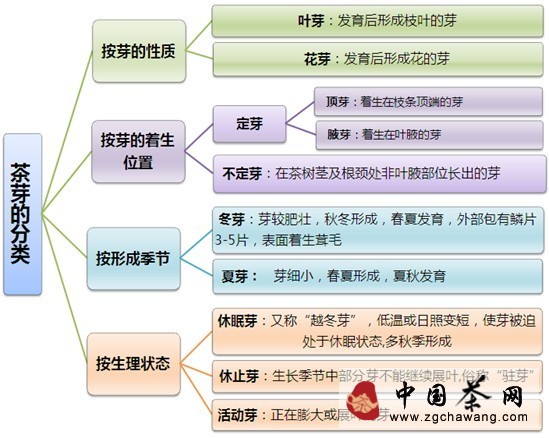
Classification of Tea Buds
On new shoots where the terminal bud has stopped growing, the two leaves near the terminal bud that appear opposite each other are called "opposite leaves." Compared to normal buds and leaves, opposite leaves age very easily, and their content of substances such as water extracts, polyphenols, catechins, amino acids, and caffeine is significantly lower than that of normal new shoots, while their crude fiber content is higher. Therefore, in production, the ratio of opposite leaves to normal buds and leaves is often used as a main indicator to assess the growth vigor of tea trees and the tenderness of fresh leaf raw materials.
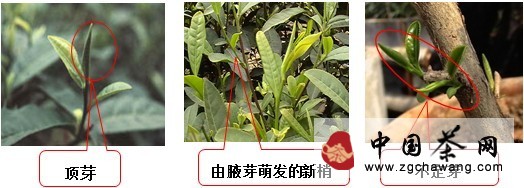
2. Tea Buds and the Quality of Tea Leaves
In production, apart from mature leaves, teas made from tea tree new shoots at different leaf positions generally have excellent biochemical quality. However, there are still differences in biochemical quality among them, showing a regular trend (as shown in the table below). The phenol-to-ammonia ratio is often used to measure the mellowness of tea taste (fresh, mellow, non-astringent, and refreshing). A smaller phenol-to-ammonia ratio indicates better mellowness and a fresher, mellower taste. A comprehensive analysis of biochemical quality indicators such as water extracts, amino acids, tea polyphenols, caffeine, and phenol-to-ammonia ratio in teas from different leaf positions shows that teas made from one-bud-two-leaf new shoots have the best biochemical quality, followed by one-bud-one-leaf and single-bud teas, while mature leaves have the poorest biochemical quality.
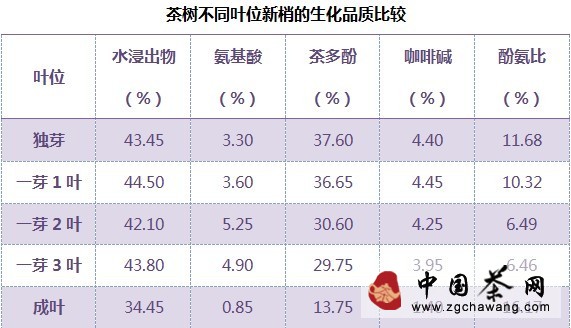
From the perspective of the current tea market, single-bud and one-bud-one-leaf new shoot teas are highly favored for their excellent appearance and have become the main raw materials for producing high-quality premium teas. Comparing the two, the water extract content in one-bud-one-leaf teas is significantly higher, making their quality as tea raw materials superior. Therefore, using one-bud-one-leaf new shoots as raw materials for high-quality premium teas not only doubles the yield compared to using single buds but also improves quality and reduces costs.
In recent years, some tea enthusiasts have excessively追捧 single-bud teas. Overall, single-bud teas have an elegant appearance, high content of polyphenols and caffeine, and good comprehensive quality. However, in terms of biochemical components, their comprehensive nutritional and drinking value is actually inferior to one-bud-one-leaf and one-bud-two-leaf teas. Thus, while tea lovers can appreciate and experience the quality of single-bud teas, there is no need to blindly pursue them.