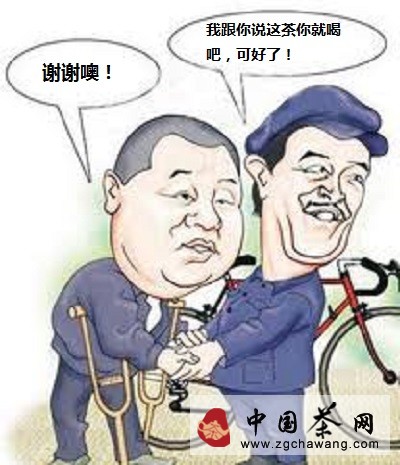
"Tea has no good or bad, only what suits you" "You'll get used to it after drinking it for a while."
Originally a reasonable statement, this is easily exploited by tea merchants for忽悠. This statement actually has context; the "tea" here refers to "various types of tea," and "suitability" includes taste, physical compatibility, and price appropriateness. More precisely: the six major tea categories, scented teas, herbal teas, etc., each have their own merits – you cannot say one type is definitively better than another. However, for any specific type of tea, there absolutely are quality differences; otherwise, the entire foundation of the tea leaf evaluation system collapses.
"My tea might not be very fragrant, but it has good 'Yun' (lingering charm)."
Aroma is the most basic criterion for judging tea quality. If it doesn't even have aroma, how can one talk about 'Yun'?
"Tea that isn't bitter and astringent isn't real tea" "Yancha that isn't bitter and astringent isn't real Yancha," etc.
This one hardly needs explanation. What tea merchant would dare忽悠 like this now? Haha.
"Astringency shows the strength of the tea soup" "Astringency can measure the power of the tea soup."
Just one counterexample: good aged Pu'er tea – none of it is astringent, yet no one would dare say such tea soup lacks power. In fact, the strength isn't about the range of the punch, but the final impact. Only tea soup with strong returning sweetness, long salivation-inducing effect, thick flavor, and long-lasting aftertaste can be considered powerful.
"I know Tea Master XXX" "I am a relative of Tea Master XXX" (implying: my tea is good!)
You are selling tea, not personal connections. Are Zhang Tianfu's relatives and neighbors necessarily tea experts? Moreover, they might not even be real relatives.
"My tea is purely natural, wild, good tea" "Wild tea is the best tea."
Tea is an artificially domesticated cash crop. Small arboreal and bush-type tea plants are the result of long-term artificial domestication. Without human management of tea gardens – no fertilization, no pest or weed control – the tea leaves might not grow well, and quality isn't necessarily guaranteed.
"It doesn't taste good now, right? My tea will taste good after storing for a few months (or a year or two)."
Strictly speaking, this isn't necessarily忽悠. Pu'er tea, White tea, Yancha, and Phoenix Dancong often improve with storage – due to aging or the 'firing' taste dissipating. However, not all teas necessarily taste better after storage. Garbage Pu'er will still be garbage even after 100 years. Over-roasted Yancha will still taste burnt even after 100 years of 'fire dissipation.' Practice is the way to test truth. For ordinary consumers, in such cases, don't buy too much at once. Wait until the storage effect is evident before deciding whether to trust that tea merchant.
"You'll get addicted to this tea after one sip." "Once you get used to my tea, you'll find other teas bland."
Tea isn't opium. As for the concept of "getting used to it" – indeed, Grandma Liu drank bitter tea all her life, got used to it, and thus found Lao Jun Mei unsatisfying.
"This tea is only available from me" "You can only get this kind of tea from me."
Strictly speaking, this also isn't necessarily忽悠, but "exclusive" doesn't equal "good"; one shouldn't inflate prices wildly just based on the concept of so-called "private custom orders."
Finally, the editor wants to address a somewhat controversial notion: Tea farmers' tea is the best tea. This concept also has忽悠 elements. The majority of tea farmers have limited production conditions and lack complete refining processes, so the raw mao cha they produce isn't necessarily truly good tea.