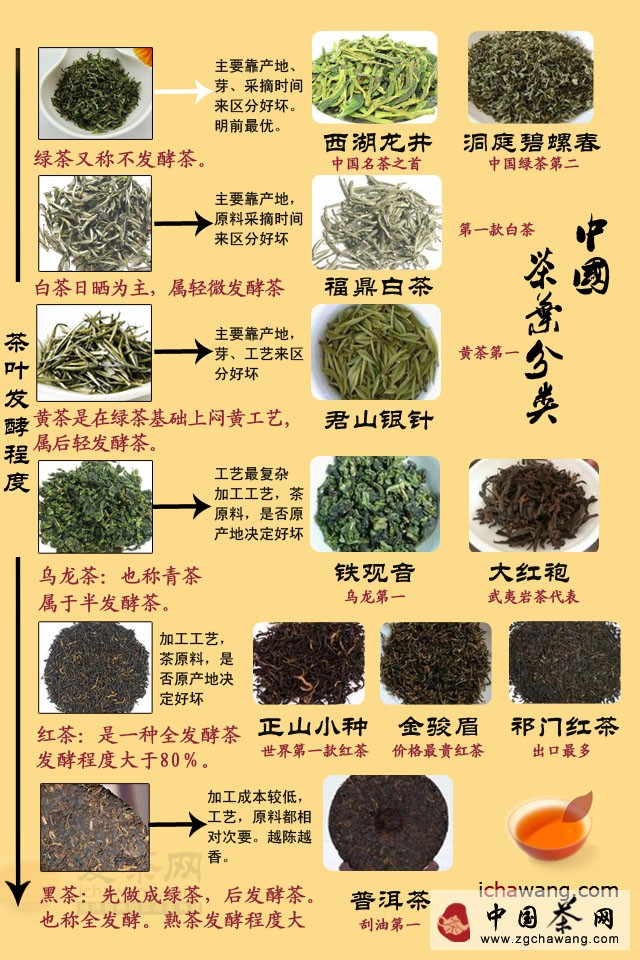
Teas produced in China are divided into six major categories: red, green, blue (oolong), yellow, black, and white.
1. Green Tea
Green tea is unfermented tea, where fresh leaves are spread to wither and then directly fried in a hot pan at 100-200 degrees to maintain their green characteristics.
2. Black Tea
Black tea is the opposite of green tea, being a fully fermented tea (fermentation degree greater than 80%). The name "black tea" comes from its red liquor color.
3. Dark Tea
Dark tea was originally mainly sold to border areas, with Yunnan's Pu'er tea being one example. Pu'er tea is made by adding water to already processed green tea and then fermenting it. Pu'er tea has the effects of lowering lipids, weight loss, and reducing blood pressure, and is very popular in Southeast Asia and Japan. However, when it comes to weight loss, the most significant effects are seen with Oolong tea.
4. Oolong Tea
Oolong tea, also known as blue tea, is a semi-fermented tea that falls between green and black tea. Oolong tea has the most complex and time-consuming process among the six major tea categories, and its brewing method is also the most particular, hence drinking oolong tea is also referred to as "Gongfu tea".
5. Yellow Tea
The famous Junshan Yinzhen tea belongs to yellow tea. The production method of yellow tea is somewhat similar to green tea, but it requires a yellowing process for three days in between.
6. White Tea
White tea is essentially made by sun-drying. Both white tea and yellow tea have excellent appearance, aroma, and taste.
Combining the above common classification methods, Chinese teas can be divided into two main parts: basic tea categories and reprocessed tea categories:
------- Fujian Xupinhao Tea Industry --------
Our company is a tea company that independently researches and develops unique products. We currently have a series of cellar-aged Tieguanyin products with exclusive national craftsmanship: Cellar-aged 2008, Cellar-aged 2003, Cellar-aged Black Pearl, and other main products, along with deep processing and wholesale: Dahongpao, Shuijingui, Dwarf Oolong, Yellow Rose, Shuixian, Rougui, and other Fujian Wuyishan rock teas, as well as Tieguanyin (Green Iron), Benshan, Huangjingui, and other Fujian Anxi oolong teas, providing high-quality sources for tea sellers at competitive prices.
Tea specialist Xiao Xu sincerely welcomes your visit!
Basic Tea Categories:
Green Tea----This is the category with the largest production volume in China, and the variety of types ranks first in the world. Green tea is characterized by high fragrance, mellow taste, beautiful shape, and durability for multiple infusions. Its production process involves fixation, rolling, and drying. Depending on the drying method during processing, green tea can be further divided into pan-fried green tea, baked green tea, steamed green tea, and sun-dried green tea.
Green tea is the category with the largest production volume in China, produced in all 18 tea-producing provinces (regions). China has the world's largest variety of green teas, exporting tens of thousands of tons annually, accounting for about 70% of the world's green tea trade market. China's traditional green teas—Meecha and Gunpowder tea—have long been popular among domestic and international consumers for their high fragrance, mellow taste, beautiful shape, and durability for multiple infusions.
Black Tea----The difference between black tea and green tea lies in the processing method. During black tea processing, fixation is omitted, and instead, withering is used to reduce part of the moisture in the fresh leaves, followed by rolling (kneading into strips or cutting into granules), and then fermentation, which oxidizes the tea polyphenols, turning them into red compounds. Some of these compounds are soluble in water, while others are insoluble and accumulate in the leaves, thus forming the red liquor and red leaves. Black tea mainly includes three categories: Souchong black tea, Gongfu black tea, and broken black tea.
Blue Tea (Oolong Tea)----This is a semi-fermented tea, meaning it is appropriately fermented during processing, causing the leaves to slightly redden, placing it between green and black tea. It has the fresh intensity of green tea and the sweet mellowness of black tea. Because the middle of the leaf is green while the edges are red, it is called "green leaves with red borders".
White Tea----This is a specialty of China. During processing, it is neither fried nor rolled; only the tender leaves covered with fine hairs on the back are sun-dried or baked gently over low heat, thus preserving the white hairs intact. White tea is mainly produced in Fuding, Zhenghe, Songxi, and Jianyang counties in Fujian, and includes varieties such as "Silver Needle", "White Peony", "Gongmei", and "Shoumei".
Yellow Tea----During the tea-making process, a pile-wilting and yellowing process is used, resulting in yellow leaves and yellow liquor. It is divided into "Yellow Bud Tea" (including Junshan Yinzhen from Dongting Lake, Hunan; Mengding Huangya from Ya'an and Mingshan County, Sichuan; Huonei Ya from Huoshan, Anhui), "Yellow Small Tea" (including Beigang in Yueyang, Hunan; Weishan Maojian from Ningxiang, Hunan; Pingyang Huangtang from Pingyang, Zhejiang; Luyuan from Yuan'an, Hubei), and "Yellow Large Tea" (including Dayeqing from Guangdong; Huoshan Huang Da Cha from Anhui).
Dark Tea----Uses coarse old raw materials, and undergoes a longer piling fermentation time during processing, causing the leaf color to become dark brown. It is an essential daily necessity for Tibetan, Mongolian, Uyghur, and other brother ethnic groups. Varieties include "Hunan Dark Tea", "Hubei Old Green Tea", "Guangxi Liupao Tea", Sichuan's "West Road Border Tea" and "South Road Border Tea", Yunnan's "Compressed Tea", "Flat Tea", "Square Tea", and "Round Tea".
Reprocessed Tea
Teas that are reprocessed from various raw teas or refined teas are called reprocessed teas, including scented teas, compressed teas, liquid teas, instant teas, and medicinal teas.
Medicinal Tea----Combining herbs with tea to make medicinal tea enhances and strengthens the efficacy of the herbs, facilitates the dissolution of the herbs, adds aroma, and harmonizes the herbal flavors. There are many types of such teas, such as "Noon Tea", "Ginger Tea Powder", "Longevity Tea", "Weight Loss Tea", etc.
Scented Tea----This is a relatively rare variety of tea. It is a product that uses floral scents to enhance the tea's aroma and is very popular in China. Generally, green tea is used as the base, though a minority use black tea or oolong tea as the base. Based on tea's characteristic of easily absorbing foreign odors, it is processed using scenting with fragrant flowers. The flower varieties used include jasmine, osmanthus, and several others, with jasmine being the most common.