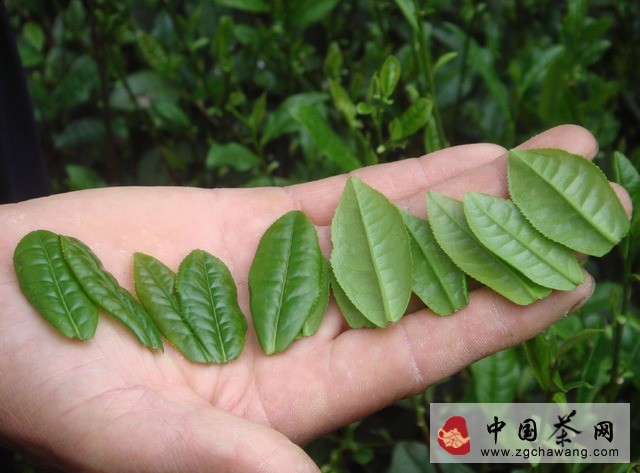
Lu'an Melon Seed Tea, a famous historical Chinese tea and one of China's top ten historical famous teas,简称瓜片, produced in Lu'an, Anhui Province. During the Tang Dynasty, it was called "Luzhou Lu'an Tea" and was considered a famous tea. In the Ming Dynasty, it began to be called "Lu'an Melon Seed Tea" and was regarded as a high-grade and premium tea. During the Qing Dynasty, it was a tribute tea for the imperial court. Lu'an Melon Seed Tea (also known as slice tea) is a special type of green tea. It is made from local unique varieties, through processes like separating leaves and removing tender buds and stems, using unique traditional processing techniques to create melon-seed-shaped tea leaves. "Lu'an Melon Seed Tea" has a long historical background and rich cultural connotation.
The fame of "Lu'an Melon Seed Tea" throughout ancient and modern times, both domestically and internationally, is also attributed to its unique origin, processing techniques, and quality advantages.
The main production areas are the old revolutionary base areas, originally Jinzhai County and Yu'an District, located at the northern foot of the Dabie Mountains. Among them, the tea produced by the Bat Cave Tea Farm is the most authentic and can be considered the finest among Melon Seed Teas. Meanwhile, the harvesting of "Lu'an Melon Seed Tea" is also unique; tea farmers pick the robust leaves from the tender shoots of tea branches. Therefore, the leaves are fleshy and mellow, with optimal nutrition, making it the only slice tea in China that is made solely from leaves without stems or buds.
The stir-frying tools for "Lu'an Melon Seed Tea" are the primitive raw wok, Miscanthus broom, and chestnut charcoal. It involves pulling fire for turning and drying, manual stir-frying, up to 81 times. The tea consists of single leaves without stems or buds, with a precious green color, a moist appearance with frost-like bloom, forming unique qualities such as clear, bright green liquor, high aroma, and long-lasting aftertaste. Precisely because of this, "Lu'an Melon Seed Tea" is not only a beverage for relieving heat and quenching thirst but also a good medicine for clearing the mind, improving eyesight, refreshing, and relieving fatigue. It is even a excellent health product for aiding digestion, detoxification, beauty, and reducing fatigue. It can also improve indigestion and bacterial acute diarrhea; drinking some Lu'an Melon Seed Tea can alleviate the condition.
Lu'an produces the largest quantity of Lu'an Melon Seed Tea, while Qishan Village in Jinzhai County has the best quality. The original production area of Melon Seed Tea is around Qitou Mountain, which was under the administration of Lu'an in the past and now belongs to Jinzhai County. The "Qishan Cloud Mist" tea produced by Qitou Mountain is the finest of Lu'an Melon Seed Tea. Qitou Mountain is a remnant of the Dabie Mountains, with an altitude of 804 meters, located at the northwestern edge of the Dabie Mountain area, connected to the Jianghuai Hills. It stands tall and majestic dozens of miles away, like a natural screen. The entire mountain is composed of granite, with lush forests, rugged rocks, flowing streams and waterfalls, and enveloped in mist. On the south slope near Qishan Village, there is a stone cave located on inaccessible cliffs, inhabited by a large number of bats, hence called Bat Cave.
The picking and processing techniques of Lu'an Melon Seed Tea are different from other famous teas. Spring tea harvesting begins after Grain Rain, when new shoots have formed "open leaves." The picking standard is mainly one bud with two or three leaves. After fresh leaves are picked, they are promptly separated; tender leaves (unopened) and old leaves (opened) are separated to stir-fry Melon Seed Tea, while buds, stems, and coarse old leaves are stir-fried into "Needle Bundles" as by-products.
The stir-frying process of Lu'an Melon Seed Tea is divided into five steps: raw wok, ripe wok, first drying, slight firing, and full firing.