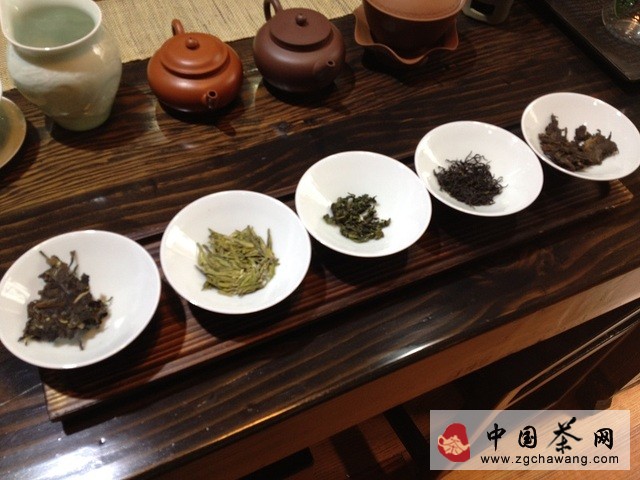
Tea is divided into six major categories: "Green Tea, Yellow Tea, Oolong Tea, White Tea, Black Tea, Dark Tea". Pu'er tea is unique and debatable due to its processing; here, we temporarily adopt the widely accepted classification that "raw Pu'er belongs to green tea, and ripe Pu'er belongs to dark tea".
Different tea types offer different tasting experiences: green tea for its freshness, black tea for its mellowness, oolong for its aroma, and Pu'er for its aged character.
Tea beginners often can't tell what type of tea they are looking at, especially before brewing when examining the dry leaves. Buying various books on tea tasting can feel like drowning in an ocean of knowledge without grasping the essentials. We understand your confusion and will only tell you the simplest things. Beginners should travel light!
First, it's crucial to understand the standard for tea classification. The black tea, green tea, and oolong tea you usually hear about are essentially differentiated not by the tea plant variety, but by the processing technique, specifically the level of fermentation which determines its category. (Someone saying black tea grows on black tea plants and green tea on green tea plants would be quite mistaken).
"Fermentation level" is the result; in terms of action, it depends on whether "killing the green" (sha qing) occurs, and when. Killing the green involves using high temperature to destroy and deactivate the oxidizing enzymes in the fresh leaves, inhibiting the enzymatic oxidation of tea polyphenols. Nowadays, when a movie finishes filming, it's also called "killing the green", probably meaning "completion, finalization". Simply put, people choose different timings for killing the green after the fresh tea leaves are picked to control the category of the finished tea.
Killing the green immediately after picking results in green tea; partial fermentation followed by killing the green results in oolong tea; full fermentation without killing the green results in black tea; additionally, there is the very special white tea, which is neither fermented nor kill-green processed; and dark tea, which is kill-green processed followed by artificial fermentation. The most unique is yellow tea, simply understood as green tea that is kill-green processed and then piled to yellow (think of stir-frying greens and covering the pot, hehe).
Knowing the essential differences in processing, let's learn simple identification. The varieties of tea are very rich, and there are always exceptions; here we only discuss the basic rules.
The secret method: First look at the shape, second distinguish the color, third smell the aroma.
The shape of tea leaves essentially falls into three categories: bud tea, leaf tea, and compressed tea. From a distance, if you see tender buds, regardless of color, there's a 90% chance it's green tea or black tea, because these two types focus on fresh, brisk flavor, and tender buds have the highest content of theanine, responsible for umami. The remaining less than 10% possibility might be Palace Grade Pu'er loose tea, set it aside for now. If you see larger leaves or leaves rolled into long strips, balls, or other shapes, it's basically oolong tea. Of course, it could also be loose Pu'er tea, but generally, non-expert tea drinkers won't encounter it easily, so let's put it aside. If it's compressed into cakes, tuos, bricks, quite dense, and could potentially be used as a self-defense weapon in an emergency, classify it all as dark tea, of which ripe Pu'er is a very important type.
Next, look closer. For tender buds, green or red, classify directly by color: green is green tea, yellow-green is yellow tea, reddish-yellow or reddish-black, black is black tea. For larger leaves, no matter how they are shaped, first treat them all as oolong tea, to be judged later by aroma. Among compressed teas, dark brown ones belong to dark tea, yellow-green or brownish-green ones are raw Pu'er tea.
At this point, the final step of smelling the aroma is just for confirmation. Green tea is fresh with a grassy scent; black tea has floral, fruity notes and a ripe aroma (somewhat like chestnuts); oolong tea is the most fragrant,芬芳扑鼻 (fragrant and assailing the nostrils), with an additional unique roasted note. If you encounter loose Pu'er tea now, its aroma is similar to green tea, quite different from other oolong teas. Pu'er has an aged aroma; ripe Pu'er is close to a jujube (date) flavor; raw Pu'er generally has a rich orchid fragrance and a 'sun-dried' scent. Besides these, dark tea has a medicinal aroma, and white tea has the freshness of green tea plus a 'sun-dried' scent.
The above is offered to elicit more valuable contributions. We welcome all tea friends to share your experiences. For any valuable experience shared, we will offer a small gift. Let's work together to make this beginner's guide more accurate and easier to understand!