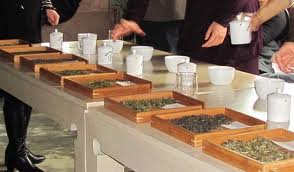
Internal Quality Evaluation: Liquor Color
The internal quality evaluation covers four items: liquor color, aroma, taste, and infused leaves. Pour the brewed tea liquor from the cup into the evaluation bowl. After preparing the liquor, you can first smell the aroma in the cup, then observe the color in the bowl (for green tea, whose color changes easily, it's better to observe the color first before smelling the aroma), then taste the flavor, and finally examine the infused leaves.
1. Liquor Color
This refers to the color of the tea liquor. Evaluating liquor color must be done quickly because polyphenols dissolved in hot water oxidize easily upon contact with air, causing the liquor of green tea to turn yellow or even red, oolong tea liquor to turn red, and black tea liquor to darken. Green tea changes the fastest. Leaving it too long can make the liquor turbid and cause sediment. Therefore, for green tea, observe the color first. Even for other tea types, it's advisable to quickly glance at the liquor color before smelling the aroma to have a general idea. When smelling the aroma, combine the observation of the liquor color, especially in cold winter, to avoid the drawback of the liquor cooling down or changing color after smelling.
Liquor color evaluation is mainly based on three aspects: hue, brightness, and turbidity.
Hue: The liquor color of tea is related not only to the tea cultivar, environmental conditions, and tenderness of the fresh leaves but also to different processing methods, which give each tea type its distinct color and liquor color. Problems in processing techniques can also lead to abnormal colors. When evaluating hue, focus on three aspects: normal color, defective color, and aged color.
Normal color: Refers to the liquor color presented after brewing tea produced under normal processing conditions, i.e., the characteristic liquor color of each tea type. For example, green tea has a green liquor, green with a hint of yellow; black tea has a red liquor, bright and reddish; oolong tea has an orange-yellow, bright liquor; white tea has a pale, light yellow liquor; yellow tea has a yellow liquor; dark tea has a light orange-yellow liquor, etc.
Defective color: Caused by improper handling during harvesting, transportation, spreading, or initial processing of fresh leaves, leading to deterioration and an abnormal liquor color. For example, improper handling of fresh leaves can cause a yellowish liquor in mild cases and a reddish liquor in severe cases. Improper de-enzyming (killing-green) resulting in red stems and leaves can darken or add a reddish tint to the liquor. Over-roasting during drying of green tea can make the liquor yellowish and turbid. Over-fermentation of black tea results in a deep, dark liquor, etc.

Aged color: Aging is one of the characteristics of tea. Under normal storage conditions, the degree of aging deepens over time. Discontinuities in the initial processing stages, such as not rolling promptly after de-enzyming or not drying promptly after rolling, can make new tea exhibit an aged color. For instance, new green tea has a fresh, bright green liquor; aged green tea has a grayish-yellow or dull liquor.
Brightness: Refers to the degree of brightness or dullness. Bright means less incident light is absorbed by the liquor layer and more is reflected, while dull is the opposite. Generally, good brightness indicates good quality, and poor brightness indicates inferior quality. A liquor that allows a clear view to the bottom is considered bright. For green tea, strong reflection from the bottom of the bowl indicates brightness. For black tea, one can also observe the color and thickness of the golden ring at the edge of the liquor surface (called the "golden ring"). A normal, vivid, and wide ring indicates good brightness; an abnormal, dull, and narrow ring indicates poor brightness and declining quality.
Turbidity: Refers to the degree of clarity or cloudiness. Clear means the liquor is pure, transparent, unmixed, allowing a clear view to the bottom—limpid and transparent. Turbid or muddy means the liquor is unclear and opaque, making it difficult to see through the liquor layer to the bottom, with sediment or tiny suspended particles. Liquor from deteriorated or aged tea showing sour, stale, moldy, or aged flavors is turbid and unclear. However, two situations should be distinguished within turbidity: "cream down" or "creaming phenomenon." This is a complex of caffeine and polyphenols, soluble in hot water but not in cold water, precipitating upon cooling. Therefore, "cream down" in cooled tea liquor indicates good quality. Another phenomenon is tea made from tender fresh leaves with many fine hairs, such as high-grade Biluochun. The liquor contains many hairs suspended in the layer, which also indicates good quality.