The main components of tea leaves
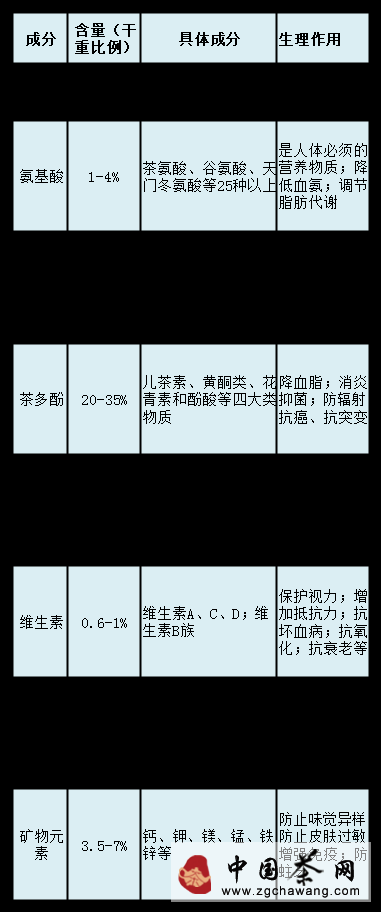
Primarily include water, proteins, amino acids, caffeine, polyphenols, carbohydrates, lipids, minerals, plant pigments, vitamins, volatile components, and organic acids. Not all of these substances can dissolve into the tea infusion through the brewing process. Components like lipids, plant pigments, and proteins are difficult to dissolve in water. The composition and content of polyphenols and vitamins change during the tea manufacturing process. The main components affecting the quality of the tea infusion are carbohydrates, caffeine, amino acids, and polyphenols.
The color of tea leaves
Substances in tea leaves include: chlorophyll, xanthophyll, carotene, anthocyanins, flavonoids, catechins, vitamin C, amino acids, sugars, pectin, proteins, etc.
Catechins are colorless. During the tea manufacturing process, they interact with oxygen (oxidation), and their color gradually deepens. The more completely catechins are oxidized, the darker the color. Vitamin C also oxidizes and turns darker.
Color change sequence: green > yellow > yellow-red > red > reddish-brown > dark brown.
Amino acids and sugars also interact, producing yellowish-brown substances. Pectin and proteins, when heated and dried, solidify on the leaf surface, deepening the color.
Light-colored finished tea leaves
Mainly the color of chlorophyll.
Chlorophyll is divided into: 1. Chlorophyll A: dark green.
2. Chlorophyll B: yellowish-green.
The younger the tea leaf, the less Chlorophyll A it contains, so tender leaves mostly appear yellowish-green. When tea leaves grow larger, the proportion of Chlorophyll A increases significantly, and the leaf color becomes dark green, as in green tea, etc. During manufacturing, if the tea polyphenols in the fine hairs (trichomes) are not oxidized and remain colorless, they appear as white hairs (e.g., Bai Hao). If tea polyphenols are heavily oxidized during manufacturing, turning yellow-orange, they become golden yellow (e.g., Junshan Silver Needle, Huangshan Maofeng).
Dark-colored finished tea leaves
Usually undergo a fermentation process. The dry tea color is not bright red but mostly black or dark brown, hence the English or Russian name for black tea is 'Black Tea'. During fermentation, chlorophyll is largely destroyed, mostly turning into dark brown substances. Additionally, a substance in tea called tea polyphenols oxidizes to produce brown substances. Sugars, pectin, proteins, and other organic compounds in the tea leaves adhere to the leaf surface and, upon drying, present a dark brown or black color.
The color of the tea infusion
Light-colored category
The substances responsible for yellowish-green infusion color are overwhelmingly tea polyphenols and their oxides. The components of tea polyphenols include flavonoids and anthocyanins, most of which are colored substances soluble in hot water. There are many types of anthocyanins, some yellow, some green, forming an important part of green tea infusion color. Flavonoids are either yellow or purple; therefore, green teas containing flavonoids have a darker infusion. Catechins (colorless), during processing, undergo partial oxidation, turning into yellow substances highly soluble in hot water, which are the main substances for green tea infusion color. If the processing temperature is not high enough, it can cause further oxidation of catechins, changing from yellow to reddish-brown. A cup of tea left for a long time will deepen in color; tea brewed from poorly stored leaves will also yield a darker infusion, due to the oxidation of tea polyphenols.
Dark-colored category
Usually not subjected to high-temperature de-enzyming (kill-green). After fermentation, tea polyphenols change drastically, oxidizing heavily and deepening in color, turning into reddish-yellow and reddish-brown substances. These mainly include theaflavins, thearubigins, and theabrownins, collectively known as 'black tea pigments'. Therefore, high-quality black tea contains more theaflavins and thearubigins.
The aroma of tea
Generally speaking, aroma is proportional to temperature. Freshly picked tea leaves have no fragrance, only a grassy smell. During processing, the grassy odor continuously volatilizes, with most of it lost. Meanwhile, aromatic substances, generally having higher boiling points, are retained. Thus, the finished tea product acquires its fragrance.
High processing temperature > imparts sweet, caramel-like aroma.
Low processing temperature > grassy odor not fully volatilized, resulting in a green/grassy taste.
The taste of tea
Umami (freshness): Main component is amino acids, fresh with a hint of sweetness, high content in tender tea leaves.
Astringency: Main components are polyphenolic substances.
Sweetness: Main components are soluble sugars, and some amino acids.
Bitterness: Main components are caffeine, anthocyanins, tea saponins.