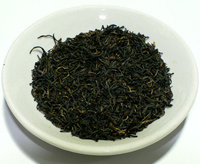
Keemun Black Tea is a famous historical Chinese tea. A renowned premium black tea, abbreviated as Keemun, it is produced in Qimen, Dongzhi, Guichi, Shitai, and Yixian counties of Anhui Province, as well as in Fuliang, Jiangxi. "Keemun stands out supreme among all fragrances, its high reputation and exquisite aroma are unparalleled." Keemun Black Tea is the finest among black teas, enjoying great prestige. It is a beloved drink of the British Queen and royal family, celebrated for its high fragrance and renowned far and wide, honored with the titles "Supreme Among Fragrances" and "Queen of Black Teas."
The quality of Keemun Black Tea varies across the production region, which is divided into three areas. From Rongkou up to Houtan and then to Likou in western Qimen, the tea from Guixi, Huangjialing, and Shijiyuan is considered the best, with moderately thick leaves, a mellow and lingering taste, rich color, and a fermentation time of about one and a half hours. From Shanli, Ruokeng to Zhukou, the tea from Ruokeng, Shanli, and Gaotang is excellent, with thinner leaves, good strip shape, strong flavor, and good color, requiring only one hour of fermentation. From Tafang to Qihong and then to Daohu, represented by Tangkengtou, Zongli, Luxi, and Daohu, the tea has thick leaves, strong flavor, dark color, and coarse stems, requiring over two hours of fermentation; this type is generally more suitable for making green tea. The black tea from the Guixi to Likou area is of the highest quality. In the past, foreign merchants would wait for the arrival of three chests—Huri Shun Gong from Guixi, Huangshan from Likou, and Baiyue—in Shanghai before opening purchases, making this area's black tea the crown of Keemun Black Tea.
The natural quality of the tea is optimal in the Likou, Shanli, and Pingli areas of Qimen. Local tea plant varieties are high-yielding and excellent in quality, grown in fertile red-yellow soil, with a mild climate, ample rainfall, and moderate sunlight, resulting in tender leaves rich in water-soluble substances. The best quality is harvested from March to April. Keemun tea has tightly rolled, slender, and even strips with a beautiful tip, and a dark, moist color (commonly known as "precious luster"). Its internal quality offers a fresh fragrance with hints of honey, and top-grade teas even carry an orchid scent (known as the "Keemun aroma"), which is rich and long-lasting. The liquor is bright red, with a sweet, fresh, and mellow taste, and the brewed leaves are red and bright. Drinking it plain best appreciates its lasting fragrance, and adding fresh milk does not diminish its aroma. It is most suitable for drinking in spring, as well as for afternoon tea or before bed. Qimen tea was already famous in the Tang Dynasty. According to historical records, before the Guangxu period of the Qing Dynasty, this area did not produce black tea but was known for green tea, made similarly to Liu'an tea, hence it was once called "Anlu." In the first year of Guangxu (1875), a man named Yu Ganchen from Yixian County, returning from official duties in Fujian, admired the popularity and profitability of Fujian black tea (Min Hong) and decided to experiment with local production. He established a black tea workshop in Yaodu Street, Zhide County (now Dongzhi County, Chizhou City), imitating the Fujian method, and succeeded. The following year, he set up branch workshops in Xilu and Shanli of Qimen County, beginning the successful production of Keemun black tea. At the same time, Hu Yuanlong from Qimen conducted "green tea to black tea" conversion in Guixi, Pingli Town, southern Qimen, establishing the "Rishun Tea Factory" for trial production, which also succeeded. He registered the brand "Hu Rishun," and from then on, "Keemun" expanded production, forming an important black tea region in China. Hu Yuanlong thus became the "originator" of Keemun black tea. It now has over 100 years of history. Keemun tea leaves are tightly rolled, slender, and elegant, with a bright red liquor. Its aroma particularly resembles fruit, mixed with orchid, fresh and long-lasting. It can be brewed alone or with milk. Keemun Black Tea is outstanding among "black teas," renowned worldwide for its "high fragrance, mellow taste, beautiful shape, and bright color." It originated during the Guangxu period of the Qing Dynasty and is a treasure among Gongfu black teas.
The finished tea has tightly rolled, slender strips with a beautiful tip, a dark and moist color, visible golden tips, a bright red liquor, a fresh, mellow, and rich taste, and a long-lasting fresh fragrance.
The "Keemun aroma," reminiscent of flowers, fruit, and honey, is world-famous, ranking first among the world's three high-fragrance famous teas.
Health Benefits
Since the components of black tea possess multiple pharmacological effects, enjoying black tea not only allows one to appreciate its elegant tranquility but also offers economical and delightful benefits in health and beauty, adding to its charm.
Refreshing and Relieving Fatigue
Medical experiments have found that the caffeine in black tea stimulates the cerebral cortex to excite the nerve center, promoting alertness, concentration, and making thinking reactions sharper and memory stronger. It also excites the vascular system and heart, strengthening the heartbeat, thereby accelerating blood circulation to aid metabolism. Simultaneously, it promotes sweating and diuresis, thus accelerating the excretion of lactic acid (the substance that causes muscle fatigue) and other waste materials in the body, achieving the effect of eliminating fatigue.
Promoting Saliva and Clearing Heat
Drinking black tea in summer quenches thirst and relieves heat because the polyphenols, sugars, amino acids, pectin, etc., in the tea react with saliva, stimulating saliva secretion, making the mouth feel moist and producing a cooling sensation. At the same time, caffeine regulates the body's temperature center in the hypothalamus, controlling body temperature. It also stimulates the kidneys to promote the excretion of heat and waste, maintaining physiological balance in the body.
Additionally, black tea is an excellent sports drink. Besides quenching thirst and replenishing fluids, drinking it before activities requiring stamina and endurance (such as marathon running) can enhance endurance because the caffeine provides a refreshing effect and helps the body burn fat for energy while preserving glycogen during exercise.
Diuretic
Under the combined action of caffeine and aromatic substances in black tea, kidney blood flow increases, glomerular filtration rate improves, renal microvessels expand, and the reabsorption of water by renal tubules is inhibited, thereby promoting increased urine output. This helps excrete lactic acid, uric acid (related to gout), excess salt (related to hypertension), harmful substances, etc., and alleviates edema caused by heart disease or nephritis.
Anti-inflammatory and Bactericidal
The polyphenolic compounds in black tea have anti-inflammatory effects. Experiments have found that catechins can bind to single-celled bacteria, causing protein coagulation and precipitation, thereby inhibiting and eliminating pathogens. Thus, drinking black tea is beneficial for patients with bacterial dysentery and food poisoning. Folk practices also often use strong tea to apply to wounds, bedsores, and athlete's foot.
Detoxification
Experiments have shown that the theine in black tea can adsorb heavy metals and alkaloids, precipitating and decomposing them. This is a boon for modern people exposed to industrial pollution in drinking water and food.
Stomach Nourishing
Black tea is fermented and baked, where tea polyphenols undergo enzymatic oxidation under the action of oxidase, reducing their content and thus decreasing irritation to the stomach. Moreover, these oxidation products of tea polyphenols can promote digestion. Therefore, black tea not only does not harm the stomach but can nourish it. Regularly drinking black tea with sugar or milk can reduce inflammation, protect the gastric mucosa, and aid in treating ulcers.
Other Benefits
Additionally, black tea has effects such as preventing cavities, delaying aging, lowering blood sugar, blood pressure, and blood lipids, anti-cancer, anti-radiation, and weight loss.