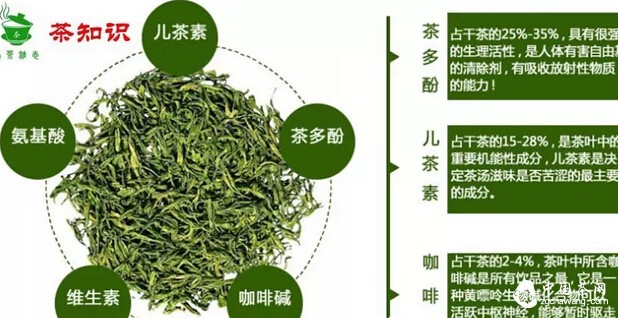
Analysis and identification show that tea leaves contain up to around 500 compounds. Some of these are essential components for the human body and are called nutritional components, such as vitamins, proteins, amino acids, lipids, sugars, and mineral elements. They have high nutritional value for humans. Another portion of compounds has health and medicinal effects, known as components with medicinal value, such as tea polyphenols, caffeine, and lipopolysaccharides.
1. Drinking tea can supplement various vitamins needed by the human body.
Tea contains multiple vitamins. Based on solubility, they can be divided into water-soluble vitamins and fat-soluble vitamins. Water-soluble vitamins (including vitamin C and B vitamins) can be directly absorbed and utilized by the body through drinking tea. Therefore, drinking tea is a good way to supplement water-soluble vitamins, and regular tea consumption can meet the body's need for various vitamins.
Vitamin C, also known as ascorbic acid, can enhance the body's resistance and immunity. Tea contains a relatively high amount of vitamin C; generally, every 100 grams of green tea can contain as much as 100 mg to 250 mg, while high-grade Longjing tea can contain over 360 mg, higher than fruits like lemons and citrus. Due to the fermentation process during processing, vitamin C in black tea and oolong tea is oxidized and reduced, leaving only tens of milligrams per 100 grams of tea, especially in black tea, where the content is even lower. Thus, the higher the grade of green tea, the relatively higher its nutritional value. Drinking just 10 grams of high-grade green tea daily can meet the human body's daily requirement for vitamin C.
Among B vitamins, vitamin B1 is also known as thiamine, B2 as riboflavin, B3 as pantothenic acid, B5 as niacin, and B11 as folic acid. The content of B vitamins in tea is shown in Table 3.
Since fat-soluble vitamins are difficult to dissolve in water, they are hard to absorb even when tea is brewed with boiling water. Therefore, it is now recommended to appropriately "eat tea" to compensate for this deficiency, by making tea into ultra-fine powder and adding it to various foods, such as tea-infused tofu, tea noodles, tea pastries, tea candies, and tea ice cream. Consuming these tea foods allows one to obtain the fat-soluble vitamin nutrients contained in tea, better realizing tea's nutritional value.
2. Drinking tea can supplement proteins and amino acids needed by the human body.
The water-soluble protein content in tea that can be directly absorbed through drinking is about 2%, while most proteins are water-insoluble substances present in the tea residue. Tea contains a rich variety of amino acids, more than 25 types, including six of the eight essential amino acids for humans: isoleucine, leucine, lysine, phenylalanine, threonine, and valine. It also contains histidine, needed for infant growth and development. Although the content of these amino acids in tea is not high, they can supplement daily requirements.
3. Drinking tea can supplement mineral elements needed by the human body.
Tea contains macroelements and trace elements required by the human body. Macroelements mainly include phosphorus, calcium, potassium, sodium, magnesium, and sulfur; trace elements mainly include iron, manganese, zinc, selenium, copper, fluorine, and iodine. For example, tea has a relatively high zinc content, especially green tea, with an average zinc content of 73 micrograms per gram, and up to 252 micrograms in some cases; black tea also averages 32 micrograms of zinc per gram. The average iron content in tea is 123 micrograms per gram of dry leaves; black tea contains 196 micrograms per gram. These elements play important roles in human physiological functions. Regular tea drinking is one important way to obtain these mineral elements.