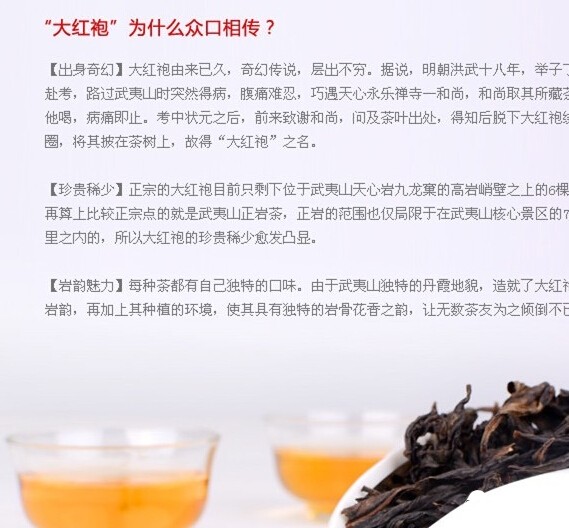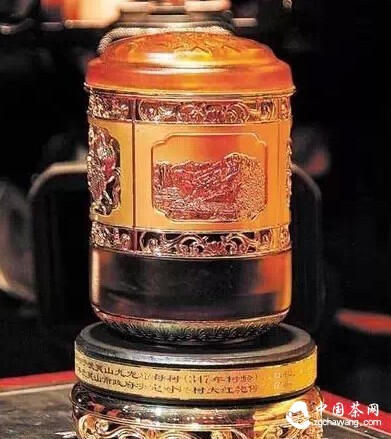
In 1998, at the Fifth Wuyi Rock Tea Festival, 20 grams of tea from the mother trees were auctioned for the first time, fetching a staggering price of 156,800 RMB. In 2005, at the Seventh China Wuyishan Da Hong Pao Cultural Festival, 20 grams were auctioned for the fifth time, reaching a sky-high price of 208,000 RMB, making it renowned worldwide.
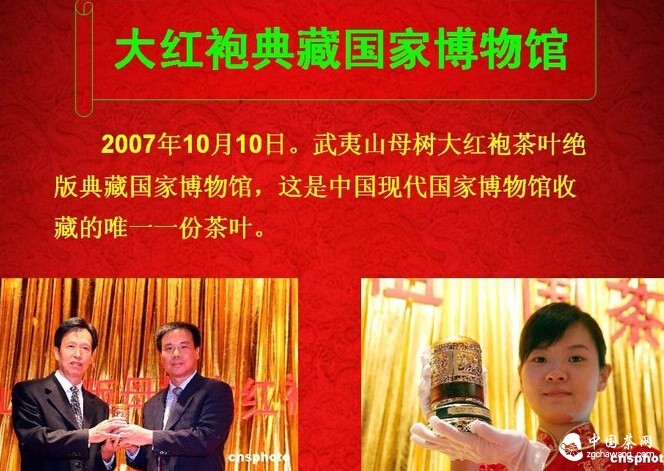
On June 18, 2003, the People's Insurance Company of China (PICC) Wuyishan Branch officially signed an insurance policy with the Wuyishan Municipal Government, underwriting the six Da Hong Pao mother trees with product liability insurance worth 100 million RMB. This is the largest insurance amount PICC has ever placed on famous tea. Note: It's not hundreds of thousands or millions, but one hundred million RMB!
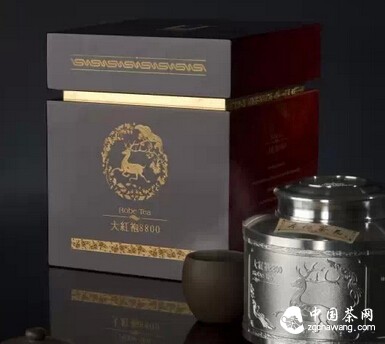
In 2008, the large-scale tea-tourism interactive project "Impression · Da Hong Pao," planned by Zhang Yimou, commenced construction.
In 2010, the fifth impression work created by Zhang Yimou, Wang Chaoge, and Fan Yue—"Impression · Da Hong Pao"—officially premiered in Wuyishan. In the same year, "Wuyishan Da Hong Pao" was newly recognized as a China Famous Trademark by the State Administration for Industry and Commerce.
In 2011, the exclusive tea brand "Impression Da Hong Pao" was jointly launched by Guan Impression Art Development Co., Ltd. (founded by Zhang Yimou, Wang Chaoge, and Fan Yue) and Wuyi Star Tea Industry Co., Ltd. This is the first derivative tea brand from the "Impression Iron Triangle's" series of large-scale landscape live performances in China, marking the beginning of a breakthrough for Chinese tea brands.
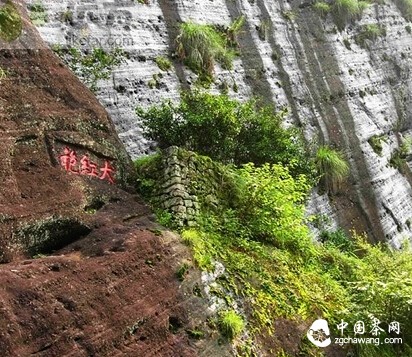
The famous cultivar "Da Hong Pao" tea trees grow on the high cliffs of Jiulongke in Wuyishan. The rock face still preserves the "Da Hong Pao" stone inscription made by a monk from Tianxin Temple in 1927. Here, sunlight exposure is short, with mostly reflected light, significant day-night temperature differences, and a constant trickle of fine spring water moistening the rock top. This unique natural environment creates the distinctive quality of Da Hong Pao. There are currently six Da Hong Pao tea bushes, all shrub-like tea clusters with relatively thick leaves and slightly reddish buds. When sunlight shines on the tea trees and rocks, the reflected light makes them appear brilliantly red and very conspicuous.
Follow the scent of tea on a journey, strolling through Da Hong Pao. On this tour route, you will see the world wonder Da Hong Pao and Wuyishan's largest Buddhist temple, Tianxin Yongle Chan Temple. Walking on the rugged path, the beautiful surrounding scenery will enchant you, making you reluctant to leave. The meaningful cliff carvings, the rich and mellow tea culture, and the long-standing Buddhist culture, if savored carefully, harmonize the pictorial and poetic意境 (artistic conception), allowing you to feel a fusion of scene and emotion, full of wit and interest. This is an ecological journey, a tea journey, and also a cultural journey. Ancient literati left inscriptions here,历代高僧 (monks of past dynasties) paused here, and contemporary tourists linger here.
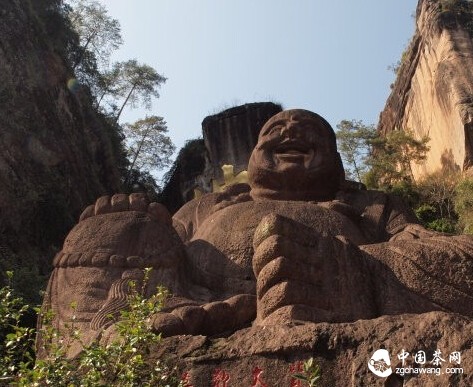
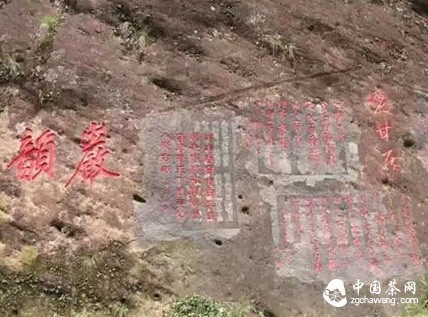
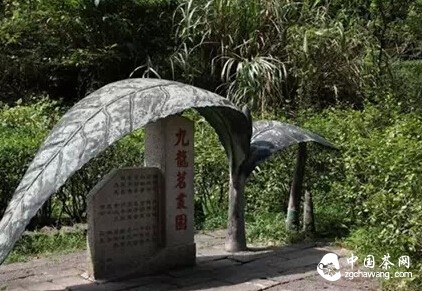
In this open area, you will find a large collection of cliff carvings. The Song Dynasty poet Fan Zhongyan praised in a poem: "Every year spring comes from the southeast, / The Jianxi River warms first, its waters slightly open. / The rare tea by the溪边 (streamside) is crowned under heaven, / Planted since ancient times by武夷仙人 (Wuyi immortals)." By the Yuan Dynasty, a Royal Tea Garden had been established here specifically to oversee the production of tribute tea. Proceeding along the path, you reach the Famous Cultivar Garden. The three huge artificially carved tea leaves you see represent the standard picking leaf shape for Wuyi Rock Tea, commonly known as "two leaves embracing a bud." The stone tablet nearby is engraved with the names of some famous Wuyi Rock Tea cultivars.
Walking on the rugged小路 (path), the beautiful surrounding scenery will enchant you, making you reluctant to leave.
Continuing forward, passing by晚甘亭 (Wangan Pavilion), an excellent spot for shade, you'll see several tea bushes对面 (opposite) that grow under the cliff face, receiving short sunlight year-round, hence called "Bu Ming Tian" (Not Seeing the Sky).
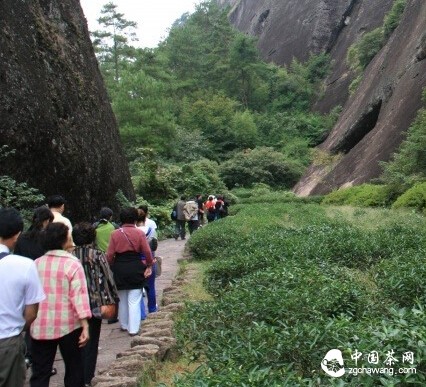
Jiulongke is a secluded and奇邃 (wondrously deep) gorge, named for the nine dragons said to reside here amidst the jagged peaks.巨石 (Huge rocks) are scattered in the gorge, with细泉 (slender springs)潺潺 (babbling) flowing, and clusters of tea bushes遍布 (covering everywhere). It is truly a valley full of spring colors and vibrant生机 (vitality), deserving its title as the "Kingdom of Tea." On the last rock face within Jiulongke, there is a盆景似的 (bonsai-like) tea garden built with stones, where several clusters of tea trees grow. These are the world-renowned "King of Teas"—the Da Hong Pao tea trees.
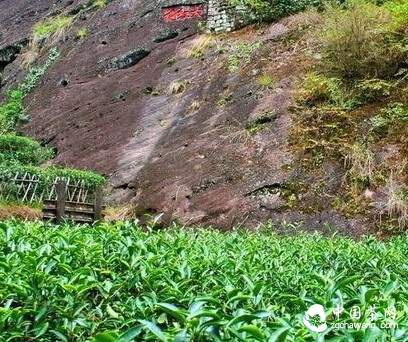
Having come this far on the journey, do you now understand why Da Hong Pao earns the title "King of Teas"? Because its growing environment is uniquely advantaged.
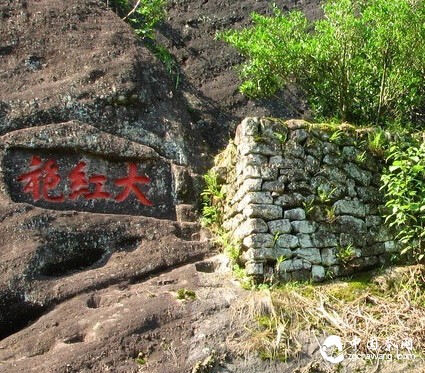
Firstly, on the cliff where the tea trees are located, there is a long, narrow岩罅 (rock crevice). Water drips from the top of the rock year-round, and along with the water, organic matter like moss falls, making the soil here more moist and fertile than elsewhere. Secondly, the upright rock walls on both sides result in limited sunlight exposure and relatively stable temperatures. Natural conditions are the objective factors contributing to famous tea, while the精湛 (exquisite) processing工艺 (craftsmanship), the茶农 (tea farmers') usual careful management, and the茶师 (tea masters') unique picking techniques further enhance Da Hong Pao's天然真味 (natural authentic flavor) and岩骨花香 (rock bone floral aroma).
Such complex and strict operating procedures stem from the经验积累 (accumulated experience) of countless generations of tea masters. Such精细而又严密 (precise and rigorous) technical requirements reflect the无限珍惜 (boundless珍惜 (cherishing)) of the Wuyishan people for this稀有物种 (rare species). No wonder when ancient Wuyishan temples picked and processed "Da Hong Pao," the monks would焚香沐手 (burn incense and wash their hands), set up altars, and chant scriptures, fearing any slight disrespect might lose the tea's精灵 (spirit) and岩韵 (rock rhyme). Superior natural conditions and精湛独到的 (exquisite and unique) tea-making工艺 (craftsmanship) make "Da Hong Pao" the "King of Teas."