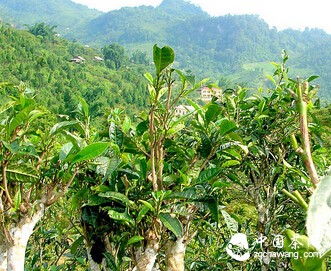
Ancient tree pure material is the highest grade of Pu'er tea. 'Pure material' can only be called so on the premise of ancient trees; terrace-grown tea has no such concept.
(I) Ancient Trees
As people age, their experience grows; as trees age, their roots become deeper, thicker, and more extensive—so-called deep-rootedness. After a hundred years, a person is said to have passed away. If a tree is still alive after a hundred years, it can probably be called an ancient tree. Or, if living people only see the tree grow but never see it born, it can also be called an ancient tree. Many people talk about ancient tree tea, but few define its age. In our opinion, it should be over a hundred years old to be called an ancient tree. The normal lifespan of a tree should be much longer than that of a human. When we say ancient tree, we use the 'ancient' from 'passing away after a hundred years' to refer to the 'ancient' of ancient trees, so ancient trees should be over a hundred years old. A hundred years is time, history, and something that cannot be created by any human effort or science. A tree that has grown for a hundred years will have very deep and extensive roots. We all know that plants rely on their roots to absorb nutrients and water. Plants with deep and extensive roots naturally have unique advantages in absorbing nutrients and water from the ground, and they have strong vitality. Abundant and sufficient nutrient absorption is reflected in thick, glossy leaves. Speaking of ancient tree tea, it does not only represent its long tree age, but the long tree age represents its deep roots, strong vitality, and sufficient nutrient absorption. Reflected in the tea leaves, it means rich internal contents.
In the same ecology, ancient tree tea is superior to small tree tea. What we emphasize here is the same ecology. By the same ecology, we mean that either none of them use chemical fertilizers or pesticides, or all of them use the same chemical fertilizers and pesticides. If no chemical fertilizers or pesticides are used, small tree tea will appear weak and astringent; if chemical fertilizers and pesticides are used, small tree tea will be both bitter and astringent.
1. Thousand-Year-Old Wild Ancient Tea Trees (Tang Dynasty or before, tree age over 1000 years)
Wild ancient tea trees in primeval rainforests, generally with a diameter at breast height of 1250px, a girth of 4000px, a height of over 15m, and a tree age of over a thousand years, extremely rare. The leaves are large, thick, with bulging veins, deep leaf margin serrations, and 9~16 pairs of leaf veins, completely different from the cultivated large-leaf varieties (6-9 pairs) planted in modern tea gardens. They have high tenderness retention, and a bud with two leaves generally weighs 0.5~1g, three times the weight of ordinary ancient tree tea. The sun-dried green tea made from them has a green-yellow liquor, a refreshing aroma, a slight wild tea-specific fishy smell completely different from the aroma of cultivated tea trees, rich water-soluble pectin, almost no bitterness or astringency, a full mouth of sweet moisture, and an extremely long-lasting and lingering aftertaste.
2. Large Tea Trees (Song Dynasty, tree age 500~1000 years)
Ethnic minority tea farmers in southern Yunnan tea regions call cultivated ancient tea trees over 5m tall and difficult to pick large tea trees. Large tea trees are generally the oldest few trees or the largest tea tree kings in the tea garden. Generally, large tea trees have a diameter at breast height of 30~1250px, a girth of 100~4000px, a height of 5~15m, and a tree age mostly between 500~1000 years. The sun-dried green tea made from the tender buds of large tea trees is called large tree tea. Based on tasting experience, the older the tea tree and the better the ecological environment, the more coordinated the taste, the higher the content of water-soluble pectin and resin, and the more mellow the taste.
3. Original Ecology Ancient Tea Trees (Ming Dynasty, tree age 300~500 years)
Most have a diameter at breast height of 10~875px, a girth of 35~2750px, a height of 3~6m, and a tree age mostly around three to four hundred years. Since the ground vegetation has not been removed, the tea garden ecology is good. Although the trees are very old, they show no signs of aging. The sun-dried green tea made from them has thick and robust buds and leaves, most with 9~16 pairs of leaf veins, rich pectin content, a sweet and mellow taste, slight bitterness and astringency, which stay in the mouth for only a short time, about a few seconds.
4. Ecology Ancient Tea Trees (Qing Dynasty, tree age 100~200 years)
Most have a diameter at breast height of 10~625px, a girth of 35~2000px, a height of 2.5~4.5m, and a tree age mostly around one to two hundred years. Due to the removal of a large amount of ground vegetation and frequent picking, many ecology ancient tea trees show signs of aging. The sun-dried green tea made from them has thick and robust buds and leaves, most with 9~16 pairs of leaf veins, rich pectin content, a sweet and mellow taste, weak bitterness and astringency, which stay in the mouth for a short time, about a dozen seconds, making it difficult to distinguish from older original ecology ancient tree tea.
5. Old Tea Trees (Republic of China, tree age 60~100 years)
Planted during the Republic of China period (1912-1949), most tea trees have a diameter at breast height of 5~375px, a girth of 15~1250px, a height of 1.5~3m, and a tree age of 60~100 years, less than 100 years. The sun-dried green tea made from them has relatively thick and robust buds and leaves, most with 9~16 pairs of leaf veins, rich pectin content, a sweet and mellow taste, some bitterness and astringency, which stay in the mouth for a short time, about a few dozen seconds, making it somewhat difficult to distinguish from ancient tree tea.
6. Small Tea Trees (1949-1976, tree age 35~60 years)
Tea trees planted between 1949 and 1976, with a tree age of 35~60 years. Most plants are 80~3000px tall, with about 1500~2000 plants per mu. The sun-dried green tea made from them has less robust buds and leaves, bitterness and astringency stay in the mouth for a long time, and the taste coordination is better than terrace tea but worse than ancient tree tea.
7. Terrace Tea Trees (1976-present, tree age 0~35 years)
After 1976, clonal cuttings of row-planted densely cultivated asexual tea tree varieties. Most plants are 60~2250px tall, with about 2000~3000 plants per mu. Due to the use of chemical fertilizers and dense planting, the yield is high, the growth cycle is fast, and the tea is strongly bitter and astringent, with the bitterness and astringency lingering in the mouth for a long time, vastly different from the taste of ancient tree tea.
(II) Pure Material
The following are five common misconceptions about pure material tea.
First: Ancient tree tea from different mountains. The characteristic of this 'pure material' tea is that as long as it is ancient tree tea, no matter which mountain it comes from or whether it is spring or autumn tea, as long as it contains no terrace tea ingredients, it is considered pure material.
Second: Ancient tree tea from the same mountain or the same village, regardless of tree age or batch. This type of pure material does not distinguish between tree ages or batches, only by season, meaning it only distinguishes between spring tea, autumn tea, and rain tea (summer tea).
Third: Ancient tree tea from the same tea garden, regardless of batch or tree age. The characteristic of this pure material tea is that it comes from the same tea garden, not the same mountain or village, but it also does not distinguish between picking batches. Although the tea from the trees tastes similar, the taste difference between tea picked in different batches is still very obvious, and it also does not distinguish between tree ages (generally, older trees are considered to taste better than younger ones). Tea picked in this way is mixed together and pressed into cakes for sale.
Fourth: Ancient tree tea from the same tea garden, by batch, but not by tree age. The characteristic of this pure material tea is that it does not distinguish by tree age but by batch. For example, the first batch of first spring tea, the second batch of first spring tea, etc. But the first batch may include tea from trees of different ages, such as 100 to 300-year-old ancient trees or 300 to 500-year-old ancient trees. Tea picked from trees of different ages is mixed together. The first spring tea is one batch, the second spring tea is another, and so on. There is no such thing as 300-year-old ancient tree first spring tea or 500-year-old ancient tree first spring tea. There is only first spring tea, second spring tea, etc., or pre-Qingming tea, post-Qingming tea, etc. Most private tea merchants going to buy tea, especially those picking in the tea garden themselves, operate like this, with very few exceptions.
Fifth: Ancient tree tea from the same tea garden, by tree age, but not by batch. This pure material ancient tree tea is classified by tree age but not by picking batch. For example, it is divided into 100-year-old ancient trees, 200-year-old ancient trees, etc. In the 100-year-old ancient tree category, there are first batches of first spring tea, second batches, etc. This pure material ancient tree tea is classified by tree age but not by picking batch. For example, batches one to six of spring tea are all collected, mixed together, and pressed into cakes for sale. For example, 300-year-old ancient tree spring tea or 500-year-old ancient tree spring tea, etc., without batch distinction. This type of pure material is what most private tea merchants call pure material.
The above five types are not real pure material. The following types are the real pure material.
First type of pure material: Ancient tree tea from the same tea garden, by tree age and by batch. This classification is much more rigorous than the previous ones. Such pure material must be picked in the same batch and the tree age must also be the same, so the quantity is relatively small. In the same tea garden, it is classified by tree age. Generally, the default classification of ancient tea trees is three types:
(1) 100 to 300 years (commonly known as around a hundred years).
(2) 300 to 500 years (commonly known as around 300 years).
(3) Over 500 years (commonly known as around 500 years).
When tea farmers or private tea merchants go to pick tea, they classify by the trunk size of the tea trees, i.e., by tree age as mentioned earlier, and then separately basket them by picking time, thus classifying by batch. Generally, only the first three batches of spring tea are picked, i.e., pre-Qingming tea, rarely post-Qingming tea. Although this method produces very pure tea, the quantity is low, and the labor is intense, so the price is also high.
It must be pointed out that generally, tea farmers do not pick tea by tree age or batch. They pick everything together and sell it as ancient tree tea. Unless someone orders tea from a tea farmer early and specifies their requirements, the farmer will pick according to the requirements. If the personal relationship is not good, the tea farmer may also adulterate it. This is why many private tea merchants prefer to pick the tea themselves or hire tea farmers to pick from the trees, with the merchant at the base of the tree collecting fresh leaves and then having someone else process them into mao cha.
Second type of pure material: Single tree. This means tea from a single ancient tree. Such tea is called 'the supreme pure material' within the industry. This is the purest pure material ancient tree tea. Generally, the oldest tea tree or a few trees in an ancient tea garden are selected, and only their first spring tea is picked. Therefore, the quantity is very small. It is usually a private collection and is rarely sold on the market. This type of tea is the favorite of enthusiasts.
Third type of pure material: Tea king tree tea. This pure material is the tea produced from trees designated as tea king trees. Such trees are basically protected by the state. The picked tea is generally only from the first two batches, and it is absolutely never blended. The quantity is extremely, extremely small.
Different people have different taste preferences, and different people have different economic capacities. Finding the tea you like based on your taste and economic ability, buying it happily, and drinking it comfortably is the most joyful way to enjoy tea. So there is no need to blindly follow trends.