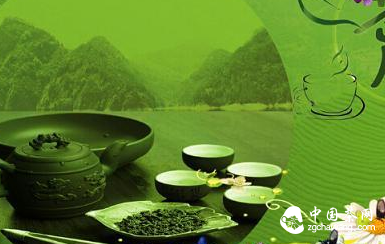
Green Tea: Completely Unfermented
This is the earliest type of tea to appear in China. It is processed through steps such as fixation (steaming), rolling, and drying (pan-firing, baking, or sun-drying). This process controls enzyme activity and the oxidation of polyphenols, leaving the tea unfermented and preserving the natural emerald green color of the fresh leaves, hence the name green tea.
In local markets, besides regular-grade green teas, famous varieties such as Longjing, Biluochun, and Taiping Houkui are also sold. Longjing is produced in West Lake Town, Hangzhou, Zhejiang Province. Premium Longjing is hand-processed with great skill, and each leaf is "straight, flat, smooth, and glossy," possessing the four excellences of "green color, rich aroma, mellow taste, and beautiful shape." It is one of the treasures among teas. Biluochun is produced in Dongting East Mountain and Dongting West Mountain in Wuxian County, Jiangsu Province. It is characterized by a clear, bright green liquor, a smooth and refreshing taste, and a sweet aftertaste. Taiping Houkui is produced in the Huangshan District at the northern foot of Huangshan Mountain. The tea buds are straight, plump, and tender, with a robust appearance, a dark green color, and white down all over. It features a clear liquor, bright color, strong aroma, mellow taste, and a sweet aftertaste, making it the best among pointed teas.
Bai Jinhuo says that green tea is completely unfermented tea, which can relieve heat and has antioxidant effects. However, he notes that because green tea is slightly cold in nature and the local climate is humid, long-term consumption can easily lead to rheumatic pain. Therefore, green tea should be consumed in moderation.
White Tea: 10–20% Fermentation
White tea is made from the tender buds and tips of superior tea tree varieties such as Dabai, Shuixianbai, and Xiaobai. It undergoes natural withering and slow fire baking, classified as a lightly fermented tea with a fermentation level of 10–20%. Its color is as white as silver, and the infusion is pale, hence the name white tea.
Bai Jinhuo says that white tea has the highest antioxidant content among the six types of Chinese tea. In the past 5 to 10 years, it has gained increasing popularity in the skincare and health beverage industries, especially in South Korea, Europe, and the United States, where white tea extract is added to shampoos or beverages.
Famous white tea varieties include Baihao Yinzhen (Silver Needle) and Bai Mudan (White Peony). Both varieties are produced in Fuding City, Fujian Province. The former has a pale yellow liquor, a strong clear aroma, and a mellow sweet taste; the latter has a yellower infusion, a fragrant sweet aroma, and a downy fragrance.
Bai Jinhuo says that white tea is generally more sweet than bitter. Due to its slightly cold nature, it is also not recommended to consume in large quantities.
Yellow Tea: An Extra High-Temperature Yellowing Process
Yellow tea, like white tea, is a lightly fermented tea. The difference is an additional high-temperature yellowing (men dui) process, which turns the originally emerald green tea leaves yellow, hence the name yellow tea.
Bai Jinhuo says that yellow tea has a similar taste to white tea but with a stronger tea flavor. It is not in high demand in local markets and is relatively rare.
Produced on Junshan Island in Dongting Lake, Hunan Province, Junshan Yinzhen is a prized variety of yellow tea and was once a tribute tea during the Qing Dynasty. The plucking and processing requirements are very strict. The finished buds must be strong, uniform in length, fully covered in white down, tightly wrapped, shaped like silver needles, and golden yellow inside.